
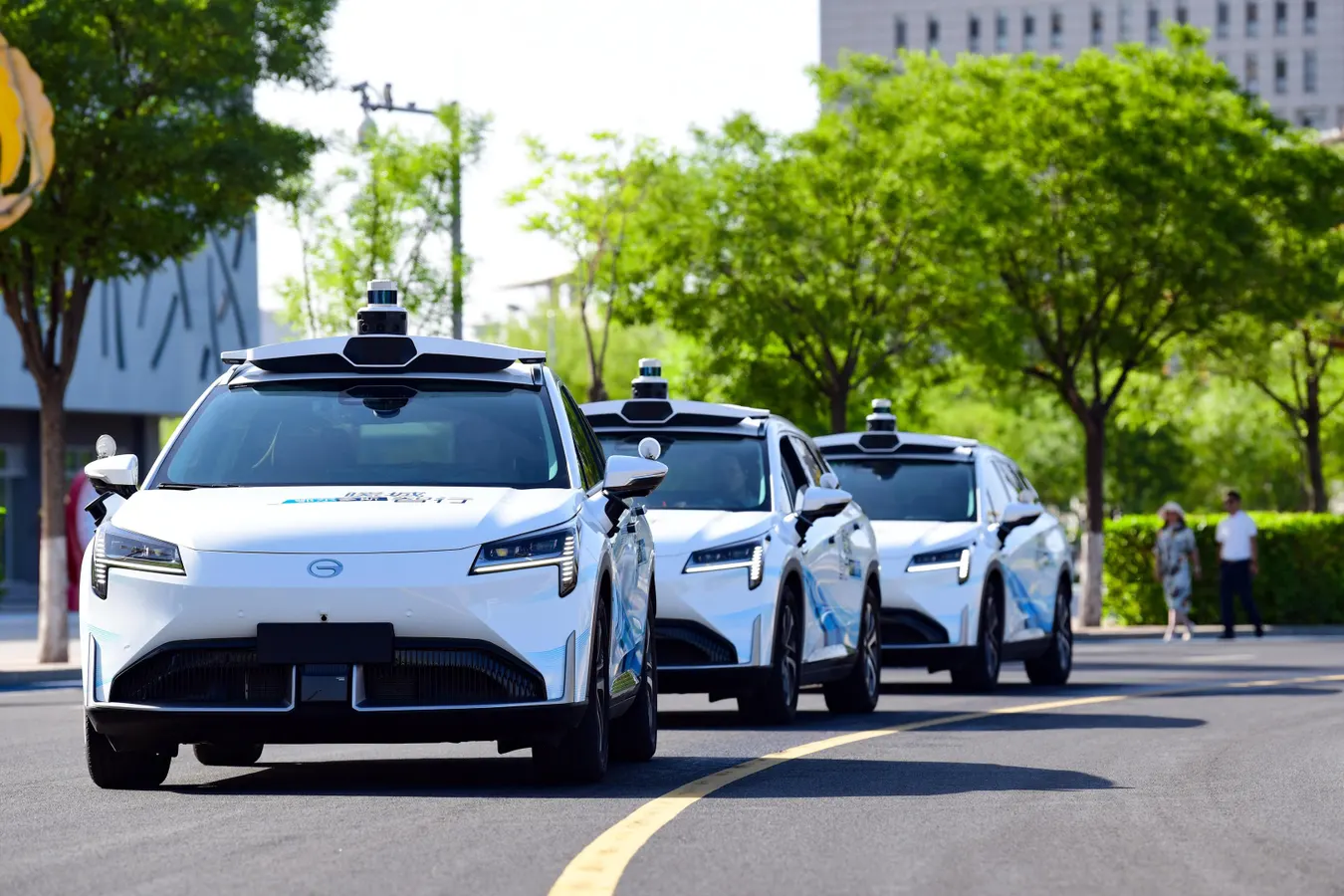

Self-driving taxis are tested on a street in Ordos, Inner Mongolia, China, July 6, 2023. (Photo by Costfoto/NurPhoto via Getty Images)
NurPhoto via Getty Images
Artificial intelligence (AI) has quietly become one of the most important, and divisive forces shaping the modern automobile. While electrification and software-defined vehicles dominate public discussion, AI is the invisible layer binding everything together—from driver assistance and infotainment to manufacturing, safety, and autonomy. As the industry now begins talking seriously about agentic AI, a more independent and decision-capable form of artificial intelligence, the question is no longer whether AI will reshape cars, but how far it should be allowed to go.
Such concerns about the potential of AI have been raised by names including Elon Musk who said, “AI is more dangerous than nukes,” and Bill Gates who wrote, “AI is changing so quickly that it isn’t clear exactly what will happen next.” Meanwhile, the Godfather of AI, Geoffrey Hinton (see video below) commented that “it could spread misinformation and eventually threaten humanity,” and Stephen Hawking said, “the development of full AI could spell the end of the human race.”
Elon Musk has said, “AI is more dangerous than nukes.” (Photo by Apu Gomes/Getty Images)
Getty Images
From Reactive to Predictive Cars
Today’s AI systems in cars are largely reactive. They respond to driver commands or sensor inputs like how adaptive cruise control reacts to traffic, lane-keeping assist responds to road markings, and voice assistants respond to spoken prompts. These systems are narrow, rule-based, and heavily constrained by software logic written in advance.
The next phase will be predictive AI. Cars will begin anticipating driver needs and environmental changes rather than merely reacting to them. Using a combination of camera data, radar, lidar, GPS, driver behavior patterns, and cloud-based learning, vehicles will predict traffic flow, weather risks, driver fatigue, and even emotional state. Navigation systems will no longer just offer the fastest route, but the safest, least stressful, or most energy-efficient route based on real-time context.
This is where AI begins to feel more “human”—and more controversial.
What Is Agentic AI—and Why It Matters in Cars
Agentic AI refers to systems that can set goals, make decisions, and take actions autonomously to achieve those goals. In automotive terms, this goes beyond today’s Level 2 driver assistance systems or Level 3 autonomy. An agentic AI vehicle would not just follow instructions, it would decide what to do and when to do it.
For example, instead of waiting for a driver to engage navigation or safety systems, an agentic AI might decide to reroute you away from a dangerous area, refuse to allow high-speed driving in poor weather, or pull the car over if it detects driver impairment. In fully autonomous scenarios, it could negotiate traffic, prioritize passenger safety versus efficiency, and coordinate with other vehicles or infrastructure.
The $64,000 is — who defines the goals of AI? Is it the driver, the manufacturer, regulators, insurers, or software providers? A car that refuses to obey a driver’s command because it deems it unsafe may save lives, but it also challenges long-held assumptions about human control and responsibility.
A general view shows fairgoers trying out Agentic AI at the Amazon China booth at the Shanghai New Expo Center during the WAIC (World Artificial Intelligence Conference) 2025 in Shanghai, China, on July 27, 2025. (Photo by Ying Tang/NurPhoto via Getty Images)
NurPhoto via Getty Images
Near-Future AI Features We Will Actually See
Despite the dramatic language around agentic AI, the immediate future of AI in passenger cars will be evolutionary rather than revolutionary. Expect to see practical, consumer-focused features appear first.
AI-powered driver monitoring is becoming far more sophisticated. Cameras are already tracking eye movement, posture, and facial expressions to detect distraction, fatigue, or stress. Rather than simply issuing audible or visual warnings, the car may adjust cabin lighting, seat position, climate control, or gradually come to a complete stop automatically.
Infotainment systems will become genuinely conversational, much like Alexa. Instead of rigid voice commands, AI assistants will understand context, remember preferences, and carry on multi-step dialogues. A driver could say, “I’m cold and tired,” and the car might increase cabin temperature, suggest a coffee stop, and switch to a more relaxing driving mode.
In early 2026, the car brands leading in advanced AI are primarily split between those pushing the boundaries of full autonomous driving like Tesla, and those integrating sophisticated, safe and intuitive AI into the user experience like Mercedes-Benz and BMW.
Predictive maintenance will also advance rapidly. AI will analyze vehicle data to forecast component wear and potential failures weeks or months in advance, scheduling service proactively and reducing unexpected breakdowns. For electric vehicles, AI will optimize battery health, charging behavior, and energy usage based on driving habits and environmental conditions.
AI and Autonomous Driving: The Slow, Careful Path
Fully autonomous driving remains the most complex and sensitive application of AI in cars. While progress continues, the industry is learning that intelligence alone is not enough—reliability, accountability, and trust matter just as much.
Future systems will likely combine AI learning models with hard safety constraints and human oversight. Rather than unleashing fully agentic AI-fitted vehicles overnight, manufacturers will deploy AI in carefully bounded domains: highways, parking, logistics routes, or geofenced urban areas. Hybrid systems—where AI makes recommendations but humans retain ultimate authority—will dominate for years.
Perhaps the most important question about AI in cars is not technical, but philosophical. Cars are deeply personal objects, tied to freedom, identity, and responsibility. As AI grows more capable, automakers will need to balance convenience and safety with transparency and driver trust. Lots of soul searching and real-world testing will need to be done to arrive at the right mix of AI intervention vs human control. But as Sam Altman, OpenAI CEO said, “We’ve got to be careful here.” Indeed, the most successful automotive AI of the future may be the one that knows when not to take control.













Leave a comment