
Stay informed with free updates
Simply sign up to the Artificial intelligence myFT Digest — delivered directly to your inbox.
Ministers will delay making contentious changes to UK copyright rules that would have made it easier for AI companies to mine media content after a backlash from the creative industries.
“Copyright is going to be kicked down the road,” said one person with knowledge of the government’s planned response to a two-month consultation on how to regulate AI companies’ access to copyrighted material, due to be released in the next fortnight.
Responses to the consultation did not favour any of the government’s proposed models for AI use of copyrighted materials. Ministers have instead decided they need to go back to the drawing board, gathering more evidence and spending longer consulting on various options, according to two people briefed on the plans.
People close to the process said there was now no expectation that the government would include an AI bill in the King’s Speech, due in May, and instead push any decisions and new legislation into next year.
One added that officials had listened to the protests from the UK’s creative industries over the risk of having their copyrighted work copied and ripped off by AI models.
The consultation follows years of tense lobbying from both sides of the debate over whether copyrighted content should be automatically included in the material AI companies use to train their algorithms.
Companies including Google owner Alphabet have argued that they should be able to mine the internet to train their algorithms, with companies and creators being given the opportunity to “opt out” of such arrangements.
But publishers, TV companies and filmmakers have argued it is unfair and unworkable to ask them to opt out. The co-chair of Working Title Films, Eric Fellner, called the proposed opt-out model an “existential threat” to the country’s creative industries.
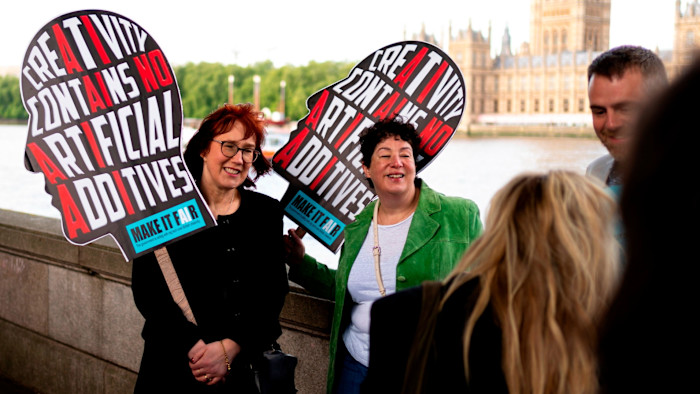
Government proposals last year to open copyrighted content for training AI models sparked a wave of protests — including the release of a “silent album” to show the impact of intellectual property theft by AI — and forced ministers to rethink, according to those close to the talks.
In the past few weeks, media executives warned against any fresh attempt to create a new system by which AI companies are given an exemption to copyright rules akin to carve-outs given to academic researchers.
Many in the media industry say they would rather strike their own content-licensing deals than be bound by any government attempt to seek a compromise with the tech sector.
In a report on AI and copyright published on Friday, the House of Lords Communications and Digital Committee said “it would be a very poor bet for the government to allow changes to copyright that could undermine the UK’s creative industries”.
Committee chair Baroness Barbara Keeley called on the government to develop a licensing-first regime, “underpinned by robust transparency, that safeguards creators’ livelihoods while supporting sustainable AI growth”.
“We want them to rule out a text and data mining exception, or a wider commercial research exception,” Keeley said.
The AI consultation — which the government is obliged to respond to by no later than March 18 with an economic impact assessment — threw up suggestions of more targeted exemptions to copyright rules for certain scenarios and companies, according to one person briefed on the plans.
Ministers wanted more time to study and consult on those new options, they added.
“Prolonged government-generated uncertainty has been exploited by AI firms and has chilled the licensing market for UK content,” said News Media Association chief executive Owen Meredith.
“There is one swift, simple step the government can take to unlock growth in UK intellectual property: publicly rule out changes to copyright law and allow the market to scale at pace.”
A government spokesperson said it wanted to establish “a copyright regime that values and protects human creativity, can be trusted and unlocks innovation”.















Leave a comment