
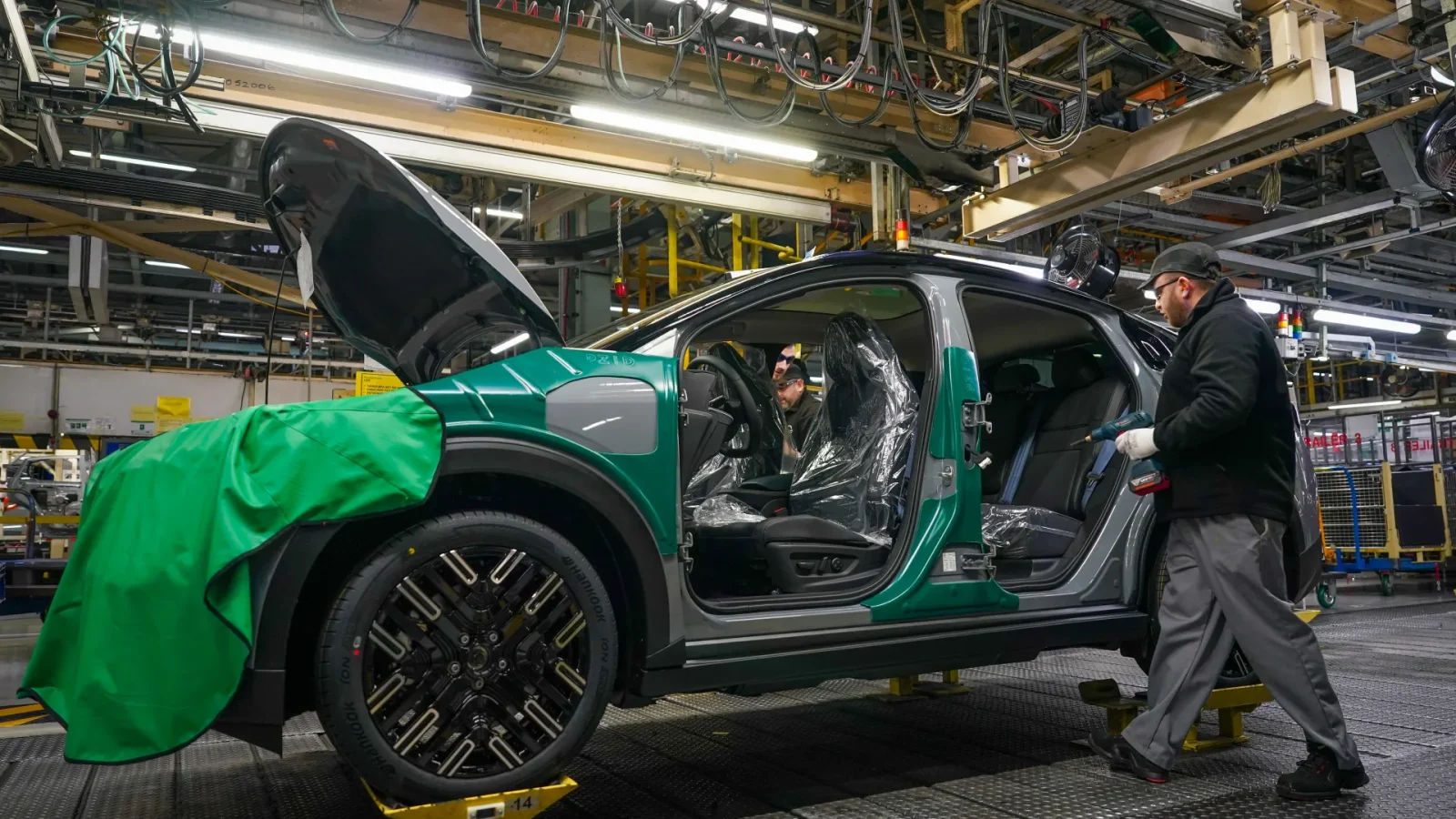
BRITAIN’S largest car factory could be forced to close if the UK is not fully included in proposed EU “Made in Europe” rules.
Nissan has warned that its Sunderland plant, which employs around 6,000 people, may be at risk if it is shut out of EU electric vehicle subsidy schemes.
A new European Commission proposal, the Industrial Accelerator Act, is intended to protect European industry from low-cost competition from China by directing public support towards green tech, including EVs, made in Europe.
Under the plans, some key incentives and public buying rules would favour motors assembled inside the EU.
Reports suggest this could apply to big areas of the market such as corporate fleets – which make up a large share of car sales across Europe.
But reports say Nissan has privately told the UK government that being excluded from EU incentives could threaten the business case for operating in Sunderland.


Indeed, an industry executive told the Financial Times that Nissan could face “an existential threat” if it was “frozen out of access to EU incentives”, because UK-built cars could become less competitive in Nissan’s biggest export market.
The Sunderland plant, which produces the top-selling Nissan Qashqai as well as the Juke and the all-electric Leaf, is capable of producing up to 600,000 cars a year.
However, it has been running well below capacity – reportedly around 30% – due to weaker demand, which adds to worries about what happens if sales and support in the EU become harder to secure.
And, as mentioned, while the plant employs around 6,000 members of staff, it also supports tens of thousands more across suppliers.
Nissan has invested billions into the site over the years, so any threat to its future would hit the wider North East economy as well as the UK car industry more broadly.
And the concern isn’t limited to Nissan.
The UK industry body, the Society of Motor Manufacturers and Traders, has said it is “gravely concerned”, warning the proposals could discriminate against UK-made vehicles and parts and damage a UK–EU trading relationship worth about £70bn a year.
Other manufacturers that build in the UK and sell into Europe, including Jaguar Land Rover and Toyota, could also feel the impact, while firms such as Ford have warned that uncertainty over the rules could disrupt long-established supply chains and make it harder to plan investment.
UK ministers are now under pressure to secure the UK’s position in any “Made in Europe” scheme, with business secretary Peter Kyle expected to step up lobbying.
On the EU side, officials have suggested trusted trade partners like the UK could still be included in some areas if there are reciprocal arrangements, but the proposals still have to be negotiated by EU member states and the European Parliament, meaning the uncertainty could drag on for months.
In a message to Sun Motors, Nissan said: “We’re pleased the Commission has addressed industry concerns and recognised how important partners are to the EU supply chain, by allowing ‘content equivalent to Union origin’ to count under the Act.
“This change should let vehicles built in these locations – which often include a lot of EU made parts – qualify for government purchasing and national EV incentives.
“However, using a different definition for corporate fleets and the small car super credit creates confusion and adds unnecessary complexity for the industry.
“A simple solution would be to apply the ‘equivalent to Union origin’ rules across all types of EV support, which would be in line with the EU’s goal of making regulations easier to understand and apply.”













Leave a comment