
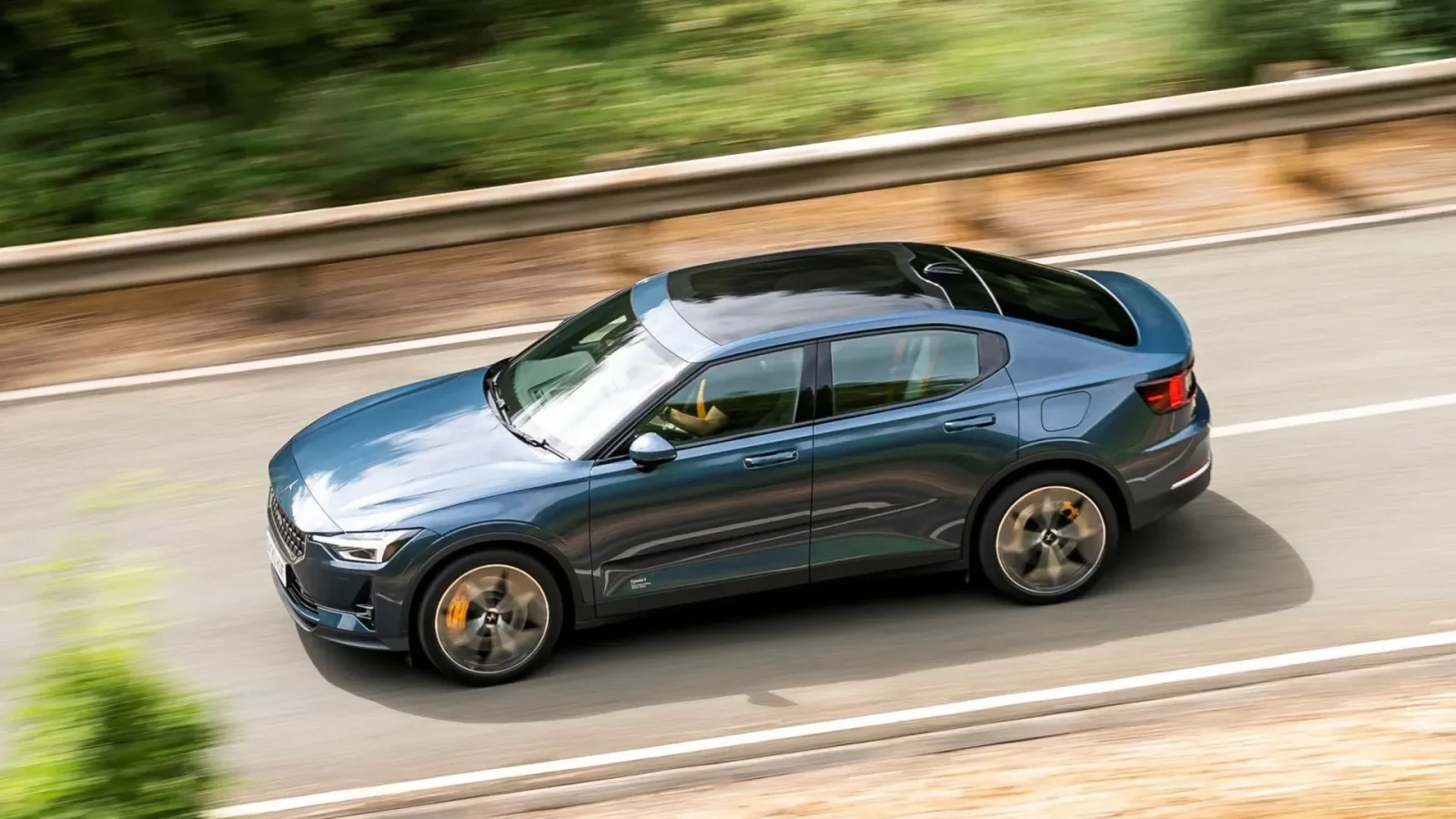
POLESTAR is sticking to its principles by staying all-electric in a bid to lift sales – while refusing to take the industry’s increasingly common fallback option of hybrids.
The Geely-owned brand, which was spun out of Volvo, remains small in volume terms.
Bloomberg reports it sold about 45,000 cars in the first nine months of last year and it has struggled to generate enough revenue and gross profit to cover its cost base, having chalked up roughly $8bn of cumulative losses since inception.
In fact, its slump has been so severe it has even had to take steps such as a share consolidation in the US to keep its Nasdaq-traded price above the $1 minimum.
A big part of the squeeze is external, as slower EV uptake in the US, heavy competition from premium rivals and tariffs hitting China-linked production and supply chains (including a 100% US tariff on China-made EVs), all makes it harder to price cars competitively and protect margins.
Polestar’s own product mix adds to the risk – because it is priced firmly in the premium bracket.


For example, the Polestar 3 and 4 roughly £70,000 and £55,000 respectively in the UK, before discounts.
What’s more, the Polestar 4’s no-rear-window set-up – relying on a camera feed – has been picked out as a potential barrier for some buyers.
Meanwhile, the Polestar 5 is pitched as a Taycan-rivalling halo car – but, by design and price, looks likely to remain a niche model rather than something that transforms volumes.
The most obvious volume fix is on the way in the form of a cheaper compact SUV – the upcoming Polestar 7 – but it isn’t expected to arrive until 2028, leaving a long gap while the company is still burning cash.
FEELING THE SQUEEZE
Many argue Polestar’s problems are partly self-made, with the brand not clearly differentiated enough from Volvo in buyers’ minds to justify its premium positioning at scale.
In the short term, Polestar is surviving by raising more money and reshuffling debt.
A report by CBT News says Polestar secured $300m in new financing and converted about $300m of debt into equity, with BBVA and Natixis involved, and it also finalised a Geely-linked term loan facility of up to $600m.
That improves liquidity and buys time for the turnaround plan under CEO Michael Lohscheller – but it doesn’t change the basic point that Polestar still depends on outside capital.
Even Polestar’s CFO has indicated more equity will likely be required, meaning further dilution remains a real risk.
But despite the pressure, Lohscheller is drawing a hard line on strategy and brand identity.
Even though many rivals are leaning back into hybrids because EV growth has slowed, he says Polestar will not add combustion engines or hybrids.
He argues Polestar’s customers are younger and expect the brand to be emissions-free – and that adding hybrids would bring extra complexity and cost.
Speaking to Autocar recently, Lohscheller said: “If we said ‘hey, we now do ICE engines in our car’, they would go ‘you can’t do that’ – so we’re not even thinking about it.
“We are doing the right things, and we absolutely believe in that, and we are backed up by science.
“One of the main reasons why people come to us is that we’re a unique company.”
And he added: “I get asked in meetings ‘will you do a hybrid?’ and the answer is ‘no, we will not’. How great is that? We will not have any emissions.
“We’re working on a super-exciting product portfolio that requires investment and resources. If you do hybrids on top of that, you just go bigger, bigger, bigger — and the world needs to be simplified.
“Simply, the mobility of the future has to be without emissions, and electrification is the best solution for that. That’s what we believe, and that’s why we continue like this.
“Five years ago, everybody said ‘this is going to happen’. Now everybody says ‘oh, it will never happen’. Both sides are wrong.
“Of course the transformation will happen. Our customers will not decide for older technology, they will go into the technology of the future.”
In a message to Sun Motors, Polestar is justifiably confident about the future.
They said: “The announcement yesterday is a strong strategy pushing Polestar into the largest automotive segments to drive volume and ultimately profitability with four new cars in three years – taking us from a 25% segment exposure to over 50% segment exposure.
“We will be addressing over 50% of the BEV market once these cars are all on the road.
“Last year Polestar was up 34% globally and 50% in Europe – record retail sales – this is an example of rare growth in a particularly challenging industry – in the UK, our growth was 95% year on year.
“We enjoy the strong operational and financial support from our major shareholders, including Volvo Cars, who in addition to being a shareholder is also a manufacturing and development partner.
“In December of last year and January of this year, we announced a total of USD 700 million in new equity financing, through external investors, strengthening our balance sheet and increasing our cash position – both equity raises are fully supported by Geely Holdings.
“Polestar is founded on three pillars of Design, Sustainability and Performance, the Sustainability element is key to our customers choice, it is valued by them and core to our mission to accelerate the move to tailpipe emissions free driving.
“Therefore we do not believe in creating even more CO2 contribution to the planet through the production of hybrids or internal combustion engined cars – the automotive industry has a climate solution – one of the few industries to have a solution.”
Additionally, Per Ansgar, CEO of Geely unit Geely Sweden Holding, told Reuters that Polestar continued to benefit from the Chinese group’s technology and that Geely would keep supporting the brand financially.
“We do this because we think that Polestar is a very strong brand,” Ansgar said, adding that Polestar had “good opportunities moving forward”.
Lohscheller also added that the brand is building on its best-ever sales year with its biggest model push yet – with four premium EVs in three years aimed at the core of the EV market.
He highlighted Polestar 5 as the “halo” GT, Polestar 4 as the current best-seller with a new variant coming, Polestar 2 as the brand’s high-volume foundation with a next-generation version due soon and Polestar 7 as a compact SUV targeting Europe’s largest EV segment.











Leave a comment