
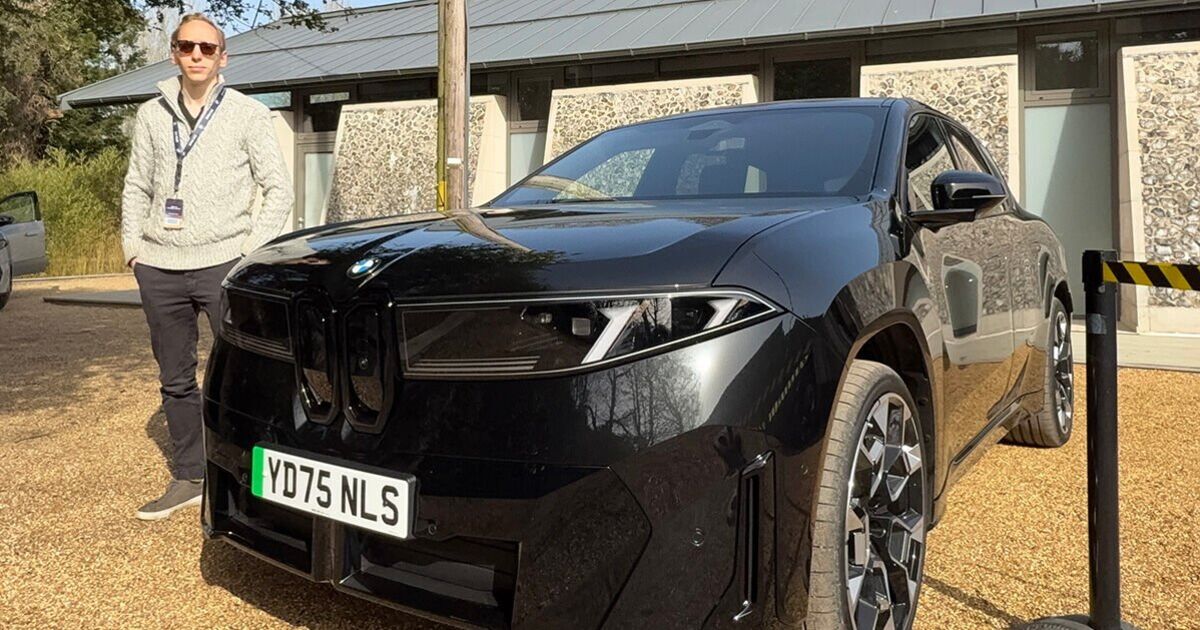

Christopher Sharp attended the UK launch of the BMW iX3 (Image: Christopher Sharp)
The BMW iX3 is not just a significant vehicle for BMW, marking the first of its new era of Neue Klasse cars, but potentially one of the most important car launches this year.
Alongside numerous members of the motoring and national press, I had the chance to attend the UK unveiling of the BMW iX3 just a few weeks after Top Gear magazine had crowned it their car of the year.
Having spent a day with the vehicle, I can fully understand why it clinched the award. I found it genuinely innovative and useful, with its driver aids being present without being overly obtrusive.
The model I drove was officially the BMW iX3 xDrive M Sport Pro version. In layman’s terms, this means it was a top specification four-wheel drive model.
All in all, the total cost of the car I drove was just over £72,000. Delving deeper into those specifications, the iX3 boasted 463hp, an unladen weight of 2.3 tonnes, and a WLTP range of 451.2 miles (722km).
Beyond the range, the price, and the general figures, the iX3 surprised me in three distinct ways and led to one, at least in my opinion, fascinating observation.
READ MORE: I drove ‘2026’s best car’ that’s not a BMW or Audi to see what it’s really like
READ MORE: I drove epic electric car and it blew Chinese rival and BMW out the park
Surprise Number 1: How it looked
BMW faced a lot of criticism a few years ago when it enlarged the kidney grills on its cars. Whilst we eventually acclimatised to this prominent design change, there was a sense that we wouldn’t mind if BMW reconsidered.
And that they have done, with the new iX3 and forthcoming 3 Series replacement arriving with considerably smaller kidneys at the front, a design shift that appears to be a tribute to the original Neue Klasse cars of the 1960s.
Despite the reduced grille, I wasn’t certain what to make of the iX3 when I initially saw photographs. It appeared somewhat stocky and compressed.
Viewing it in person, though, and it all became clear. The vehicle was longer than it appeared and the front bodywork slightly lower, so that it all seemed rather more refined.

A BMW iX3 (Image: Mike Stobe, Getty Images)
Surprise Number 2: The handling
The laws of physics ought to dictate that a 2.3-tonne electric SUV shouldn’t handle well, but the BMW does. Rather like rivals Audi, it manages to communicate effectively and with subtlety through the seat, steering and pedals.
You can genuinely navigate your way along a road with confidence that you understand what each corner is doing, and that’s before you reach the regenerative braking.
Regenerative braking is when the car’s braking systems are utilised to return more energy into the battery to provide you with more range. Powerful regenerative braking systems can enable you to operate using just one pedal.
However, the BMW’s is somewhat different in that it functions with the satnav. In simple terms, if you input your destination, the system analyses the upcoming corners and predicts the amount of regenerative braking required to decelerate the car.

The interior of the BMW iX3 (Image: Christopher Sharp)
For instance, if you’re approaching a roundabout at 18mph it will brake less than if you’re nearing a bend on a country road at 50mph.
This doesn’t imply that you should refrain from using the actual brake pedal, as the system won’t bring the car to a complete stop for you, but it is highly intuitive.
Whilst it’s possible to disable this system, its impressive functionality begs the question – why would you want to? Equally impressive is the interior. There’s no instrument cluster in front of you, but there is the anticipated large touch screen.
Additionally, BMW has incorporated a small screen that runs just below the windscreen. This may sound peculiar, but it means you don’t need to divert your gaze from the road to check your speed, identify your next turn, or see what song is playing.

The information bar inside the BMW (Image: Christopher Sharp)
Surprise Number 3: I preferred driving my own car
The following might seem like a criticism, but in one respect it isn’t. I drive a BMW MINI Clubman Cooper S; it’s a 189bhp four-wheel-drive MINI estate that weighs around 1.5 tonnes.
I’m always fascinated when I return to it after test-driving a car because I enjoy comparing a car released in the 2010s to one launched now given the significant changes that have occurred.
As I made my way home, it dawned on me that I favoured driving my car not simply because it felt nimbler and more enjoyable, but because I didn’t need to deactivate anything once I’d gotten into it. I didn’t need to configure driving modes, I didn’t need to disable driving aids, I could simply get going.
I would suggest that this illustrates how impressively BMW’s Clubman has stood the test of time from a handling and dynamic standpoint.
Pitting the iX3 against a nearly decade-old MINI – a vehicle manufactured by BMW – is, I acknowledge, somewhat of an unequal comparison. There’s inevitably going to be a touch of personal car preference coupled with the principles of physics, and I recognise how privileged one is to be invited to the UK launch of a new vehicle.

Christopher’s MINI (Image: Christopher Sharp)
However, it highlights that just a few years ago, cars allowed us to get on with things, didn’t interrupt us as frequently; left it to us to remain between two white lines on the motorway.
Modern cars are safer than ever before, and that’s positive. Yet they are also designed for a world where independent thought is declining and people want to concern themselves less.
In certain instances, this has led to remarkable progress in the car, particularly regarding safety and providing advance warning. Consider parking sensors, blind spot monitors and the iX3’s satnav informing you what type of curve lies ahead, like having a passenger doing the navigation who’s familiar with the route.
These are excellent developments, and ones that enable you to prepare more effectively as a driver. Which is precisely why the iX3 thoroughly deserves its car of the year accolade.
Should the remainder of BMW’s Neue Klasse range bear any resemblance to it, then there remains genuine optimism for driving pleasure in an ever more electrified landscape.
Christopher’s Verdict: 9/10













Leave a comment