
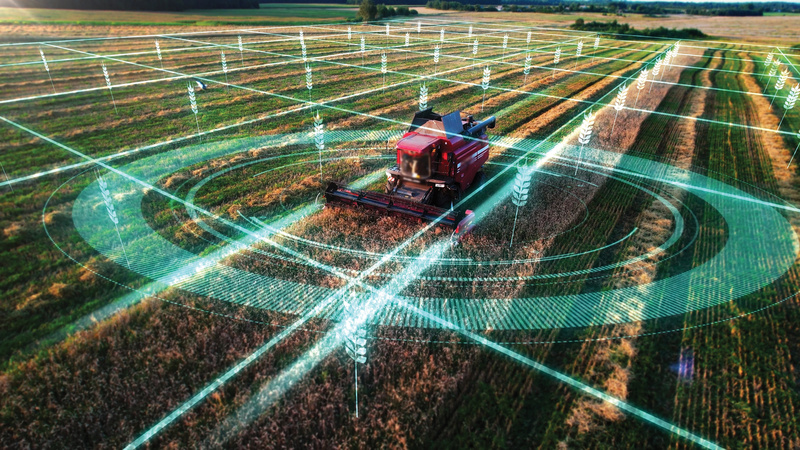
Agriculture is one of the UK’s key strategic industries but has not traditionally been seen as a leading user of digital technologies. However, that is starting to change thanks to increasing functionality in farm machinery, satellite connectivity, the incoming 6G hybrid communications standard and, inevitably, AI.
According to NFU Mutual’s Agri-Tech Report, around 60% of farmers were using some form of precision agriculture by 2023 – although many remained cautious about the costs of adoption. A 2024 survey by the National Farmers Union found its members wanted to see more research and results in AI, alongside measures to reduce methane emissions and enable carbon sequestration.
Agriculture’s contribution to the UK economy was £14.5bn in 2024, according to the Department for Environment, Food and Rural Affairs (Defra). The country’s agricultural industry is made up of large holdings based on livestock and cash crops (led by wheat, barley and oats), and others based on speciality crops (historically dominated by asparagus and hops). Both sectors can benefit from new technologies, even on relatively small holdings.
The main restraint on technology adoption among UK farms has been the state of broadband coverage outside towns and cities. Poor connectivity can make it impossible to monitor crops and soil conditions in real time; even where field data can be gathered, it often needs to be taken back to a farm’s offices, where connections remain worse than those elsewhere. Waiting until the end of the working day to upload data over wifi limits capability, as well as the attractiveness of many potential applications.
However, the falling cost of satellite connectivity, particularly through SpaceX’s Starlink, is driving improvements. Starlink has separate deals with two of the biggest agricultural equipment manufacturers, John Deere and CNH Industrial, which deliver rural broadband.
During the rest of this decade, 6G is expected to move through the 3GPP standards body, with early commercial deployments predicted in around 2030. The new standard will be ‘AI native’ and will integrate both traditional cellular and satellite networks. This will build on the non-terrestrial network capabilities of the final 5G standard releases and increase the viability of edge and cloud applications.
Even before 6G arrives, companies such as John Deere and CNH Industrial are building up huge data resources. The former launched a smart industrial programme in 2020 and has said that 500 million ‘engaged’ acres were feeding into its operations centre at the end of 2025. This centre gathers information from 30,000 datapoints – including machinery such as tractors and harvesters – every minute. So far, 10 billion agronomic and machine-based measurements have been collected and are being used as training data for AI.
CNH Industrial, meanwhile, offers farmers access to its FieldOps cloud-based management platform, which is rapidly approaching a similar level and has scope for plenty of expansion.
Companies like these provide an entry point for AI-enhanced precision agriculture and could help to overcome farmers’ scepticism. For example, John Deere and CNH Industrial’s latest self-propelled crop sprayers both incorporate computer vision, machine learning, edge processing and robotics. This allows them to analyse crops’ ‘green’ or ‘brown’ status in the field, patch-by-patch, and then tailor the amount of nutrient or herbicide applied accordingly.
“By using cameras to identify weeds and spray only where necessary, there can be a reduction on average herbicide usage by over 50% while still achieving the same weed-hitting rate as broadcast application,” Deanna Kovar, president of John Deere’s agriculture and turf division, claimed at the company’s December 2025 technology open day.
Similar features are being used to enhance other types of farm machinery. “Take the example of a harvester,” says Francesca Protano, head of technology strategy and product innovation at CNH Industrial. “The farmer pushes a couple of buttons to say, ‘I’m going to harvest this type of crop – corn, whatever – and it’s this type of field,’ and off you go. The machine sets itself up and perhaps the customer thinks it’s magic, but it’s AI, and it’s mechanics.
“What matters is that we show that we can make this happen and they don’t need to have a degree in electronics.”
These advances are building out an important infrastructure, with the machinery allowing the use of sensors on farms where farmers may previously have been reluctant to invest because of the connectivity challenge.














Leave a comment