
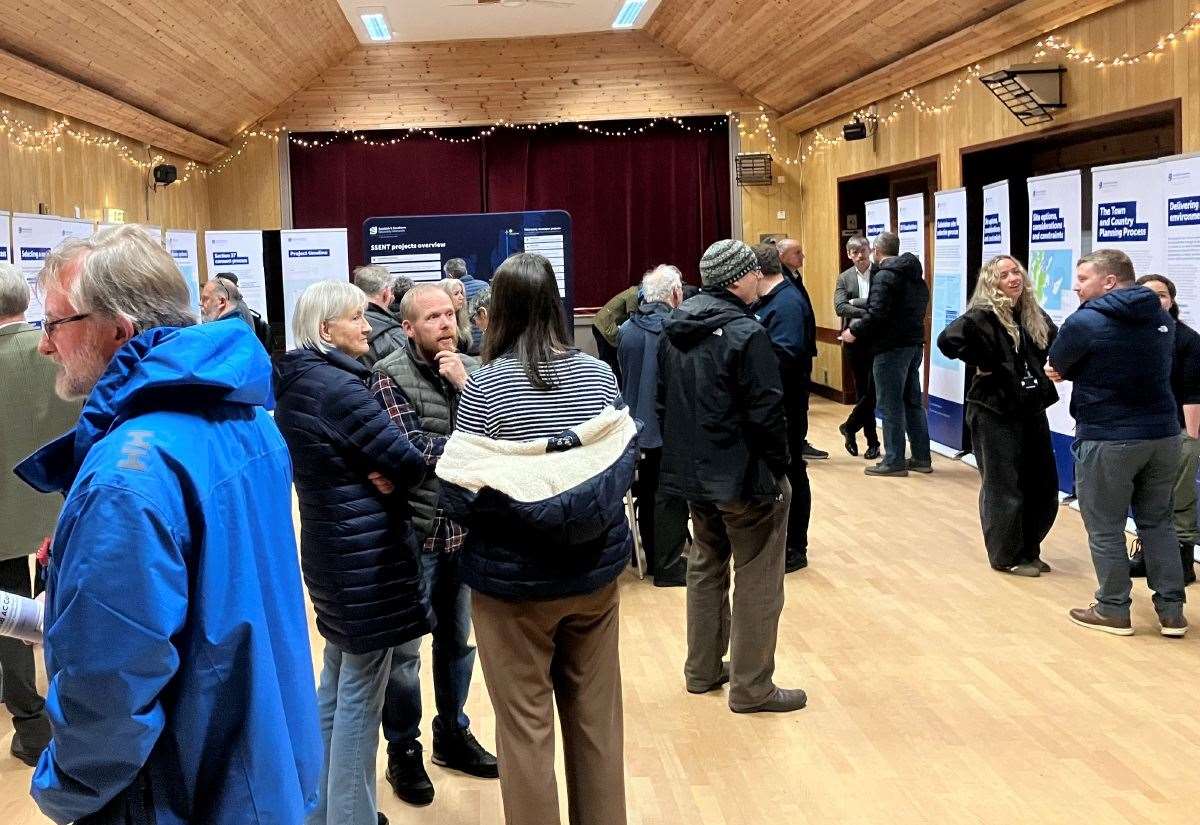
Steps to develop a major infastructure project in the North Mainland were compared to “corporate-greed money making” during a consultation meeting in Voe.
Crowds voiced widespread opposition to SSEN plans to run a line of lattice towers almost 40 metres high up a section of land.
But consultees said they hoped the five hour event would provide the chance for meaningful consultation, and not just a “tick box” exercise.
The energy giant was consulting on a planned connection between a proposed new substation, currently known as Kergord 2, and a substation hub further north.
SSEN plan to connect the two, possibly using a long line of towers measuring 38 metres high, with a 366 metre span.
Three possible route options are being assessed, starting from the existing Kergord station – home to the HVDC converter that connects Shetland to the mainland – and incorporating the proposed site locations for Kergord 2 and the northern hub.
SSEN says the project plays a “crucial” role in integrating Shetland’s renewable energy sources into the wider electricity grid.
It takes consideration of renewable projects, such as the proposed Energy Isles and Beaw Field windfarms in Yell, the Statkraft hydrogen plans at Scatsa and the Scotwind offshore projects east of the isles.
But residents in the area remain concerned.
Voe resident John Goddard said he was “not greatly impressed”.
“I don’t think it’s going to be good for the wildlife and landscape,” he said.
“If we’re talking about climate change and raising the green objective, then – at some point – there’s going to have to be benefit to this, but at what cost to the natural environment and natural world?
“What we’re seeing at the moment is like corporate greed money-making.” He added there was little sign of a just transition for isles-based workers.
Also attending the event was Elaina Leach.
“I would hope that this is an actual consultation and not just a tick-box to say they’ve consulted,” she told The Shetland Times.
“Because having a meeting and asking people to come isn’t actually a consultation.”
Lead development project manager, Cath Swan, said she was eager to hear feedback on the plans.
“We want to take on board as much feedback as we can from the community,” she said.
“We do have a licence obligation to provide these connections, but how we do that is more within our gift.”
The existing Kergord substation operates at 132kV.
Ms Swan said the energy giant hoped to “step up” that voltage to 220kV.
She said sticking with 132 could mean two lattice towers running in parallel to each other.
“If we step up the voltage to 220, it means we can get it down to running a single line between the two sites – between the Kergord 2 substation and the northern hub.”
She said she appreciated lattice towers were new to the isles, but added parts of the mainland used 275kV lattice towers that were almost 50 metres high.
“Being able to keep it down to 220 rather than 275 means we can keep them 10 metres shorter. So it’s a real reduction in height, taking on board the feedback that we’ve had around that visual impact.”
But many were anxious that the cables should go underground, rather than be carried by huge towers.
Ms Leach added: “I’ve had a quick look around, and there seems to be nothing about burying them. It all seems to be huge pylons.”
Ms Swan said there were sections where there was “potential” to go underground, but added that was not SSEN’s “natural preference – because there’s quite a significant environmental impact.”
“For the 220 (kV) towers we’re proposing, you can get a span of 300 metres between those typically, so you’ve got big sections where there isn’t that impact on the ground.”
She said that would take account of the “sensitivity on the environment, particularly around peatland and nesting birds”.
She added going underground would require additional equipment to be stored at each of the substations.
“It’s not always technically feasible, it can be very challenging from a construction perspective.”
But she encouraged people to share their feedback if there were areas of “particular sensitivity” where undergrounding would make a significant difference.
















Leave a comment