
Unlock the Editor’s Digest for free
Roula Khalaf, Editor of the FT, selects her favourite stories in this weekly newsletter.
The Labour government has set out plans for a scaled-back digital ID scheme that excludes children and personal data such as addresses as it tries to sell the controversial policy to British voters as a way of making public services more convenient.
Chief secretary to the prime minister Darren Jones launched a nationwide consultation into the digital ID scheme on Tuesday, announcing a preferred option of restricting the scheme to those over 16.
Ministers have been considering following the Estonian model where newborn babies are assigned a unique number from birth that parents can use to manage digital records as well as make appointments and fill out applications online. This has not been ruled out, but a consultation warned that it would bring privacy and child-protection issues.
Jones said he wanted digital ID to end “a legacy system of call centres, paperwork and the need to tell your story multiple times to different parts of government” and to drive more efficient public services.
People could use the system to pay vehicle tax, check eligibility for childcare support and “even remind yourself what day your bins are being collected”, Jones added.
Ministers say digital ID should include name, date of birth, nationality and a facial image for biometrics. However, a consultation suggests other data such as home address and biological sex could be excluded. Jones said he wanted to “start with as little data as possible” and only include more if users wanted it, stressing the system would be “entirely voluntary”.
He hopes the convenience of the system will tempt millions to sign up, with officials saying that uptake of similar schemes in other countries has been about 90 per cent.
The scaled-back plan comes after a succession of tweaks and alterations to the digital ID proposal — and the way it is being presented to the British public — since it was first announced last September.
Ministers are hoping to sell the scheme as making “government by app” more convenient to voters and as a tool that could be used to improve a wide range of public services. While digital ID is estimated to cost £2bn, Jones said “tens of billions of pounds every year” could be saved through more efficient services.
Consultation documents also ask whether it should be used in the private sector for taking out loans, buying homes or proving age for buying alcohol.
The announcement on Tuesday marks a contrast to the launch of the initial plans for digital ID last September when Prime Minister Sir Keir Starmer described it as a tool to control illegal immigration by making it impossible to work without one.
In January, Starmer also retreated on plans to make digital ID mandatory for all workers in the UK, allowing people to offer other types of digital proof of their right to work such as passports.
Police will not be able to ask people to present digital ID for purposes such as stop and search.
Right-to-work checks and tax disc payments are scheduled to be available from 2029 but other uses are not expected until the 2030s.
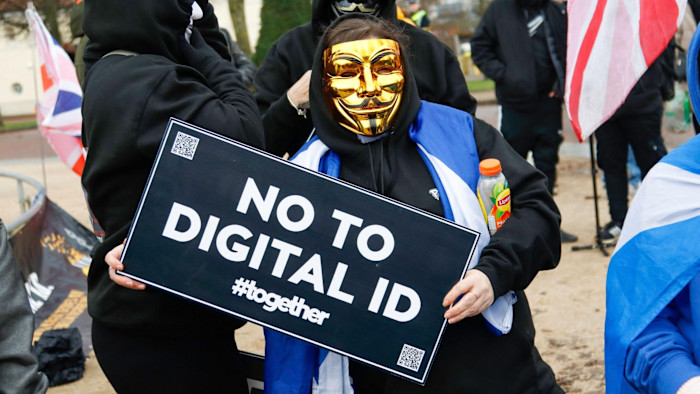
A recent poll conducted by research company Ipsos found that about 40 per cent of the public opposed digital ID, while 32 per cent supported it and 29 per cent had no opinion.
“When the public voted for change they also voted for better public services and this is what Labour governments at their best are all about,” Jones said as he launched the consultation in the House of Commons on Tuesday.
“We will debate the difficult questions, find ways forward and build a system that can secure the trust and support of everyone.”
There has been unease inside the government about the scope of the digital ID scheme, with several senior officials arguing that ministers needed to make a more positive case around the public utility of the electronic system rather than its role in simply penalising people who are not legally allowed to work.
Jones also announced on Tuesday that the government would establish a so-called People’s Panel on digital ID that would bring together individuals from across the country and from different backgrounds to provide their views on the proposals.














Leave a comment