
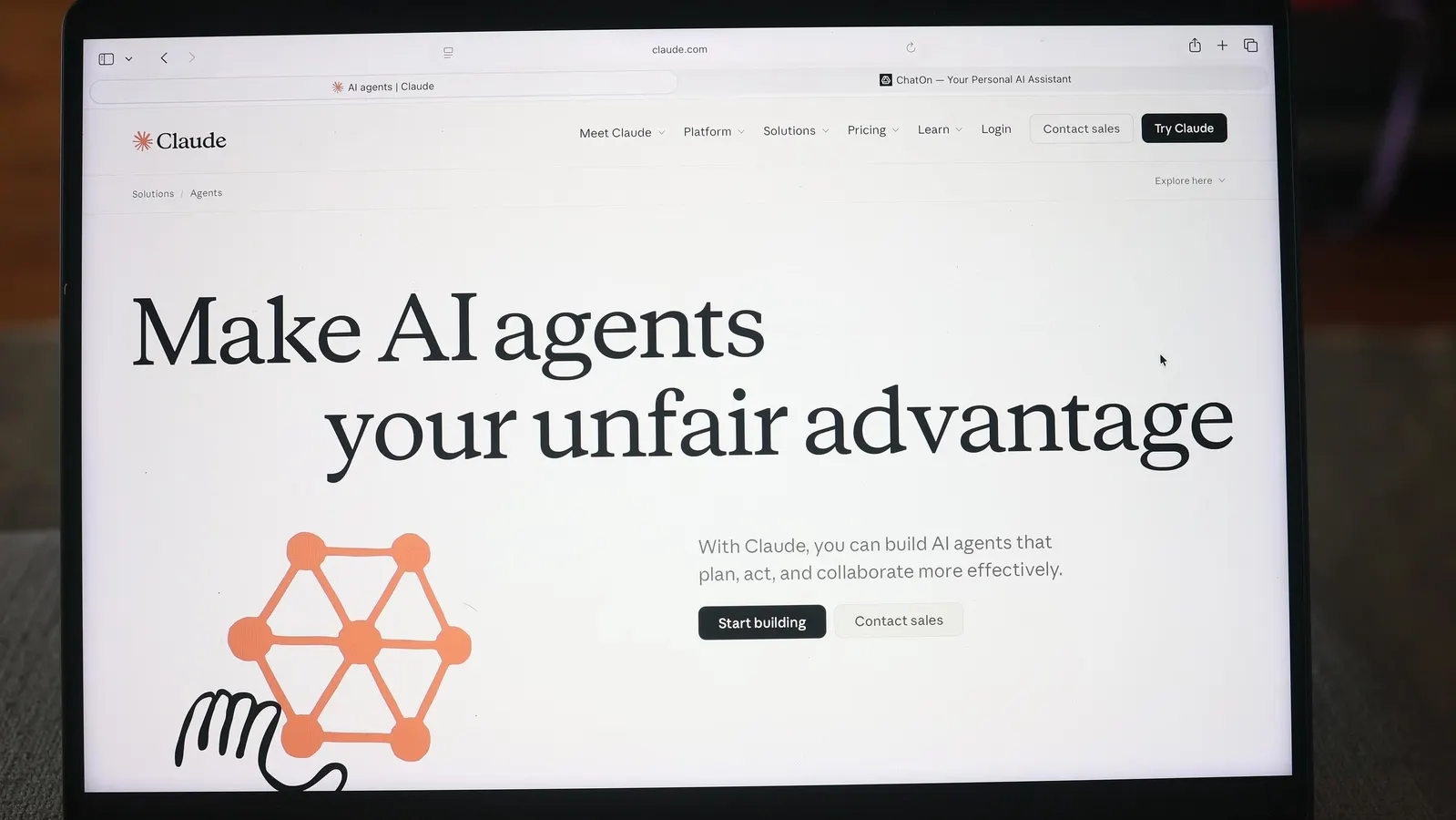

Anthropic acquires Vercept to improve computer use
Getty Images
AI has spent the last decade staring at a screen, typing text and waiting for a human to click the next button. Making AI genuinely useful for complex work requires solving perception and interaction problems, which remains challenging for machines.
To address those needs, Anthropic announced its acquisition of Vercept this week, in a move that signals the company’s intent to move further into full computer interaction. While the company already had capabilities to interact directly with desktop and web apps, the acquisition represents a strategic pivot toward building autonomous digital workers that can navigate live applications with human-like agency.
The Shift From Text To Action
Claude has evolved rapidly. The latest iteration, Claude Sonnet 4.6, demonstrates a massive leap in capability. But their tools still lacked sophistication when it came to making the AI systems actually do things.
Consider the difference between a writer and an editor. A writer creates content. An editor navigates a publishing platform, uploads files, checks formatting and hits publish. Computer use enables Claude to do the latter. It allows the AI to take on multi-step tasks inside live applications. This capability solves problems that code alone cannot address. Complex software environments often require navigating menus, filling out forms and interpreting visual layouts.
Vercept’s team focused on building systems that allow AI to see and act within the same software humans use every day. The goal is to create AI that can manage business needs that span multiple tools and teams without needing constant human supervision.
Anthropic already demonstrated computer-use capabilities inside Claude before this acquisition. The company previewed versions of Claude that could control a virtual desktop, move a cursor, open files, browse websites and complete structured workflows. In controlled environments, the results were impressive. The model could book travel, populate forms and extract data across tabs.
But demonstrating capability is not the same as delivering reliability at enterprise scale. Claude’s early computer-use stack relied heavily on the foundation model’s reasoning power. It would look at screenshots, infer what UI elements meant and decide which action to take. That works when interfaces are clean and predictable. But it was also slow, error-prone and chewed up a lot of tokens.
The screenshot-based approach fails when layouts shift, states change mid-process, permissions block access or latency introduces ambiguity. Real enterprise software is messy. It contains modal windows, nested workflows, dynamic dashboards and inconsistent design standards across vendors. And organizations aren’t too comfortable with AI systems that are constantly taking screenshots.
The gap is around perception and state awareness. Vercept specialized in that layer. Instead of treating every screenshot as a fresh puzzle, they built systems that model the structure and continuity of an application over time. Humans do this instinctively. We know when a window is loading, when a process has stalled or when a dialog box changes the context of an action. Most AI agents do not. Anthropic saw Vercept as a way to make Claude situationally aware and operationally dependable.
Why Perception Matters
Most people take visual perception for granted. We look at a screen and instantly know where to click. An AI model must be trained to perform this function and it must do so across thousands of different applications, each with its own design language.
That problem sounds subtle. It is not. If an agent misinterprets a button label, it produces an error. If it misinterprets application state, it can trigger cascading failures across systems. Enterprise deployment magnifies that risk. An AI agent interacting with a CRM, ERP or financial system is not drafting a memo. It is executing actions with operational consequences. Reliability is no longer a nice-to-have feature. It is table stakes.
Vercept spent years addressing the gap between an AI’s internal reasoning and the external reality of user interfaces. The founders of Vercept, Kiana Ehsani, Luca Weihs and Ross Girshick, bring deep experience in machine learning and computer vision. Their expertise complements Anthropic’s strength in large language model reasoning. The combination reflects a broader industry realization. Reasoning alone does not create agents. Agents require grounded interaction with dynamic environments.
This acquisition follows Anthropic’s earlier purchase of Bun, a developer-focused startup building tools for running and orchestrating AI agents in production environments. The moves show that the company is consolidating the layers required to transform Claude from a conversational model into an execution platform.
Building a Business Case For Digital Workers
Anthropic has been quickly moving to cement their place inside of businesses looking to make use of AI. The current wave of AI tools focuses on efficiency. They help users write faster, analyze data quicker or generate code snippets. The next wave focuses on autonomy. Companies will deploy AI agents that execute tasks end to end.
The friction point is integration. Many enterprise systems lack comprehensive APIs. Even when APIs exist, they often expose only partial functionality. Humans navigate the interface directly because it remains the most universal integration layer. In the earlier days of AI, this is the space where so-called Robotic Process Automation tools played, using recorded or scripted human interaction actions to replay for future tasks. Think more automation than intelligence.
But with AI systems that can natively understand interfaces, it bypasses the need for hardcoded or custom integration work. That is the economic logic behind Anthropic’s move. Vercept strengthens the one layer that makes cross-system automation feasible without rewriting enterprise software.
Competing In The Agent Wars
The race to build autonomous AI agents is accelerating. OpenAI has introduced Operator-style systems that allow models to browse and take actions across applications. Google has showcased multimodal agents under initiatives like Project Astra that blend vision, reasoning and real-time interaction. Startups are layering orchestration frameworks on top of foundation models to create task-running agents.
All of these companies are capable of interacting with desktop applications and websites. The competitive difference is who can deliver predictable, safe and auditable performance inside production environments. Computer-acting agents expand the risk surface. They can access sensitive data, trigger transactions or alter system configurations. Enterprises will not deploy such agents at scale without guardrails, logging and policy enforcement.
Anthropic emphasizes its Responsible Scaling Policy as a core differentiator, although there are increasing questions about Anthropic’s long term commitment to its fundamental AI safety and responsibility practices.
Owning the perception-action stack enables Anthropic to embed these controls directly into the system. The Vercept deal provides some strategic insulation. It also helps ensure that Anthropic controls the layer that determines whether Claude becomes a trusted digital operator.













Leave a comment