
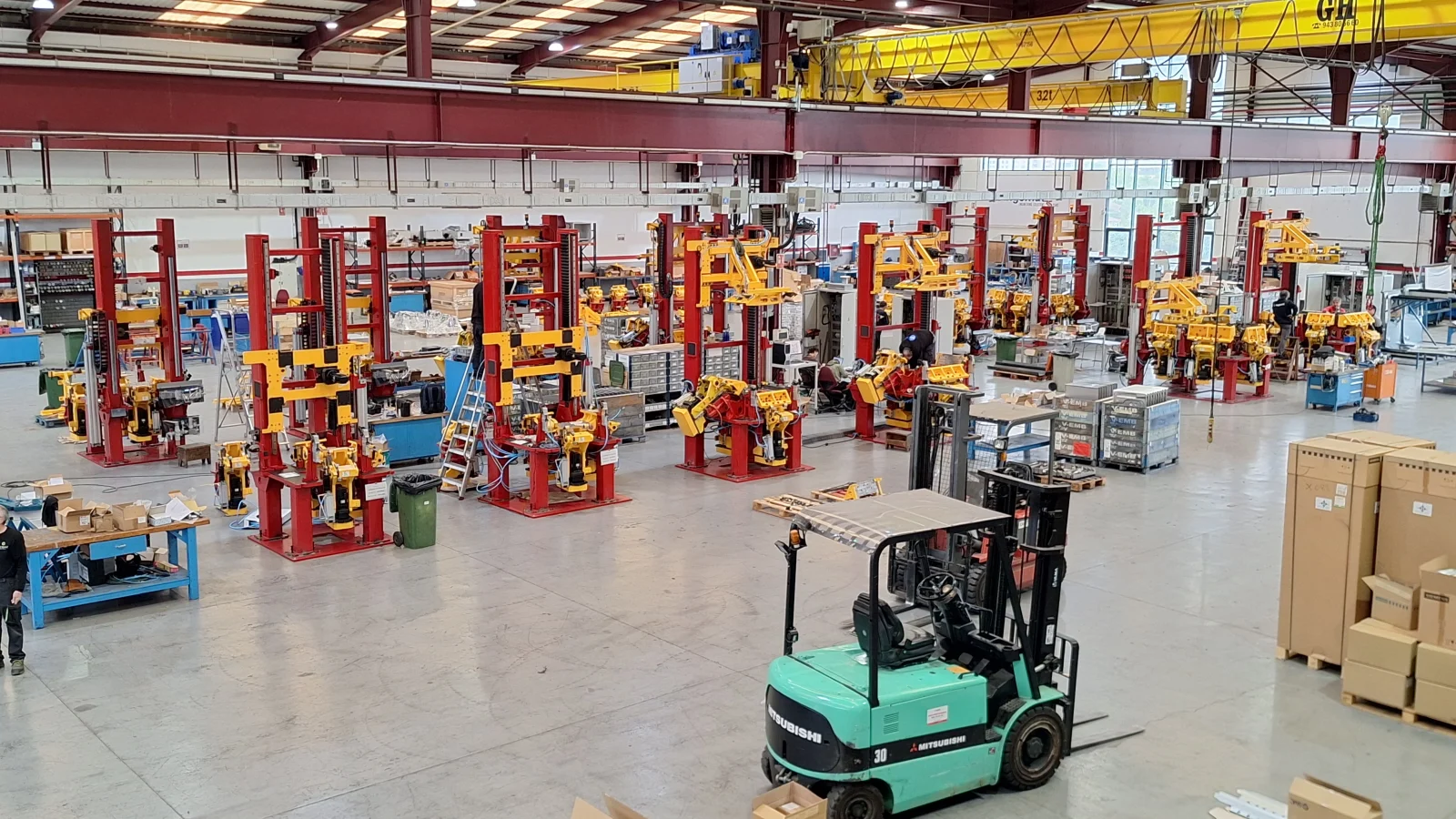
The current situation in the automotive sector is forcing manufacturers and their Tier 1 suppliers to work with increasingly shorter and changing series, using the same production line for several vehicle models. In this regard, flexibility has become a key factor, and robotics a fundamental ally.
In this report, we talk to experts such as Sumcab Robotics, Fanuc, Ingemat, Robotnik and ABB about the current situation in the sector, the challenges it faces and the emergence of AI, as well as how they see the future.
Ignacio Iraolagoitia, commercial director of Ingemat, warns that, in the current context, ‘it is essential to invest in automated solutions that provide true flexibility and scalability.’ He continues: ‘From our point of view, it is essential to design cells and lines that allow our customers to modulate their investment as actual demand is confirmed, thus minimising the risk associated with CAPEX and avoiding initial oversizing, and which are also convertible and reusable in other future projects or programmes’. He also explains that ‘the ability to minimise project completion times is becoming increasingly important.’

In the current context, Adolfo Ibañez, director of the Sumcab Robotics business unit, argues: ‘We are seeing increasingly versatile production cells, capable of quickly adapting to new products or configurations thanks to the use of multi-tool robots, easily relocatable collaborative robots and autonomous mobile robots, which allow processes to be adjusted without major structural modifications.’ Sumcab warns that this evolution poses new technical challenges ‘in line with our spirit of practical innovation, especially with regard to the routing of cables and tubes in multi-tasking robots.’ The director of the Sumcab Robotics business unit explains that ‘these new highly flexible cells are made possible by technological advances, which are enabling higher levels of efficiency and, as a result, a faster return on investment. However, this new scenario also demands a high degree of stability in the production process.’
Albert Fibla, Robot Sales Manager at Fanuc Iberia, comments that ‘industrial robotics solutions help vehicle manufacturers to absorb sharp fluctuations in demand more effectively. Robotics allows production capacity to be adjusted without resizing the plant.’ He goes on to say that ‘manufacturers require flexibility in terms of volume, but also in terms of product and mix. These requirements need to be adapted quickly to increases and decreases in volume.’ In this regard, Fibla tells us that ‘robots can reuse part of the programmes, use automatic tool changes and integrate artificial vision and sensors to adapt to each product without interruption.’ The company’s Robot Sales Manager tells us that FANUC has recently installed a system in Europe that combines 3D cameras with AI algorithms trained using neural networks, enabling industrial robots to operate in real time, even in messy or constantly changing environments.
Robotnik explains that its experience shows that mobile robotics provides operational flexibility by allowing production lines to be quickly adjusted without compromising quality. “Thanks to their modularity and advanced programming, robots can switch between different specific tasks in different locations in a matter of hours, minimising downtime and avoiding bottlenecks. This capability not only optimises plant efficiency, but also allows manufacturers to respond competitively to peaks and troughs in demand, maintaining production continuity and consistency in quality standards,” they comment.
Sergio Martín states that, although the automotive industry remains strategic for ABB Robotics, for years the company has been applying robotisation to solve challenges in all sectors: electronics, food and beverages, logistics, energy, consumer goods and life sciences. ‘This diversity generates powerful synergies. Innovations in flexibility, collaborative robotics, artificial vision and digital integration that originate in one sector are adapted to others, while the automotive industry’s demands for precision, quality and robustness become best practice in any industry,’ says Martín. ‘Together, automotive experience, cross-cutting innovation and the integration of AMRs, cobots, industrial robots and intelligent analysis software generate robust, flexible and sustainable solutions capable of responding to increasingly demanding and customised markets.’
Transferring knowledge to other industries

With regard to creating synergies that translate into good practices applicable across sectors, Adolfo Ibañez, from Sumcab, believes that Spain still has a long way to go. “Robotics has experienced significant growth in sectors other than automotive, and from our position as a long-standing supplier to this sector, diversification is a natural evolution. In many cases, it is not so much a question of developing completely new applications, but rather of adapting solutions that have already proven their effectiveness in the automotive industry, adjusting them to other processes in the manufacturing industry.” He also explains that many robotic applications were created to meet the high demands of productivity, quality and repeatability typical of the automotive industry, and today they are being transferred to other sectors where the product changes. ‘This is the case, for example, with applications for parts handling, product application, welding and artificial vision systems, which can be perfectly extrapolated to industries such as metallurgy, household appliances, capital goods and even certain segments of the food and consumer goods sectors.’
In short, Ibañez argues that ‘sector diversification is not only an opportunity for growth, but also a way to transfer knowledge and optimise industrial processes across the board, taking advantage of the experience accumulated over years in the automotive sector’.
Albert Fibla, from Fanuc, explains that “applications are becoming increasingly diverse. One of the sectors in which robotisation has grown the most in recent years is food and beverages. Many of those responsible for facilities in the sector came from the automotive sector, and technologies and processes based on automotive concepts were implemented. After the pandemic, the logistics and e-commerce sector has grown particularly strongly with applications for picking, sorting, packaging and others.‘ He also states that ’the concept of the robotised and connected factory (digital factory) is no longer something only for large companies and, partly thanks to the falling cost of automation and robotisation solutions, robots are being introduced in all types of small and medium-sized companies.”
Ignacio Iraolagoitia from Ingemat, explains that they are ‘actively analysing the possibility of contributing our knowledge and technologies to other sectors beyond the automotive industry.’ ‘Many of the solutions we develop for bodywork—robotic handling, welding, artificial vision, online quality control, traceability and process standardisation—are perfectly transferable to other industries,’ says Iraolagoitia. He goes on to argue that ‘the main challenge is that, in many of these sectors, business volumes tend to be smaller, which makes it more difficult to justify the return on investment in automation using traditional schemes.’
For Robotnik, “one of the main advantages of mobile service robotics is its flexibility and ability to adapt to virtually any sector or application. It is becoming increasingly rare to find industrial robots designed exclusively for the automotive industry. In contrast to this rigidity, multipurpose robots offer a versatile solution, as they can automate tasks in both automotive environments and logistics warehouses.” This philosophy, present in Robotnik’s robots, has led to valuable synergies.

Sergio Martín states that, although the automotive industry remains strategic for ABB Robotics, for years the company has been applying robotisation to solve challenges in all sectors: electronics, food and beverages, logistics, energy, consumer goods and life sciences. ‘This diversity generates powerful synergies. Innovations in flexibility, collaborative robotics, artificial vision and digital integration that originate in one sector are adapted to others, while the automotive industry’s demands for precision, quality and robustness become best practice in any industry,’ says Martín. ‘Together, automotive experience, cross-cutting innovation and the integration of AMRs, cobots, industrial robots and intelligent analysis software generate robust, flexible and sustainable solutions capable of responding to increasingly demanding and customised markets.’
Collaborative and mobile robotics on the rise
Regarding the evolution of trends such as collaborative robotics and mobile robotics, Adolfo Ibáñez from Sumcab highlights that ‘collaborative robotics and mobile robotics are two of the most relevant trends in industrial automation today, although with different roles and rates of adoption.’ In both cases, we see a clear trend towards hybrid solutions, where fixed, collaborative and mobile robotics coexist within the same production environment. The real challenge is no longer just the technology, but its correct integration into the process, ensuring safety, reliability and return on investment.”

According to Albert Fibla (Fanuc), “collaborative robotics has enabled new applications that until a few years ago could not be robotised, and there is a growing market with new robot models, functions and applications. In addition to being able to program trajectories by manual guidance, our collaborative robots can include vision developed by us (iRVision) and force sensors (Force Sensor), providing solutions for applications where the robot has to see and feel.‘ ’With regard to mobile robotics, our robots can be easily integrated into existing mobile platforms, of which there are many. We have not considered developing mobile platforms, but we do collaborate with different manufacturers to help integrate our robots into those platforms,” he explains.
Ignacio Iraolagoitia (Ingemat) explains that the introduction of both collaborative robotics and mobile robotics is being gradual ‘and much more selective than initially anticipated, which we consider to be a positive thing, because it allows each technology to be applied where it really adds value’. ‘In the case of collaborative robotics, its main limitation continues to be its load capacity and, in certain cases, its working speed, which restricts it to very specific processes,’ he argues. For its part, ‘mobile robotics—and AGVs in particular—is already part of several of the projects we are currently executing. This is forcing us to adapt our own engineering and design processes so that the intralogistics of our customers’ factories are integrated naturally,’ explains Iraolagoitia.
In the case of Robotnik, the concepts of mobility and collaboration have always evolved together. “It is becoming less and less common to find industrial environments designed exclusively for robots, since, from an operational and functional point of view, it is natural for these spaces to be shared by people, robots and other machines. Safety and reliability become even more important when it comes to mobile robots that interact dynamically with their environment. For us, safety is an absolute priority, integrating it from the initial design stages to the final operation,” they explain.
Sergio Martin (ABB Robotics) points out that ‘cobots allow us to work close to people, improving ergonomics, safety and productivity, and facilitating rapid changes on the line. Their adoption is growing even among SMEs, thanks to their ease of integration and programming.’ For their part, AMRs “represent one of the clearest vectors of growth. ‘Advanced fleet management with AMR Studio allows multiple robots to be coordinated, optimising routes, times and safety, and making material flows in the plant more efficient,’ explains Martín. “At ABB, we combine industrial robots, cobots and AMRs to offer hybrid and flexible solutions that can adapt to changes in demand, offer customisation and maintain high levels of quality, productivity and safety. Robotics is no longer just automation: it is a strategic tool for transforming the way we produce.”
AI, a present reality that facilitates work
Finally, we wanted to learn about the current experience of applying AI and the future prospects of the companies we contacted. Fanuc has already shown real examples of physical AI applications implemented on an open platform. The company works closely with Nvidia in the development of Artificial Intelligence applications for robotic applications. ‘As part of this initiative, we have launched a controller to control Fanuc robots on the open source robotic development platform “ROS 2”. Our robots are also compatible as standard with “Python”, a programming language widely used in AI development,’ explains Albert Fibla.
At Ingemat, they are approaching the application of artificial intelligence from two clearly complementary angles, as Ignacio Iralagoitia points out. “On the one hand, we are integrating AI solutions developed by our industrial equipment suppliers into our product lines, especially in areas such as advanced artificial vision for quality control and defect detection, predictive maintenance based on real operating data, and automatic optimisation of process parameters to improve cycle times, consumption and production stability. On the other hand, we are using AI to optimise our own internal processes, from the commercial phase to engineering development and project management. The aim is to make them more efficient, more robust and more agile,‘ they comment. Looking to the future, they see AI ’as a key enabler for moving towards increasingly autonomous and adaptive lines”.
At Robotnik, Artificial Intelligence is already a tangible part of several real-world applications, especially in mobile inspection robotics but also in Autonomous Mobile Manipulation applications. ‘For example, RB-Watcher, the inspection and security robot, combines AI with computer vision to interpret its environment, detect people or objects, and make decisions in real time with a high level of accuracy, even in complex conditions or with variable lighting.’ ‘The future outlook points to an evolution towards robotic systems with a greater ability to perceive, interpret and act autonomously in dynamic environments. This will be fundamental for outdoor mobile robotics, allowing it to expand its operational range and take on more complex tasks with greater precision,’ they say.
Artificial Intelligence (AI) is already present in ABB Robotics and is revolutionising the way materials are produced and moved in factories and logistics centres. Today, it is used in predictive maintenance, process optimisation, artificial vision and autonomous robot navigation, improving efficiency, quality and safety. Looking to the future, ABB is promoting initiatives such as Autonomous Versatile Robotics (AVR), which combines industrial robotics, cobots and autonomous mobile robots in intelligent, autonomous and adaptable solutions. Thanks to AI, these systems will be able to learn from the environment and from data in real time. At ABB, ‘AI is not just a promise for the future: it is already transforming industry and logistics today, and will be a key driver of flexibility, productivity and sustainability in the coming years,’ concludes Sergio Martín.













Leave a comment