
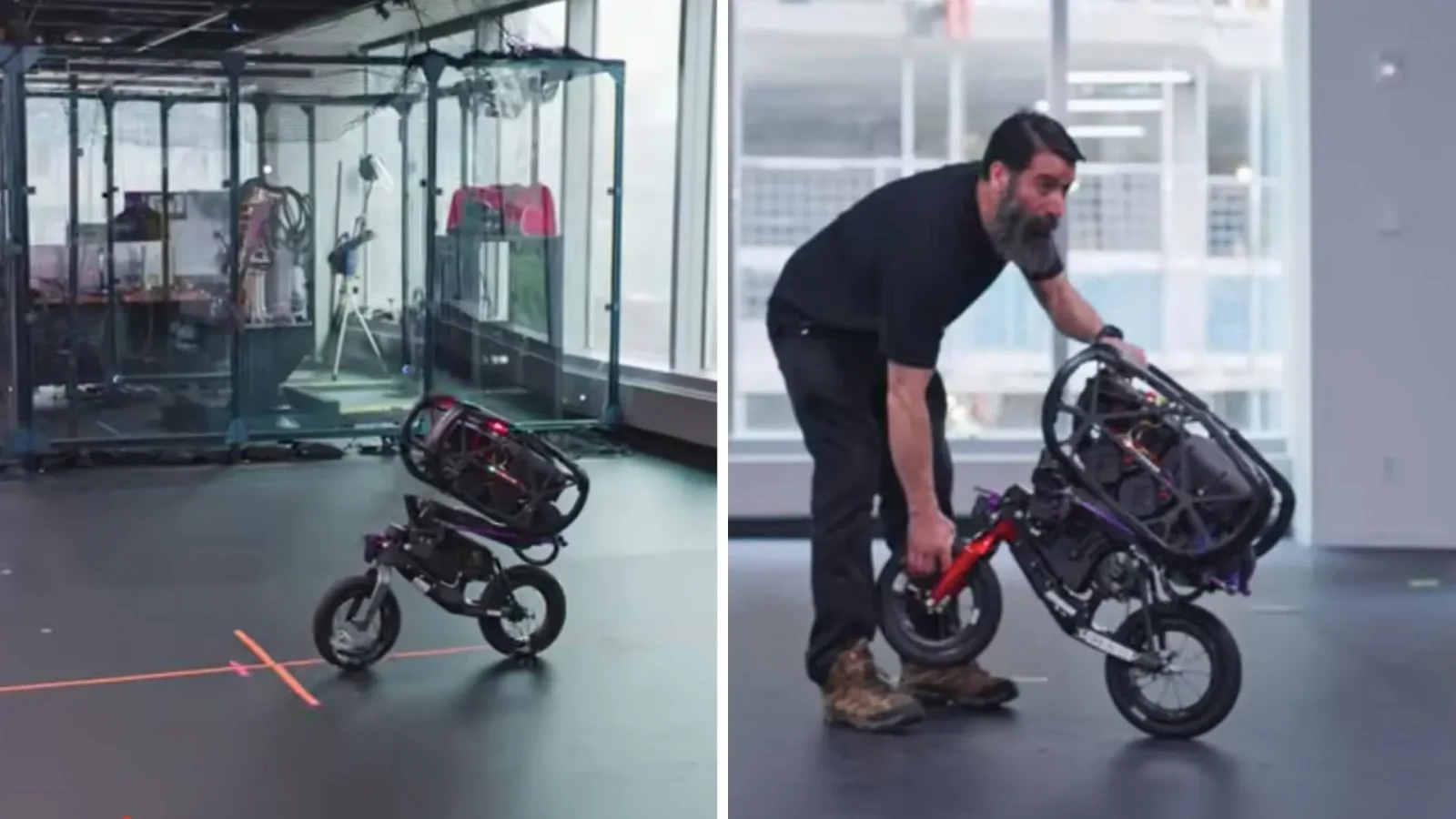
Scientists have created a bicycle-style robot designed to travel at high speed while successfully navigating obstacles. The innovation marks a notable step forward in robotics mobility.
Developed by researchers at the Robotics and AI Institute (RAI), the robotic platform called Ultra Mobility Vehicle (UMV) is modeled after the movement and balance of a human riding a bicycle, enabling it to maintain stability on two wheels while moving quickly.
Unlike many conventional robots that slow down in complex environments, this machine is engineered to stay balanced and maneuver efficiently even when obstacles appear in its path, according to the paper published in on the arXiv pre-print server.
Robot relies on advanced control algorithms
To achieve this performance, the robot relies on advanced control algorithms and artificial intelligence techniques that allow it to constantly analyze its surroundings. Using onboard sensors and computing systems, it can detect potential barriers and adjust its movements instantly. Instead of following a fixed path, the robot continuously modifies its balance, steering, and speed so it can safely avoid collisions while maintaining forward momentum.
“A fundamental challenge in robotics is balancing robots that move with speed while being terrain agnostic,” Ben Bokser and Surya Singh, two of the co-authors of the paper, told Tech Xplore.
“Wheels provide efficiency while legs handle stairs, curbs, and rough terrain. It becomes a trade-off of how complex, expensive, and energy-hungry you want your robot to be versus how much you want the robot to be able to handle the unknown while it moves around. We kept coming back to the fact that trial cyclists and mountain bikers bridge this gap every day.”
Robot can perform quick turns and jumps
Another important capability of the robot is its agility. It can perform dynamic movements such as quick turns and jumps to overcome obstacles that would normally stop wheeled robots. By combining balance control with jumping ability, the robot can pass over barriers and continue moving without needing to stop or change direction significantly. This design allows it to function effectively in environments that contain uneven surfaces, objects, or sudden obstructions.
The robot’s speed and flexibility make it particularly promising for tasks that require rapid movement through crowded or unpredictable spaces. Researchers suggest that similar robotic systems could eventually be used in fields such as search-and-rescue missions, disaster response, inspection work, and automated delivery. In such situations, a robot that can move quickly while adapting to obstacles could provide major advantages over traditional ground vehicles.
Combining mechanical engineering with artificial intelligence
The development of this bicycle-like robot demonstrates how combining mechanical engineering with artificial intelligence can lead to highly agile machines. Robots with these capabilities could be valuable in environments where speed and mobility are essential, such as search-and-rescue operations, urban exploration, infrastructure inspection, and disaster response. Because the robot can travel quickly and overcome large obstacles, it could potentially access locations that are difficult or dangerous for humans or conventional robots to reach.
Overall, this project highlights a growing trend in robotics research: designing machines that move more like humans or animals. By studying natural movement and applying advanced AI techniques, engineers are creating robots that are not only faster but also far more adaptable to real-world environments.















Leave a comment