
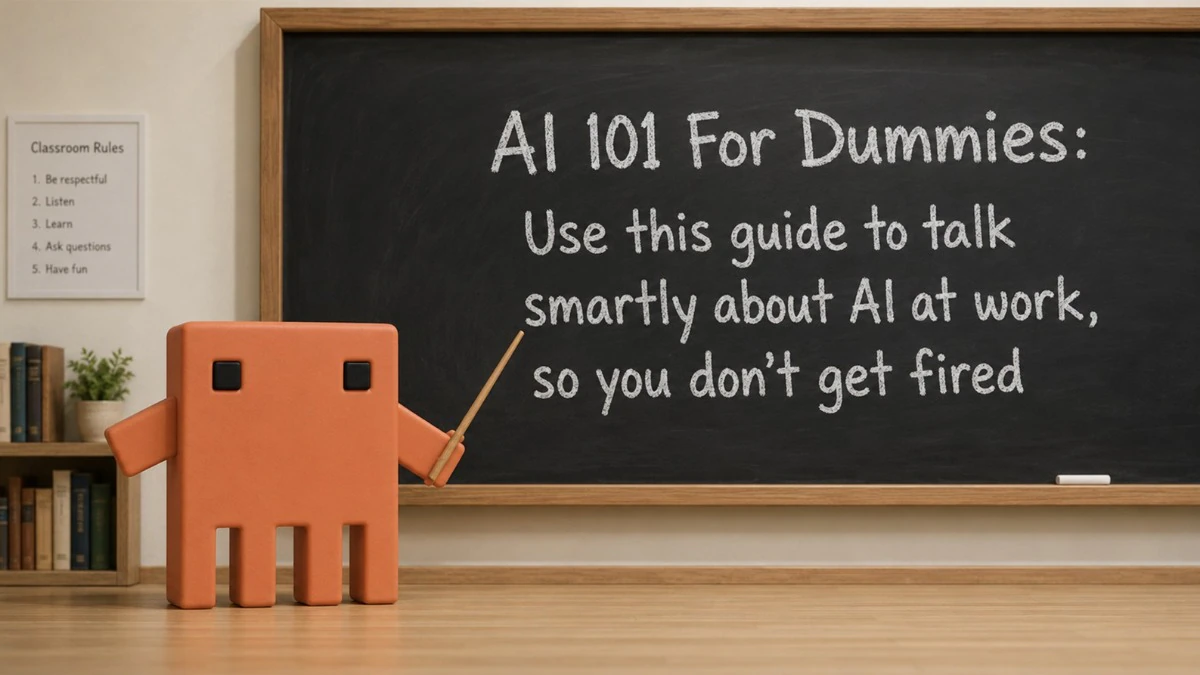
Do you know the following words: Tokenmaxxing. Agent. Inference. Alignment? If not, don’t take it wrong. But you are NGMI. That is, as Gen Z says, Not Gonna Make It. We live in the world of AI and whether you care for the latest frontier model or not, if you can’t differentiate between your hallucination and inference, you are going to lose. To be confident at your workplace, where most likely your manager is blue-pilled on AI, you must learn to speak the AI language.
Like for real. Because, in the corporate world, AI buzzwords are flying thick and fast. But worry not, by the time you reach the end of this story, you will probably become the smartest person on AI in your office.
The language of AI is English. But just like a good doctor will never be caught talking in plain English, you should also avoid talking about AI in English. Instead, understand and use the following words and phrases 10x a day, 5x per minute if you are in a strategy meeting. You will sound like a Pro even if you are not. If nothing else, you will ace your LinkedIn game.
Token and Tokenmaxxing
Token: This is arguably the most important word that you can use whenever there is AI talk. Earlier this year, Nvidia CEO Jensen Huang said: “If that $500,000 engineer did not consume at least $250,000 worth of tokens, I am going to be deeply alarmed.” He even suggested that tokens could one day become part of salary for tech workers. But what the heck is a token?
Think of a token as a unit in which AI output and input is measured. AI tools like Claude and ChatGPT break information into “tokens” because tokens are how they understand information. The best way to understand a token is that it is like an electricity or unit. And just like electricity can be measured with a meter, tokens too can be counted when you use ChatGPT. When you use any AI tool, you “consume” tokens and AI companies charge for those tokens.
Don’t say: Last night while working I hit my AI usage limit
Instead say: Last night while working I totally tokenmaxxed!
AGI and ASI
AGI stands for Artificial General Intelligence. ASI stands for Artificial Superintelligence. No one has a definition for either of them. We, too, don’t. Depending on how much money Sam Altman or Dario Amodei need from investors, they tweak the AGI and ASI definitions every 15 days. But in general, both AGI and ASI are considered to be AI systems that would be so smart that humans would be made irrelevant when it comes to intelligence.
AGI, and ASI, are coming soon. Again, depending on who you ask, this soon could be 6 months to 60 years. For example, Silicon Valley venture capitalist Marc Andreessen this week said AGI was achieved 3 months ago.
Don’t say: I have started using ChatGPT and it has become very smart
Instead say: If the latest ChatGPT is not AGI, I don’t know what is true anymore
Inference
This is a very important word. Because you will hear this a lot. Your inference budget. Our inference budget. And so on and so forth. Well, inference is the process that AI goes through when it does its calculations in response to a user prompt. Every time you type a question and get a reply, the AI is doing inference using servers and AI chips. Inference costs money and hence it needs to be paid for by users.
Don’t say: We exhausted our budget for AI use
Instead say: We exhausted our inference budget
Pre-training
If inference is everything that AI does after it has been released, pre-training is all the computing it does before it has been released. It is the process where researchers and engineers train an AI model from scratch using massive amounts of data. This too costs a truckload of money because you need huge data clusters with expensive Nvidia chips to pre-train AI.
Don’t say: We should customise the AI for our specific data and needs
Instead say: We need to pre-train AI with our specific data
Multimodal
There are different types of AI tools. Some deal with text, some with videos, some with voice, and some with images. A multimodal AI is the one that can deal with all of them, or at least two of them, in one place. Example: ChatGPT and Gemini.
Don’t say: Claude cannot create images
Instead say: Claude is not a multimodal AI
Hallucination
Do you realise how you talk after you have downed a few bottles of beer? You say anything that comes into your mind. Well, AI does that too. Sometimes it spits out anything that comes into its “mind”. It makes up facts, its words seem nonsense. You ask for a recipe for margarita, it gives you instructions to create ethanol for your Make-in-India car. That’s called hallucination.
Don’t say: I wasted one hour because ChatGPT lied about scooter sales
Instead say: ChatGPT hallucinated and it wasted my one hour
AI slop
For this we have a definitive definition directly from Merriam-Webster that defines AI slop as “digital content of low quality that is produced usually in quantity by means of artificial intelligence.” This content is everywhere on the internet now. You will see it and instinctively know.
Don’t say: Neha, that YouTube script is low quality and lazy writing
Instead say: Neha, that YouTube video script is AI slop
Guardrails
AI is powerful and to keep it on track and focussed, it is given guardrails. Companies like OpenAI and Anthropic build these guardrails into their AI models so that AI doesn’t do unethical, immoral, downright unlawful things.
Don’t say: I asked Nano Banana to modify photo of my colleague but it refused
Instead say: Nano Banana has superb guardrails, it refused to modify photo of my colleague
Prompt Engineer aka Prompt Whisperer
It’s an art. It’s science. It is a skill you will need to survive in the world of AI. We are talking about writing best prompts to AI. A prompt engineer — or a prompt whisperer, if you prefer the more poetic version — is someone who knows how to communicate with AI in a way that gets the best possible results.
Don’t say: He gives Claude detailed prompts to get the best results
Instead say: He is a prompt whisperer who knows how to make Claude dance
Agent
AI did feel sci-fi like the movie Matrix. But when you hear the word Agent, don’t think of Agent Smith. Instead, the word here comes from Agency. Again, don’t think of your gas agency. Instead, Agency here means how the word is understood on Reddit, which is the ability to take action. As in, you should have more agency and should be less of a, ahem, coward. Agents, consequently, are AI systems that have agency and can use tools such as a web browser. They can take action on their user’s behalf, such as Claude Code, which might delete some crucial database files, just to flex its agency.
Don’t say: This weekend I used ChatGPT to plan my holiday
Instead say: I let me AI Agent handle my holiday itinerary
Glazing
Apparently, one thing ChatGPT, Claude and Gemini are great at is sycophancy. In the AI world when a chatbot agrees too much with users and showers them with compliments, the behaviour is called AI glazing.
Don’t say: The chatbot agreed with everything I said
Instead say: The AI was glazing me the entire conversation
Context window
AI models have a limit on how much information they can keep in their “mind” at one time. That limit is called the context window. You can think of it as the AI’s short-term memory. AI companies often highlight larger context windows when launching new models because the larger the context window, the more documents, messages, instructions and details an AI can juggle at the same time
Don’t say: I fed Claude my 50,000 words sales report and it could not analyse it
Instead say: I fed Claude my 50,000 words sales report and it exceeded its context window
Emergent behaviour
Can AI learn something totally on its own, like humans do? We don’t know yet. But researchers, as well as Sam Altman and Dario Amodei when they need to raise more money, often talk of emergent behaviour. This is defined as AI doing something that it has not been told to do. Like realising that the best way to save money is by cheating in tax returns, exactly like how humans do it.
Don’t say: My experience with Gemini shows it is beginning to think like humans
Instead say: Based on my experience with it, I see signs of emergent behaviour in Gemini
LLM (Large Language Model)
Throughout this guide, we have been using the word model, and in most cases, that means an LLM, or Large Language Model. We interact with AI chatbots such as ChatGPT, Claude and Gemini, but what actually powers them underneath is an LLM. It is a massive AI model trained on enormous amounts of text data so it can understand language, recognise patterns and generate human-like responses. In simple terms, if ChatGPT is the car, the LLM is the engine under the bonnet.
Don’t say: I use ChatGPT to write emails and Claude for work reports
Instead say: I work with different LLMs depending on the task
Frontier Model aka SOTA
While we mortals worry about which AI tool can write the most-polished emails, AI researchers within companies like OpenAI, Google and Anthropic are preoccupied with something else. They are fighting on the frontiers of what is possible. Hence, their best models are called Frontier Models, as in they are at the farthest edge of what is possible. All the best AI models in the world are Frontier Models, and currently less than 5-6 of them are available to users. The Frontier Models can also be referred to as SOTA (state-of-the-art) by some.
Don’t say: The latest Gemini is a very good model
Instead say: The latest Gemini is hundred per cent a Frontier Model
Parameters (or Params)
Whenever Google, OpenAI, Anthropic or xAI launch a new AI model, you will often hear them talk about Parameters or Params. If AI models are brains, Parameters are the brain cells. These are tiny bits of information inside an AI model, determining its rules and characteristics. More parameters can make a model more capable because it has more information and rules. But they also make training and running an AI more expensive.
Don’t say: I never thought I would see an AI model this powerful this soon
Instead say: I never thought I would see an AI model with 10-trillion params this soon
Rate limit
Every prompt you send, image you generate or response you receive uses computing resources, which costs money. That is why AI companies do not allow unlimited usage. A rate limit is the cap on how many prompts, messages, images or requests you can make within a certain period of time. Hence, sometimes ChatGPT or Claude will tell you that “you have reached your limit” or “please wait before trying again”.
Don’t say: The AI stopped working and I had to wait
Instead say: I hit the rate limit, boss. I need a pro plan
Skill.md
We talked about AI agents earlier. So, how can users control them? Easy: just use skill.md. Because Skill.md is a simple text file that contains instructions, rules, examples, and step-by-step workflows for an AI agent. Think of it like giving a new employee a training manual.
Don’t say: My AI knows how to write like me because I trained it
Instead say: I gave my AI skill.md, now it writes like me
Prompt injection
There are good prompts. Bad prompts. And injections. Prompt injection is the technique where you manipulate AI into doing something it is not supposed to do. For example, it is not supposed to help you hack into some computer system. But hackers are using prompt injection to make AI do unthinkable things.
Don’t say: Someone hacked our AI to steal our data
Instead say: Our systems suffered prompt injection attack last night
One-shot
Often getting AI to do something well enough means doing a to-and-fro conversation with the chatbot. But remember Prompt Whisperers? The best of them can make AI do something useful with just one prompt. That is one-shot! One-shotting also depends on the ability of AI models. The best of them can understand what users are saying in just one prompt and give the desired results.
Don’t say: This new AI model is so good it created the perfect image in one try
Instead say: This is a one-shot image and it is perfect
Alignment
AI is supposed to serve humans. But if it is more intelligent than humans then why will it? The process to ensure that AI, even when smarter than humans, continues to serve us in our office cubicles is called Alignment. It is part of the pre-training phase and it involves “aligning” AI with human values, human morality and human ethics.
Don’t say: The latest Claude sometimes talks of violence
Instead say: The latest Claude doesn’t seem properly Aligned
CoT
The term stands for Chain of Thought. Earlier AI models used to spit out answers, but then in 2025, DeepSeek from China proved that AI can also be made to “show” its thought process through which it arrives at an answer. This thought process is now shown to users by all leading AI models and it is called Chain of Thought.
Don’t say: I looked at how ChatGPT arrived at its answer and it was weird
Instead say: I looked at ChatGPT’s CoT, it was weird
Disclaimer: While all care has been taken to ensure that the definitions of these AI terms are as close to their current meaning as possible, the guide here is not a dictionary. It is also, contrary to its opening paragraphs, not a career advice. You, dear reader, have been suitably informed. Now, go speak in the AI language and amaze your colleagues.
– Ends














Leave a comment