
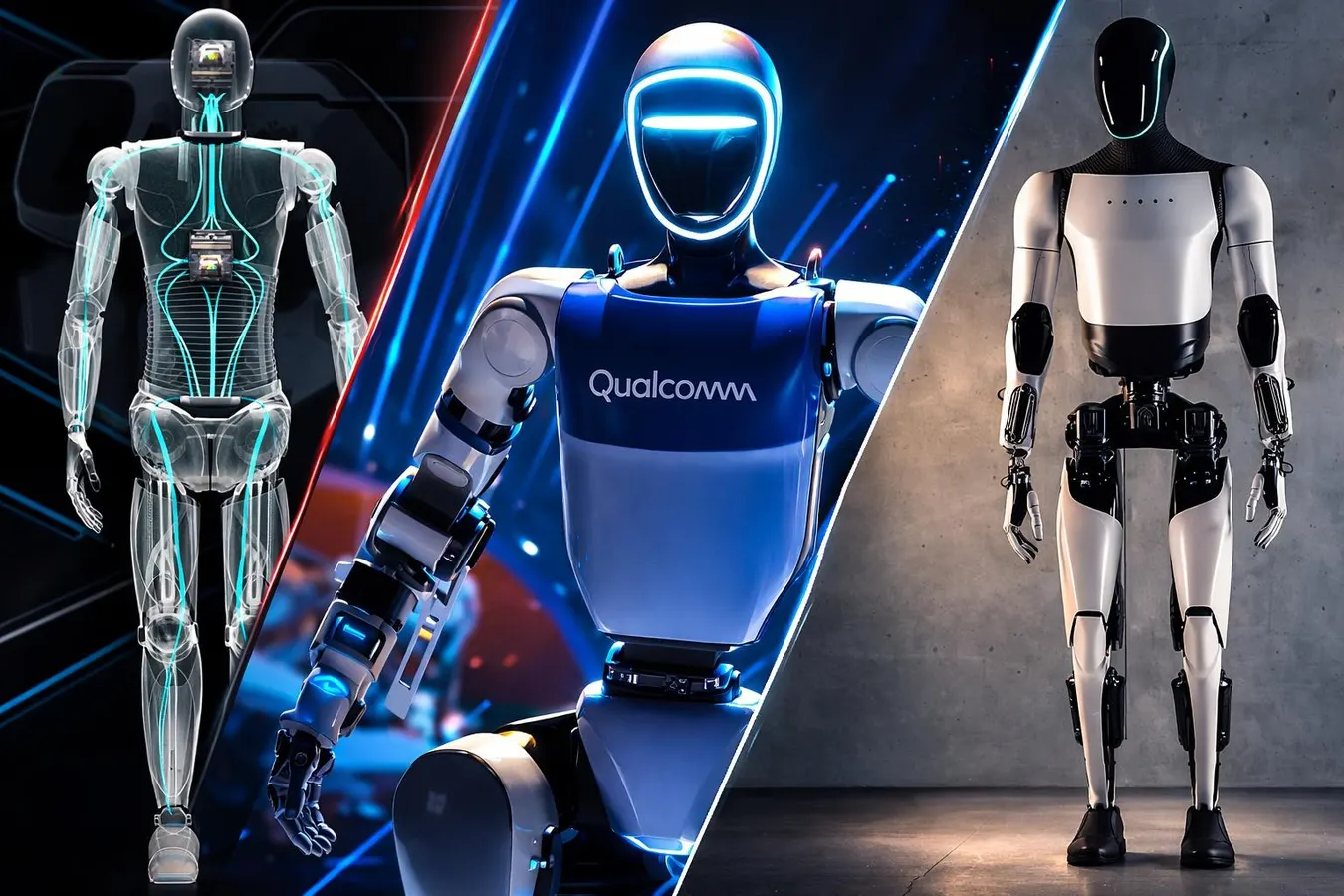

Humanoid Robots From Nvidia, Qualcomm and Tesla
Nvidia, Qualcomm, Tesla
Despite many public predictions that autonomous vehicles (AVs) would be the dominant vehicle platform by 2020, the road to autonomy has been a difficult one, paved with market, technical, legal, and regulatory challenges. However, with more than a decade of investment in developing, testing and deploying autonomous vehicles, the same technology is proving to be the key to enabling advanced robotics. And with fewer hurdles to cross, the adoption curve will be much steeper.
Physical AI leveraging lateral innovation
While robotics have been widely used in industrial applications for more than four decades, these platforms have traditionally relied on rigid mechanical architectures and hard‑coded programming. The latest generation of robots requires far more sophisticated technology to transform into autonomous machines.
Autonomous robots, whether in auto, industrial, or humanoid form, share the same requirements for perception, planning, and control. From a hardware perspective, robots require advanced sensor technology to perceive and operate within their operating environment relative to other objects, including humans. This requires advanced cameras, radar, LiDAR, gyros, accelerometers, and/or ultrasonic sensors. Autonomous robots also require movement planning to predict potential interactions with other objects and real-time control over all possible actions, often under adverse conditions. And from a software perspective, autonomous robots require a complex software stack that includes sensor fusion, device drivers, trained ML models, reasoning/agentic AI models, and real-time processing, with safety at its core.
2025 proved to be a critical year for robotics. It marked the convergence of advanced sensors, high-performance computing, high-speed/low-latency wireless connectivity, and agentic AI, many of which were developed for AVs, to build the advanced robotic systems envisioned since the 1950s. This was evident at CES 2026 and MWC 2026, where robotics dominated the discussions and technology announcements. However, the companies that have been leading the charge into AVs also appear to have the advantage in enabling advanced autonomous robots, including humanoids, by leveraging the same underlying AI hardware and software technology.
Turning cars into robots
Autonomous Vehicles from Nvida, Qualcomm, Tesla
Nvidia, Qualcomm, Tesla
Three players that stand out in this respect are Nvidia (NASDAQ: NVDA), Tesla (NASDAQ: TSLA), and Qualcomm Inc (NASDAQ: QCOM). Nvidia was an early entrant into advanced robotics and has developed a complete vertical hardware and software technology stack featuring its Jetson series SoCs, Isaac SDK & libraries, and GROOT foundation models, much of this leveraging technology from Nvidia’s Drive platform for AVs. Nvidia-based autonomous robots are currently deployed in many materials handling applications, ranging from warehouses to retail delivery. Similar to Nvidia, Tesla has a complete vertical technology stack ranging from custom SoCs to software for its AV Autopilot platform and plans to leverage this expertise to expand into autonomous humanoid robots. Tesla has even allocated previously used automotive manufacturing space for its Optimus humanoid robots starting as early as 2026. More recently, Qualcomm announced plans to enter the advanced robotics market as part of the company’s diversification strategy. Qualcomm is seeking to leverage its highly successful Snapdragon Ride platform, including the Snapdragon Ride Pilot developed with BMW, and its broad ecosystem to advance robotics and physical AI.
In addition to the platform’s technology, Qualcomm seeks to leverage its financial success in the automotive sector to fund efforts in robotics and other segments. According to its latest earnings, Qualcomm is starting to convert its $45B automotive revenue pipeline, the highest for advanced automotive systems, into meaningful revenue, breaking through the billion-dollar threshold in fiscal 1Q 2026 and accelerating. At this rate, Qualcomm is projected to surpass $4B in automotive revenue this year, well ahead of the pace needed to reach its $8B revenue forecast by fiscal 2029. The Qualcomm robotics efforts fall under its focus on IoT, and the same executive vice president for automotive, Nakul Duggal.
Qualcomm’s entry into advanced robotics was marked by the introduction of the Dragonwing IQ10 SoC series and the RB5/RB6 robotics platform, both announced at CES 2026. As with other segments, the platform leverages Qualcomm’s high-performance/low-power processing, high-speed/low-latency connectivity, open-source software solutions, and broad developer ecosystem to advance robotic applications, starting with industrial and drone applications. Qualcomm demonstrated the flexibility and sophistication of its robotics platform at CES with a humanoid robot that was developed in less than four months.
AV investment finally pays off with robots
Because of the lower regulatory requirements and clear benefits, autonomous robots, even humanoids, are likely to be adopted much faster than AVs. We could see a rapid return on investment across industries, especially those facing labor shortages, such as agriculture, manufacturing, and healthcare. While it is still in the early stages of the AI era, the tech industry is rapidly moving from general intelligence on devices to intelligent autonomous machines. While the thought of humanoid robots may still cause some concern, especially given all the movies that have depicted them negatively, their potential to aid humanity is tremendous. It is not difficult to imagine a world of autonomous robotics within the next 10 to 15 years, enhancing human endeavors by performing highly valuable yet mundane or inherently dangerous tasks, freeing humans to focus on more innovative, value-added pursuits. It’s also likely that they will be sharing the same technology as the leading autonomous vehicles, success in in one will feed the other.
Tirias Research tracks and consults for companies throughout the electronics ecosystem from semiconductors to systems and sensors to the cloud. Members of the Tirias Research team have consulted for IBM, Nvidia, Qualcomm, AMD and other companies throughout the data center, AI and Quantum ecosystems.















Leave a comment