
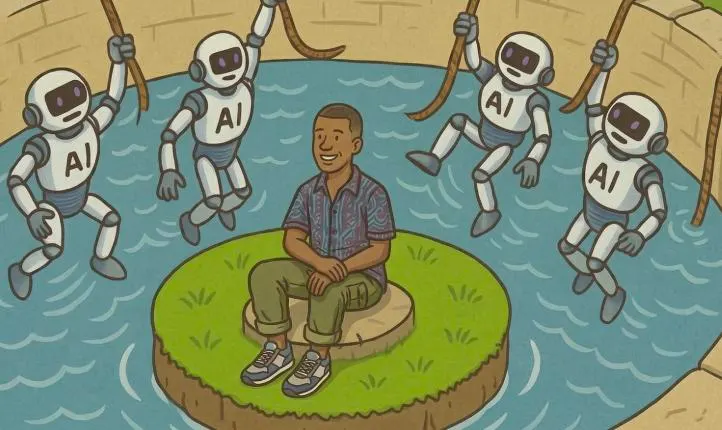
Written by Henri Pierre-Jacques II, Co-founder and Managing Partner, Harlem Capital
My old boss used to say: “Everything in life is about people.” I have been investing for ten years and the longer I do this, the more I believe he was right.
The AI revolution has made products faster, teams smaller, and answers cheaper. It has automated workflows that used to take entire departments. It has compressed years of software development into months. But it has not changed the most important variable in any business: the people.
In fact, it has made them more important.

The Lesson We Already Learned
COVID taught us something we needed to be reminded of: Working from home made us more productive, comfortable and in control of our time. But, many of us arrived at the same realization that we missed each other. We missed the hallway conversations, whiteboard sessions and lunches. We were built for community. Productivity is not a substitute for it.
The same tension is playing out now with AI. We are getting our answers faster and our tools are smarter. Some people are replacing their coaches, their therapists, even their friends with chatbots. And many of those same people are quietly pushing back, not against the technology, but against the cost of losing the human on the other side.
No matter where you land on that debate, it comes back to the same thing; people.
The Founder Perspective
I talk to founders every day. I ask about product, market, competition, capital. But for the past year, the number one source of stress I keep hearing has nothing to do with any of those things. It is talent.
Hiring is harder right now than at any point. Agencies are overwhelmed and underperforming. AI tools are helping with outbound but not with conversion. Salaries for the roles that matter most are at all-time highs because the supply of great people has not kept up with the demand for them.
The founders who are winning this fight are not the ones with the best job descriptions. They are the ones who got close to the right people before they needed to hire them. They are treating talent the same way the best VCs treat founders, building relationships long before there is a transaction to be made.
The product advantage in AI compresses fast. What does not compress as quickly is the team that can keep building the next one. That is the real moat.
The VC Perspective
This is the most exciting time I have ever had as an investor. The technology shift is real. The founders starting companies right now are some of the most talented I have encountered in ten years of doing this.
It is also the hardest time to invest. Moats built on product are eroding faster. A startup that has a defensible position today may not have one in six months. The pace of model releases and platform shifts has removed the buffer that used to give early-stage companies time to establish themselves.
So I have gone back to the founder. When markets shift this fast, the quality of the person matters more than the quality of the product at the moment of investment. I am doing more in-person meetings. I am spending more time getting to know founders before there is a term sheet on the table. I am partnering more with people I have built real relationships with over time.
I am doing fewer deals with more intentionality. That is not a retreat. It is a recognition that in a moment of maximum uncertainty, the human is the most durable bet.
The Customer Perspective
Customers are already using dozens of tools. They are being pitched dozens more every month. The inbox is full. The attention is gone. Breaking through that noise on product alone is becoming nearly impossible.
This is part of why the most interesting AI companies I am watching have a service component. Not because the technology is not strong enough to stand alone, but because the human touchpoint makes the product more valuable. It reduces churn. It increases usage. It builds the kind of trust that a great product feature cannot buy.
The companies that understand this are not treating service as a cost center; they are treating it as a distribution strategy. The relationship is the moat.
The One Thing That Does Not Compress
Ten articles into this series, I have written about the collapse of the old SaaS playbook, the death of vertical expertise, the compression of moats, the pressure on founders, and the evolution of what great looks like. The through line in all of it is the same.
Everything in life is about people.
AI will keep getting faster. Models will keep getting smarter. Products will keep getting cheaper to build and harder to defend. The companies and investors who understand that the human layer is where the durable value lives are the ones who will win.
Every moat AI has destroyed was built on a product, a process, or a market position. None of those are permanent. The only one it cannot touch is the person. That has always been true. It is never been more true than now.
Henri Pierre-Jacques II is the Co-founder and Managing Partner of Harlem Capital. Follow him on LinkedIn and Twitter.
This is a content marketing post from a Forbes EQ participant. Forbes brand contributors’ opinions are their own.













Leave a comment