
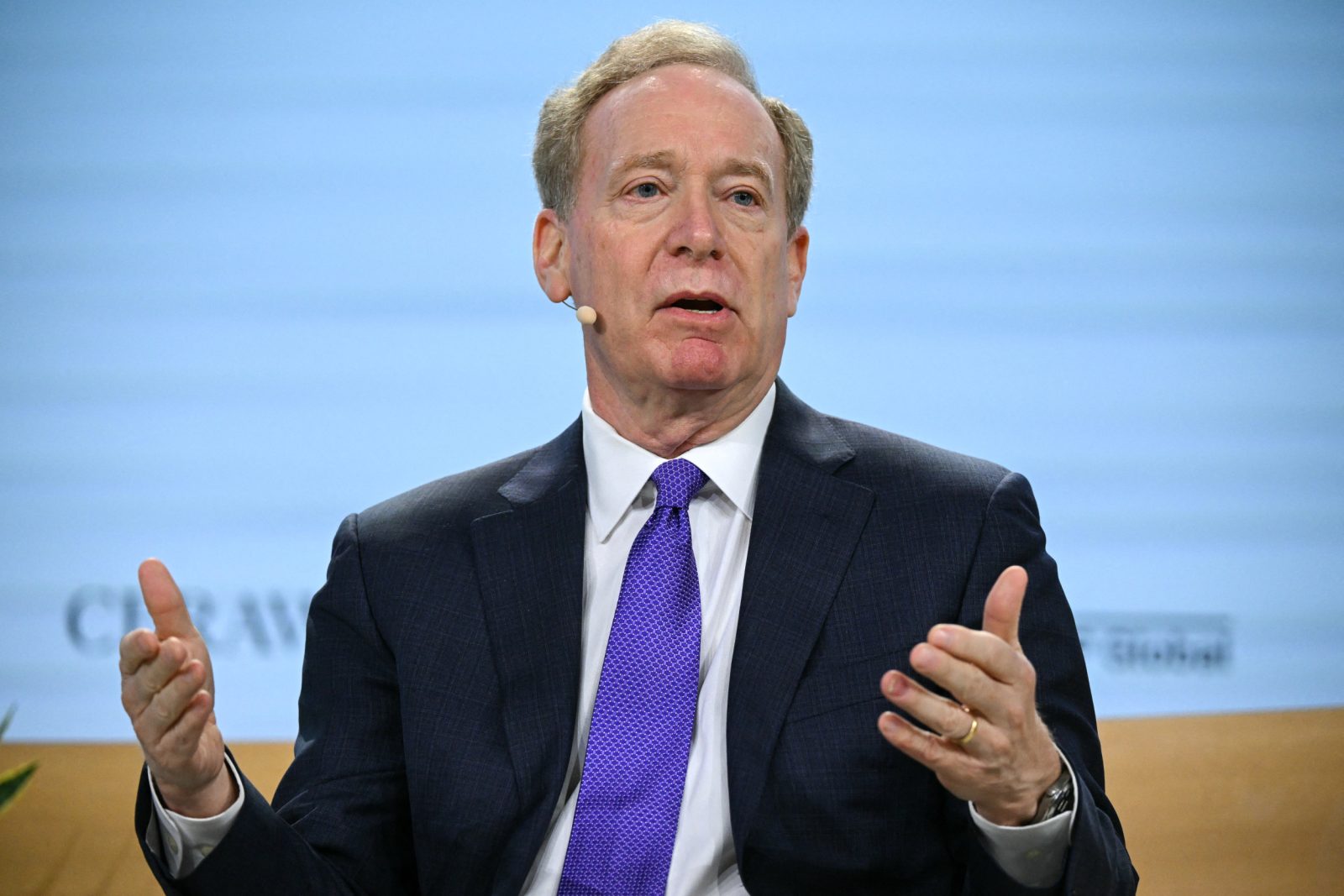
As warnings about artificial intelligence replacing millions of workers dominate headlines, Microsoft President and Vice Chair Brad Smith is urging those concerned about the job market to “not panic.”
In an interview with Axios, Smith pushed back against what he described as increasingly alarmist predictions about AI-driven job losses, arguing that the technology industry has mishandled the public conversation around the future of work. His message was simple: “Let’s not panic.”
The comments come at a time when concerns about AI’s impact on employment have intensified. Executives from leading AI companies, including Anthropic and OpenAI, have warned that artificial intelligence could automate large portions of white-collar and entry-level work in the coming years. Those predictions have fueled anxiety among students, recent graduates, and workers already facing an uncertain labor market.
Smith believes many of those forecasts are overstated. Speaking to Axios and elaborating on a recent Microsoft blog post, he criticized the tendency of some technology leaders to make sweeping claims about AI eliminating jobs. He went on to say that such rhetoric risks alienating young people who are entering the workforce and trying to understand how emerging technologies will affect their futures.
“Tech leaders tend to repeat two mistakes,” he said. “One is: They overestimate the impact of technology, especially the pace at which it will arrive. And second: The tech leaders often underestimate people. … There was a time when humanity discovered that a horse could run faster than a person. So, people learned how to ride horses. Let’s use AI to help people do more and not replace us.”
The Microsoft executive pointed to growing resistance among college students as evidence that the industry needs to rethink its messaging. During commencement ceremonies this spring, some graduates reportedly booed references to AI, reflecting concerns that the technology could undermine career opportunities. Smith called that reaction a “wake-up call” for Silicon Valley.
“[Graduates are] right to raise concerns and ask hard questions, including about AI and its impact on their future. They face multiple headwinds as they enter the job market. This includes AI automation of tasks in current entry-level positions and, especially in the tech sector, corporate pressure to reduce headcount to help pay for AI’s enormous capital expenditures,” Smith wrote.
In a June 10 blog post titled AI, Jobs, and the Next Generation, Smith argued that technological revolutions have historically transformed work rather than eliminated it. He compared AI to previous breakthroughs such as photography, electricity, and digital computing, all of which displaced some tasks while creating new industries and professions.
“People have been proving this for millennia,” Smith wrote, emphasizing that human adaptability and creativity have repeatedly allowed workers to evolve alongside new technologies.
However, he acknowledged that AI is already automating certain tasks traditionally performed by entry-level employees and that many companies are simultaneously trying to reduce costs while investing heavily in AI infrastructure.
Smith wrote that skepticism of AI “also involves other factors, including geopolitical uncertainty, trade tensions, and correction from over-hiring in the early years of the decade. Like a perfect storm, the wind is blowing from multiple directions.”
According to his analysis, AI’s impact on jobs is likely to unfold gradually rather than through a sudden wave of mass unemployment. His view contrasts with some of the more dire predictions emerging from parts of the AI industry. However, several technology leaders have recently begun softening earlier warnings.
OpenAI CEO Sam Altman has acknowledged that job disruption may occur more slowly than initially expected, while Microsoft AI chief Mustafa Suleyman recently clarified that his forecasts focused on automating tasks rather than eliminating entire professions. Earlier this year, Federal Reserve Governor Christopher Waller said he does not expect AI to “blow up” the labor market, instead viewing it primarily as a productivity-enhancing tool.














Leave a comment