
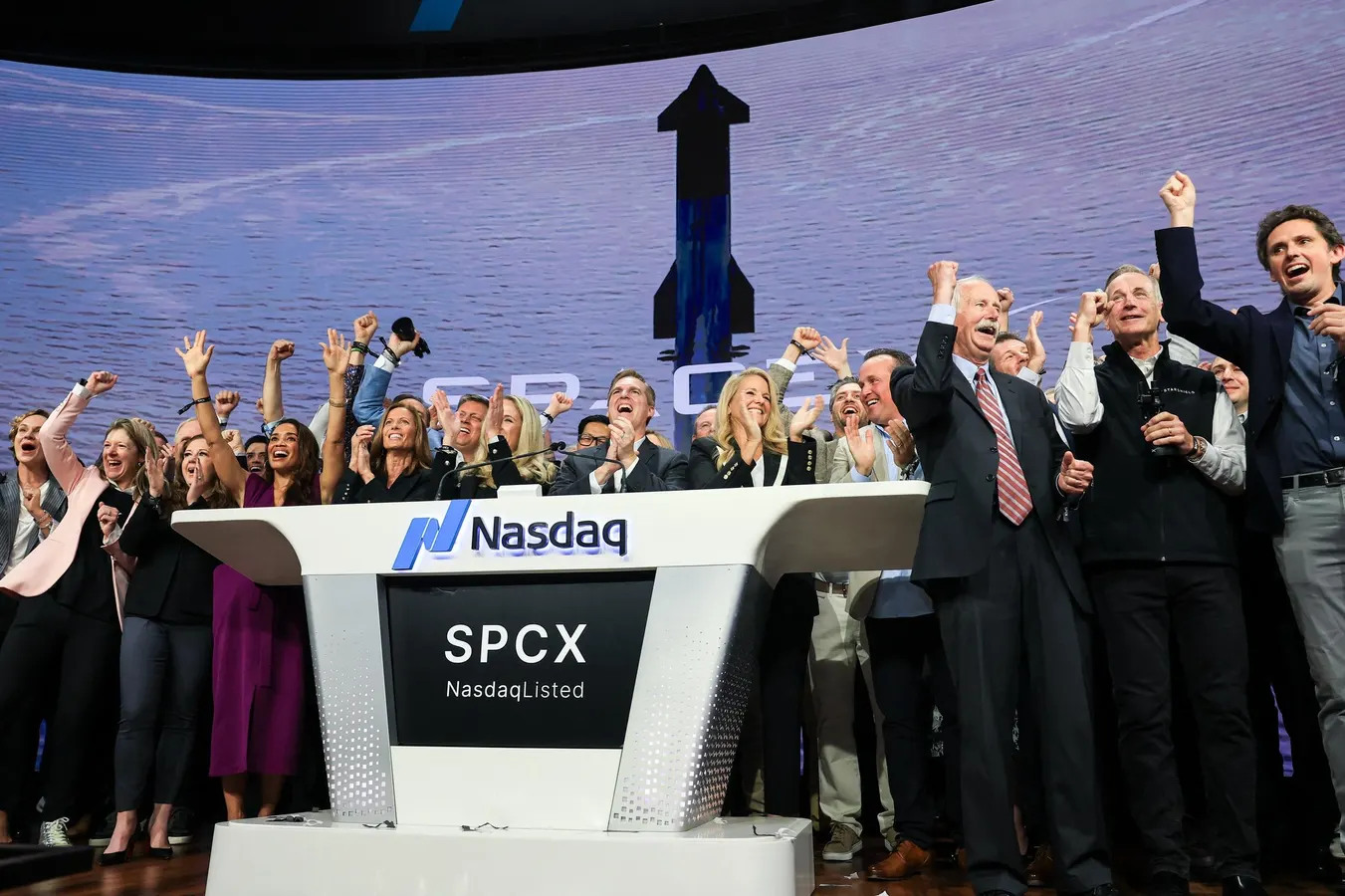

SpaceX’s IPO filing shows most of its AI-segment revenue is old X advertising and subscriptions, not Grok or compute.
AFP via Getty Images
Twitter last opened its books to the public in the spring of 2022, weeks before Elon Musk agreed to buy it and switch off the lights. For three and a half years after that, anyone trying to size up the business had to make do with Musk’s own posts and the occasional leak. That window has now closed. On June 11, SpaceX priced its initial public offering at $135 a share, and tucked inside the prospectus it filed with the Securities and Exchange Commission is the first audited account of what X, Grok and the rest of xAI actually earn. The headline writes itself: SpaceX is an AI company now. Read the revenue note, though, and the AI line turns out to be mostly the thing formerly known as Twitter.
SpaceX folded xAI into itself in February, and xAI had swallowed X the year before. All of it now sits in one bucket the company calls its AI segment. For 2025 that segment booked $3.2 billion in revenue against a $6.4 billion operating loss, according to the filing. The loss has had plenty of attention. Where the $3.2 billion comes from has had almost none, and that is the part worth slowing down for.
What The ‘AI’ Line Actually Holds
Start with what the segment is made of. The filing groups four very different money-makers under one roof. There is advertising on X. There are paid subscriptions to X and Grok. There is the licensing of the platform’s data to outsiders. And there is the business of selling spare computing power to other companies. The first of those, advertising, is a straight inheritance from Twitter. It is a recovering ad business with a new badge sewn on.
The growth tells the story plainly. SpaceX says the jump in the segment’s top line came largely from $465 million in what it labels AI solutions and infrastructure revenue. Of that, $365 million was the rise in X and Grok subscriptions and $88 million was data licensing, as TechCrunch noted in its read of the filing. Advertising chipped in another $116 million of increase. Add the genuinely new, genuinely AI-flavoured pieces together and you are still looking at a slice of the whole. The remainder, the bulk of the $3.2 billion, is the legacy platform doing what it has always done: selling ads and Premium ticks.
A quick word on what these terms mean, because the labels do a lot of hiding. Data licensing is renting out the firehose of public posts so other firms can train their own models on it. Selling compute means letting an outside company run its software on your machines for a fee. Neither requires Grok to be any good. Both would exist if xAI had never built a model at all.
Mind The Scope Before You Do The Arithmetic
Here is where it pays to be careful, and where a lot of quick takes on the filing went wrong. The $116 million advertising figure in the AI segment is the year-on-year increase, not the whole ad business. Independent forecasters put X’s total advertising for 2025 at a different order of magnitude. eMarketer, whose estimate was widely reported, pencilled X’s global ad revenue at roughly $2.26 billion for the year. Those two numbers measure different things, and subtracting one from the other gives you nonsense. The useful point is simpler: the platform’s advertising base dwarfs anything the model is bringing in, and advertising is the engine that was already running.
A 2022 ad business with a 2026 badge. Most of what sits under SpaceX’s “AI” heading is X selling ads and subscriptions, the same way Twitter did before it went dark.
How Much Of It Is Grok
Not much, on the evidence the company itself supplies. The prospectus reports about 550 million people using X each month as of the end of March, with roughly 117 million of them touching Grok’s features. Better than one in five, which is respectable for a chatbot bolted onto a social network. It is a long way from a business that pays for a $12.7 billion-a-year construction habit.
The paid numbers are thinner still. SpaceX counts about 6.3 million paying subscribers across both products, split between roughly 4.4 million on X Premium and around 1.9 million on the SuperGrok tiers, a breakdown drawn from the filing. The company is candid that it has barely begun selling Grok to businesses. It says it expects its enterprise and government products to be attractive and to win customers, language that quietly concedes the wins are mostly ahead of it, not behind. When a filing talks in the future tense, it is telling you where the present runs out.
Why The Composition Matters To The Price
At $135 a share the company came to market valued near $1.75 trillion, which works out at something north of 100 times its 2025 sales depending on which revenue figure you use. People pay multiples like that for a story about the future, not a verdict on the present. The story here is artificial intelligence.
Goldman Sachs, the bank leading the deal, has told investors the AI business could throw off $322 billion in revenue by 2030, a projection picked apart by Light Reading. That is an underwriter’s forecast, not a number from the audited accounts, and it arrived as a single line with nothing underneath it. Hold it next to what the filing shows today and the gap is the whole game. The market is extrapolating a mountain from a base that is, for now, mostly advertising. Buy the shares and you are betting the composition of that $3.2 billion changes beyond recognition inside five years.
SpaceX’s Side Of It
To be fair to the company, it does not pretend Grok is paying the bills. Its argument is that the pieces belong together. X is described in the filing as the data engine for the model, the live stream of human chatter that keeps Grok current, and the subscriptions and ads are the cash that funds the training while the model finds its feet. On that reading, calling the whole thing an AI segment is a bet on where the value pools, not a claim about where it sits today. The subscription line is moving in the right direction, climbing a further $177 million in the first quarter of 2026 alone. Whether social-media money and model money are really one business, or two strapped together for the prospectus, is the judgment each investor has to make.
The Bottom Line
If you are weighing SpaceX stock or any fund that holds it, price the AI segment for what it earns now, which is largely advertising and subscriptions carried over from Twitter, and treat Goldman’s 2030 figure as the hope it is. The filing hands you the disaggregation for free. Read the revenue note before you read the roadshow.














Leave a comment