
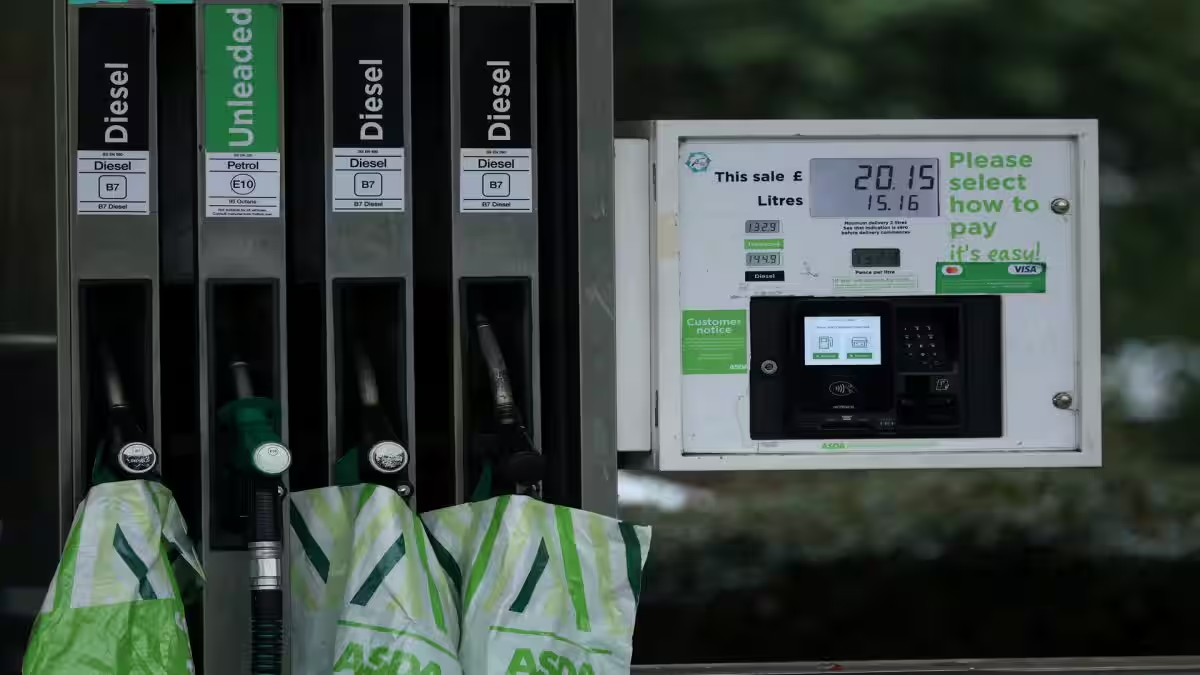
UK economy could contract in 2027 if the Strait of Hormuz remains closed into next year, EY warned, as higher energy prices could fuel inflation and weaken Britain’s recovery
The UK economy could contract in 2027 if the Strait of Hormuz remains shut until next year, EY warned, raising concerns that a prolonged energy crisis could fuel inflation and stall Britain’s fragile recovery.
The accounting firm said Britain’s economic outlook would depend heavily on how quickly shipping through the key energy route resumes. If the Strait of Hormuz reopens by the end of September, EY expects the UK economy to grow 0.8 per cent in 2026 and expand 1.2 per cent in 2027.
However, under a scenario where the disruption continues into early or mid-2027, the economy could shrink 0.2 per cent next year, while growth in 2026 would slow to 0.5 per cent.
“If the Strait of Hormuz reopens in the coming months, we expect the UK to avoid a more pronounced downturn, but an extended closure into 2027 would raise inflation and could push the economy into contraction next year,” said Peter Arnold, EY UK Chief Economist.
Prolonged energy disruption could reignite inflation
The Strait of Hormuz is one of the world’s most important energy transit routes, with a significant share of global crude oil and liquefied natural gas supplies passing through the narrow waterway.
 More from Business
A prolonged closure would likely push up global energy prices, increasing costs for businesses and households and adding pressure on inflation.
EY estimates inflation could rise to 6.4 per cent by the end of 2026 under the extended disruption scenario. This compares with a lower peak of 3.5 per cent if the Strait reopens within the next few months.
Higher energy costs could also weigh on consumer spending and business investment, making it harder for the UK economy to regain momentum.
Bank of England outlook less pessimistic
EY’s projections are more severe than the Bank of England’s latest adverse scenario.
The central bank had modelled a situation where oil and gas prices remain 30 to 60 per cent higher than markets expected. Even in that case, the Bank of England projected the UK economy would continue to grow by close to 1 per cent next year, while quarterly inflation would peak at 4.5 per cent.
EY expects the Bank of England to keep interest rates unchanged through 2026 before beginning to ease monetary policy next year.
The firm forecasts two rate cuts in April and July 2027, which would bring the benchmark interest rate down from 3.75 per cent to 3.25 per cent.
UK labour market shows signs of strain
The warning on economic growth comes as Britain’s labour market faces increasing pressure.
A survey by recruitment platform Indeed showed job postings fell 11 per cent between the start of 2026 and July 17. Vacancies were also 32 per cent below pre-pandemic levels.
“The UK’s labour market is under sustained pressure. Hiring demand is falling across most parts of the economy, while posted wage growth is gradually cooling,” said Jack Kennedy, senior economist at Indeed.
The slowdown has been particularly challenging for younger workers. Graduate job postings were down 7 per cent year-on-year as of July 10 and reached their lowest seasonal level since 2020.
Summer job postings, which include temporary and seasonal roles, were also at their weakest level in four years.
Advertised wage growth slowed to 3.9 per cent annually in the three months to June, the weakest pace since February 2022.
Demand for AI skills rises despite hiring slowdown
While overall recruitment weakened, demand for artificial intelligence-related skills continued to grow.
Indeed said AI tools and related programmes appeared in 9.4 per cent of UK job postings at the end of June, the highest share recorded so far.
The rise in demand for AI capabilities comes as businesses increasingly look to adopt automation and digital technologies despite a broader slowdown in hiring.
Britain has also been dealing with a worsening youth employment challenge since the pandemic, with more than one million people aged 16 to 24 currently not in education, employment or training, according to previously released data.
Last week, new Prime Minister Andy Burnham announced plans to align technical education and training programmes with local employment needs in an effort to improve job opportunities for young people.
With energy markets, inflation and employment conditions weighing on the outlook, the future path of the Strait of Hormuz disruption could prove critical for Britain’s economic recovery.
With inputs from agencies.














Leave a comment