
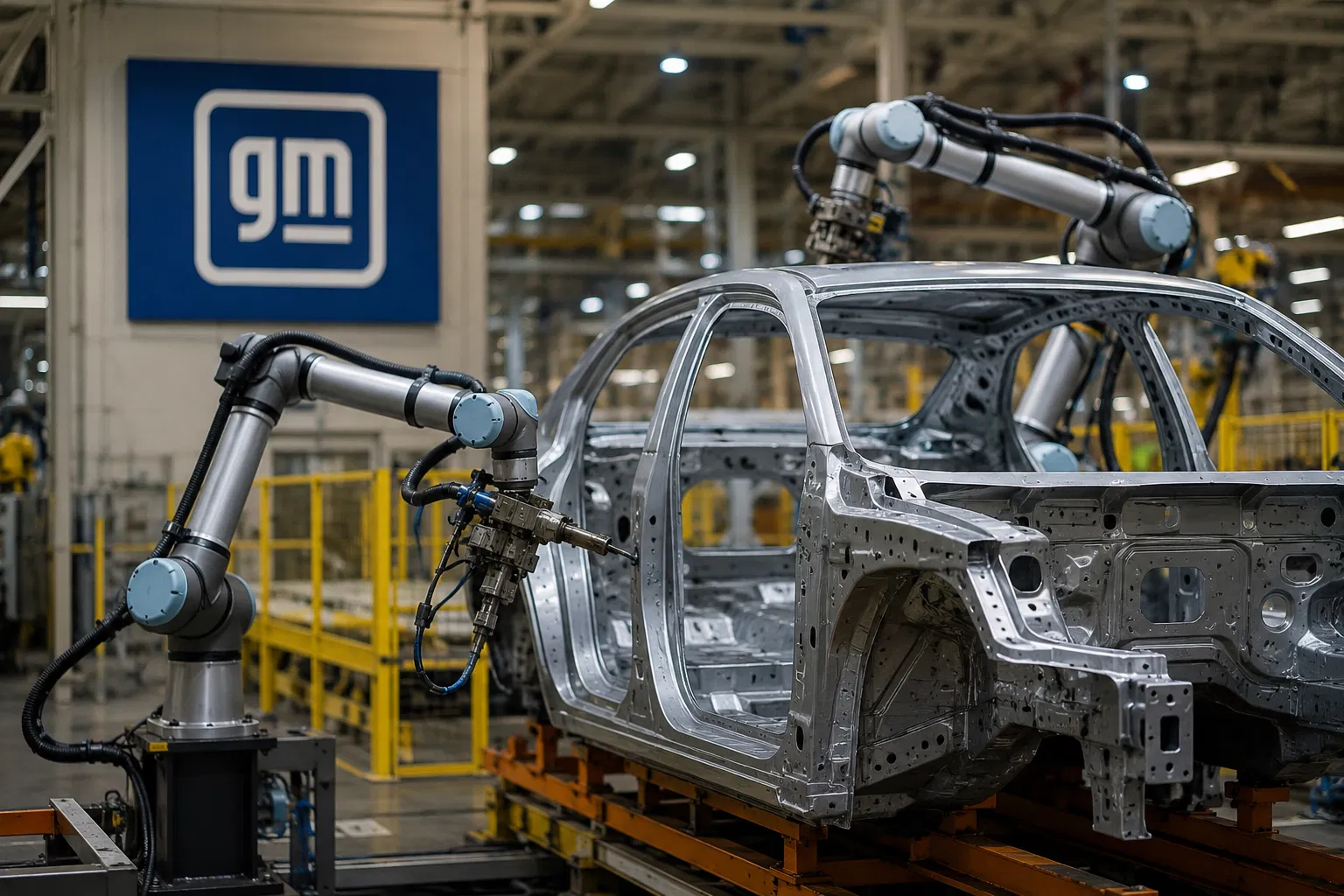
General Motors (GM) has expanded the deployment of collaborative robots, or cobots, at its Factory Zero assembly plant in Michigan, introducing around 50 robots to work alongside employees as part of its broader manufacturing automation strategy. The rollout has coincided with workforce reductions at the facility, with reports indicating that more than 1,000 workers have been affected.
Factory Zero is one of GM’s key electric vehicle production facilities, where the company is increasing the use of advanced manufacturing technologies while continuing to reshape parts of its workforce.
Cobots take on repetitive assembly tasks
The newly deployed cobots are assisting employees with repetitive production activities on the assembly line, including attaching vehicle body panels and supporting other manufacturing processes.
According to GM, the robots are designed to operate alongside workers rather than replace them.
Kevin Kelly, a company spokesperson, said GM has been expanding the use of collaborative robots across its manufacturing network as part of a wider effort to integrate advanced technologies into production.
Kelly said the technology is intended to:
- Improve workplace safety
- Reduce the physical strain associated with repetitive tasks
- Increase manufacturing flexibility
- Strengthen the competitiveness of production operations
GM also confirmed that some employees affected by the operational changes have been placed on temporary layoff, although the company has not provided a timeline for their return.
Workforce impact draws union scrutiny
The automation programme has prompted criticism from the United Auto Workers (UAW), which believes the increased use of cobots is reducing employment opportunities for union members.
According to Crain’s Detroit Business, James Cotton, President of UAW Local 22, said the union believes staffing levels are being reduced as collaborative robots assume more production work.
The union has also questioned GM’s position that the installations primarily improve workplace safety and has reportedly filed grievances over the deployment of the technology.
Separately, UAW President Shawn Fain has criticised the wider adoption of automation and artificial intelligence across manufacturing, saying productivity gains generated through technology should benefit employees rather than contribute to workforce reductions.
Automation expands alongside restructuring
The latest rollout comes as GM continues broader organisational restructuring across several parts of its business.
In recent months, the automaker has reduced headcount across its engineering and information technology functions while continuing to invest in automation, artificial intelligence and advanced manufacturing capabilities.
The developments reflect a broader transformation taking place across the automotive industry as manufacturers seek to improve production efficiency while accelerating the transition towards electric vehicles.
Key developments
According to GM and report cited by Crain’s Detroit Business:
- Around 50 collaborative robots have been deployed at Factory Zero
- The robots assist workers with repetitive assembly line operations
- More than 1,000 workers have reportedly been affected by workforce reductions at the facility
- Some impacted employees have been placed on temporary layoff
- GM says the technology is intended to complement employees rather than replace them
- The UAW has questioned the impact of the rollout on union jobs and filed grievances over the installations
Automation expected to remain central to manufacturing
The expansion of collaborative robotics at Factory Zero highlights the growing role automation is playing in modern vehicle production.
While GM maintains that cobots are intended to enhance workplace safety and support employees, the latest workforce reductions have intensified debate over how manufacturers balance productivity gains with employment.
With automotive companies continuing to invest in AI-enabled production systems and advanced robotics, automation is expected to remain a central issue in future labour discussions and manufacturing strategy.














Leave a comment