
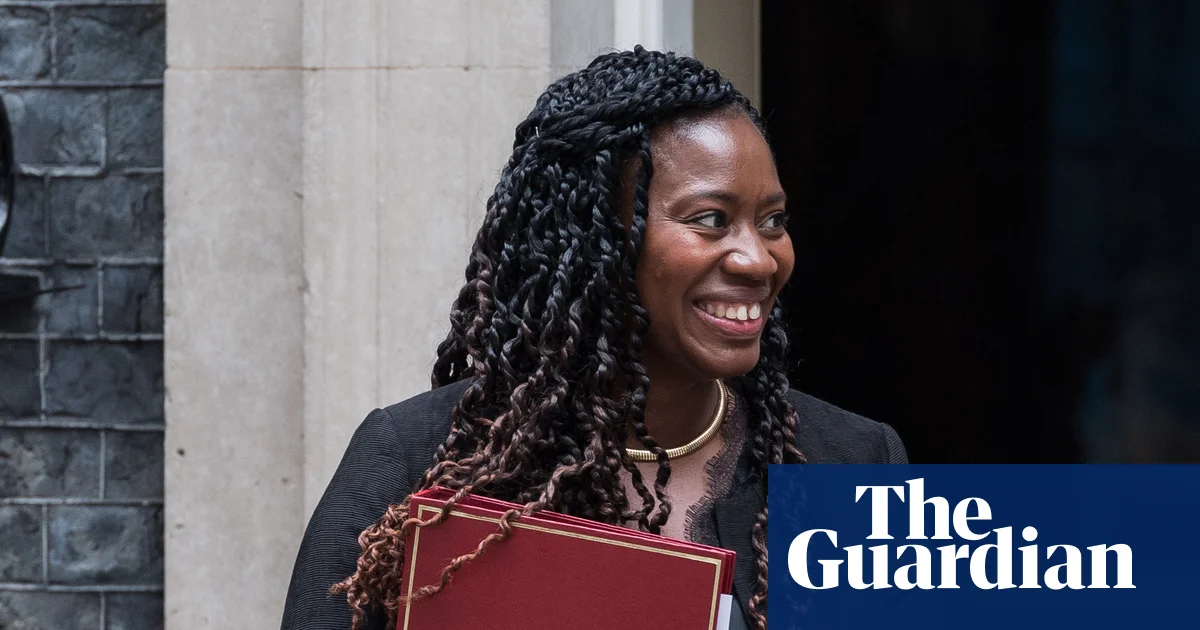
In her first 48 hours as energy secretary, Miatta Fahnbulleh was left in no doubt about the thorny policy decision at the top of her in-tray. Protesters from Fossil Free London met her outside her new offices dressed as firefighters holding placards reading: “We’re already putting out fires, don’t start new ones.”
The MP for Peckham – a radical economist who is outspoken about the climate crisis – is a surprising choice as secretary of state for energy and net zero for those who believe the speculation in Westminster that Andy Burnham wants to approve new oil and gas drilling in the North Sea.
Protesters outside the Department for Energy Security and Net Zero (DESNZ) on Wednesday were taking no chances on whether the rumours were correct, demanding in full voice that the new energy secretary scrap all new drilling.
The decision on whether to approve new drilling, most specifically at the Jackdaw and Rosebank fields off the north-east coast of Scotland, is one that Fahnbulleh’s predecessor and intellectual ally, Ed Miliband, may be relieved to have dodged – he has previously described the Rosebank licence as “climate vandalism”.
Jackdaw and Rosebank are not covered by the ban on new licences for North Sea drilling because their applications were already under way when Labour took office, and a government decision on whether to grant them has been long trailed.
However, people close to Fahnbulleh believe she has the skills, intellect and knowledge to challenge the much-disputed claims that drilling for more fossil fuels will bring the UK energy resilience.
“She is a hugely impressive person, she is an economist and has obviously risen up quickly through the ranks to become secretary of state,” said one source. “She will have a really good grip of a lot of the different issues.”
“The reality is that the science is very clear,” said Tessa Khan, executive director of the campaign group Uplift. “Burning the reserves in existing oil and gasfields will blow the global carbon budget and breach the 1.5C climate limit the government has committed to.”
Far from being a departure from the commitment to transition away from fossil fuels to clean energy, Fahnbulleh’s appointment is a continuation of the Miliband era, which drew rightwing attacks for his mission to decarbonise the UK’s power sector by 2030.
From 2017 to the end of 2023, Fahnbulleh led a policy thinktank widely considered the bible for radical economic thinking through the prism of climate, social justice and the environment.
The New Economics Foundation (NEF) coined the phrase “Green new deal” for a suite of policies to tackle the 2008 financial crisis, climate breakdown and soaring energy prices. As head of the NEF, Fahnbulleh was at the pinnacle of designing economic policies operating strictly within environmental limits and with social justice at their core.
In a joint report with Friends of the Earth in 2021, her organisation called for a total end to new drilling in the North Sea basin, the cancellation of all future licensing rounds, the revocation of all undeveloped licences and the rejection of any applications for development consent. Today, those who collaborated with her in the past are watching her first steps closely.
“She must hold the line against harmful fossil fuel expansion – including the highly contentious Jackdaw and Rosebank fields – make cheap, clean energy available to all and build on Ed Miliband’s efforts to scale up our renewable power capacity,” said Imogen Dow, energy lead for Friends of the Earth.
Fahnbulleh’s rise is meteoric. She becomes the only MP among the 2024 intake to be given a full cabinet position – a career path predicted by the New Statesman, who said she was “a natural candidate to join the frontbench” when they placed her in a guide that year to the 50 most influential people in progressive politics.
She was born in Liberia in 1979, where her father was a prominent politician. Aged six, Fahnbulleh came to Britain with her parents as asylum seekers fleeing the mounting tension that erupted into the first Liberian civil war. Her family successfully claimed asylum in the UK, settling in Tunbridge Wells, Kent, where she attended an independent school. “My childhood in Liberia had a massive impact,” she has said.
“You see abject poverty and extreme wealth, you see how the family you were born into affects your life and you understand why inequality is wrong. It’s not just that it perpetuates itself, it’s that it’s fundamentally wrong and it needs to be changed. And that’s my core, that pursuit of economic justice.”
She went on to study PPE at Lincoln College, Oxford, graduating in 2000, before pursuing an MA and then a PhD in economic development at the London School of Economics.
Fahnbulleh was a former adviser to Miliband before becoming an MP, and first joined the ranks of government as his deputy in DESNZ. After that, she became a minister at the Ministry of Housing, Communities and Local Government.
Fahnbulleh is one of the key policy brains in the Burnham cabinet and, like him, she champions the bottom-up approach of focusing economic growth in local communities, devolving resources and tax-raising powers.
“I think she is an excellent appointment,” said Laura Clarke, CEO of the global environmental law charity ClientEarth. “She has real expertise in both energy and the economics of it. And she absolutely understands the economic imperative of transitioning to a green economy as well as the energy security and social imperatives.”
As she treads her new path, Fahnbulleh will have to dodge accusations from the right of being a net zero zealot, and lobbying from parts of her own party and some trade unions to open up new North Sea drilling.
But the politician who was the first minister to resign after Labour’s disastrous local election results in May is not someone likely to be pulled in a direction she does not want to go.
“We have not acted with the vision, pace and ambition our mandate for change demands of us,” she told Keir Starmer in her blunt resignation letter. As the UK emerges from three unprecedented heatwaves, which saw wildfires across the country and broke all climate records, that task is now one upon which she will be judged.















Leave a comment