
| Updated:
The Bank of England should abort its costly approach to unwinding quantitative easing, which is stoking the government’s elevated borrowing costs and costing the taxpayer billions of pounds, a group of analysts and bond investors have said.
The government’s long-term borrowing costs have risen to levels not seen this century, amid unease at the country’s fiscal path and the inflationary impact of the Iran war. The yield on the 30-year gilt, the name for UK government bonds, was sent to its highest level since 1998 last month, while 10-year gilt yields remain close to post-financial crisis highs of more than 5.1 per cent struck in April.
The upward pressure on UK borrowing costs forms part of a wider sell-off of long-dated government bonds that last week led US Treasury secretary Scott Bessent to double its buyback of debt; an unusual move to keep long-term debt costs down.
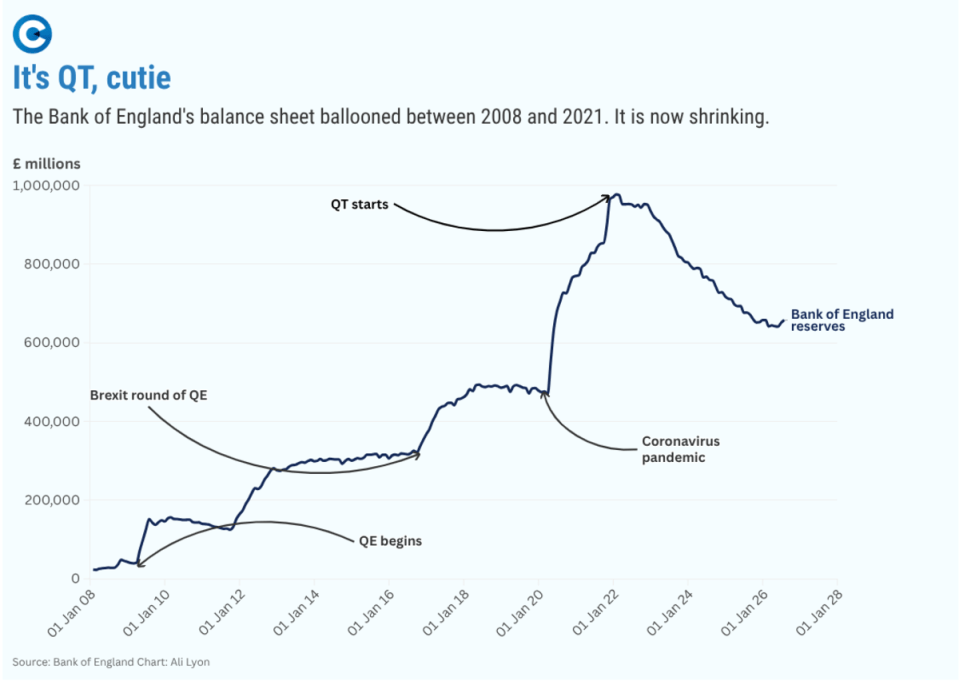
The market tumult – and Bessent’s subsequent intervention – has cast fresh scrutiny on the Bank of England’s unusual approach to reversing the more than £800bn of gilts it bought during the era of quantitative easing (QE).
The central bank is the only major monetary authority actively selling that stockpile of bonds, in a move that adds to the supply of long-dated gilts on the market and lowers their price, which moves inversely to their yield.
The process, known as ‘active quantitative tightening’, is different from those adopted by other central banks, which have mostly chosen to let their bonds mature without replenishing their reserves.
“At a time when the US government is using Treasury buybacks to support yields at the long end of the curve, it is reasonable to ask whether the UK still needs to be adding additional gilt supply through active sales,” said James Carter, co-head of fixed income at W1M. “The balance sheet can continue shrinking without actively selling bonds into the market.”
Bank of England officials have long argued that the central bank’s active approach to quantitative tightening (QT) was necessary given the government has historically issued a greater proportion of longer-dated bonds. Without active sales, its QT programme would therefore have taken longer than those of the Federal Reserve and European Central Bank, as the bonds on its balance sheet would take longer to mature.
Governor Andrew Bailey launched a staunch defence of the controversial approach, arguing in May that it would give the Bank the firepower to launch another round of QE “if needed”. But a growing number of City analysts believe that given it has shrunk the size of its balance sheet by nearly half since the programme was first launched four years ago, the central bank should end active sales at an eagerly anticipated vote next month.
Neil Wilson, investor strategist at Saxo UK, told City AM the case for continuing active QT was “rather weak”, given the Bank of England has already unwound £400bn of QE-era bond buying “and is approaching balance sheet level of 2022”.
“QT should have been ended months ago,” added Damian Pudner, senior research fellow at the Great British Think Tank. “The Bank of England has shown itself behind the curve yet again.”
The Bank raised its estimates of the impact of QT on long-term borrowing costs at last month’s Monetary Policy Report. Officials said they now believe the programme has added up to 30 basis points – or a third of a per cent – onto the yields of long-dated bonds, and acknowledged it has “accounted for a modest increase in long-term interest rates”.
Bank of England bond sales piling pressure on public finances
Separately, the Bank is facing a growing backlash over the added pressure QT is putting on public finances.
Other central banks have opted to keep losses from their respective programmes on their own balance sheet before spreading out the bill to their government over time. But under an agreement between then governor Mervyn King and Chancellor George Osborne, the taxpayer is responsible for covering the vast losses incurred by the central bank’s effort to shrink its balance sheet immediately, blowing a hole worth tens of billions of pounds into the public finances each year.
Defenders of the arrangement say the taxpayer benefited from years of quantitative easing, and consequently should foot the bill during its unwinding. But official Bank of England estimates suggested losses from the QT are now expected to reach as much as £125bn, enough to fund the Department for Education’s budget for two years.
“The strongest argument for slowing active QT is increasingly fiscal rather than monetary,” W1M’s Carter said. “Selling gilts today crystallises losses immediately for the Treasury, whereas allowing bonds to mature spreads that burden over time.”
The Bank of England sets its path for bond disposals the year ahead every September. Last year, the rate-setting Monetary Policy Committee voted to shrink its balance sheet by £75bn, down from £100bn the previous two years.
In a note published last week, Deutsche Bank analysts predicted the committee members would next month vote to slow that pace again to just £50bn alongside a move to halt active sales entirely.
“The case to go further on reducing long bond sales has strengthened,” they wrote. “We think that the Bank will drop long bond sales altogether or, at a minimum, reduce its allocation of long bond sales further to reflect current market conditions.”















Leave a comment