
Car giants including Volkswagen, Vauxhall and Ford have seen their sales take a hammering in recent years.
But it’s not because motorists are falling out of love with the established brands they’ve known and trusted for decades.
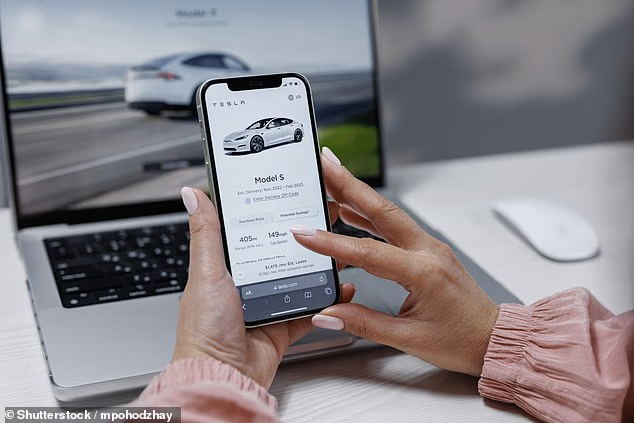
Instead, British car buyers are increasingly choosing their next set of wheels using an Amazon-style approach, and it has helped a fresh wave of Chinese competition thrive.
Research by automotive data technology experts Vehicle Data Global (VDG), exclusively shared with This is Money, has found that almost all motorists now begin their car-buying journeys online, comparing models before visiting dealerships or showrooms.
And previously unknown Chinese brands have been able to gain traction online in much the same way Chinese-made products established their dominance on Amazon.
VDG says the switch to electric vehicles has accelerated this trend.
Operations director Ben Hermer tells us: ‘Car buyers are increasingly applying their online shopping habits, developed through buying electronics and household products from unfamiliar online brands on Amazon, to their car-buying process.’

This is Money reveals that British car buyers are choosing their next set of wheels through an Amazon-style approach: Here’s how EVs and Chinese brands are hooking motorists online
In the decade between 2015 and 2025, Ford fell from the UK’s most popular car brand to third overall.
But that decline is nothing compared with Vauxhall, which has tumbled from second place to 13th.
The former favourites have seen their registrations cannibalised by increasing competition, with sales down 64 per cent and 70 per cent respectively.
Even Volkswagen, last year’s market leader, recorded registrations 19 per cent lower than a decade earlier.
VDG’s analysis of car brand fortunes over the past two decades suggests the decline of some of Britain’s household automotive names reflects a broader shift in consumer behaviour, as researching and shopping online becomes the norm.
In particular, the move to EVs has intensified the pressure on traditional car giants by positioning vehicles more like feature-rich consumer goods, making comparisons easier than ever.
Hermer said: ‘Electric cars lend themselves particularly well to feature comparisons in the same way that household and other consumer products are assessed on Amazon, with buyers keen to compare range, charging speed, battery capacity and features such as cabin screen quality and driver-assistance equipment alongside traditional considerations such as warranty length and finance terms.
‘This has favoured Chinese manufacturers, who come from an existing culture of providing long lists of standard features, compared with established manufacturers that have tended to bundle many of their most advanced technologies into costly option packs.’
This has enabled relatively unknown brands to compete for attention from the outset on the basis of value.
As a result, motorists are increasingly adopting an Amazon-style comparison mindset when shopping for a car, rather than relying on the brand loyalty that once guided many buying decisions.

Today, the car marketplace is overflowing with unfamiliar but highly specified and affordable Chinese products, mirroring how Amazon changed the way consumers shop
Join the discussion
Are you loyal to traditional car brands, or do features and price now matter more when choosing your next car?
How Amazon-style buying benefits Chinese brands
Back in the sixties and seventies, vehicle choice was largely limited to familiar manufacturers, with many drivers remaining loyal to the marque they had always owned.
Today, the marketplace is overflowing with unfamiliar but highly specified and affordable Chinese products, mirroring the way Amazon transformed consumer shopping habits.
VDG compares the pressure facing car brands and dealerships to the challenges experienced by the High Street in its battle against online retail.
But it isn’t the growth in online car purchasing, the most obvious Amazon comparison, that has had the greatest impact on the automotive market, VDG says.
Instead, the bigger influence has been increased competition based on price, specification, availability and digital appeal.
Hermer explained: ‘Facing several years of increased living costs, car buyers increasingly favour Chinese manufacturers, which tend to provide long equipment lists and exciting technological features as standard.
‘Cars are increasingly becoming bundles of searchable features, which for some buyers may be more important than longstanding engineering pedigree, handling character and brand history.
‘As a result, the Amazon-style research process has conditioned many consumers to respond to instantly eye-catching promises, such as “360-degree camera included.”‘

Many new Chinese car companies are owned by the same parent group despite operating under different brands. One of the most prominent examples is Omoda and Jaecoo, with the latter producing the best-selling Jaecoo 7
Amazon-style brand choice: Not as it seems
In the same way Amazon gives the impression of almost limitless brand choice and competition, many seemingly independent products actually come from the same factories or corporate groups. VDG says the same pattern is now emerging in the car market.
The most prominent example is Omoda and Jaecoo, both Chery brands, with the latter producing the ‘Temu Range Rover’ Jaecoo 7 SUV. Together, they have sold more than 100,000 cars in the UK despite only celebrating their second anniversary in August.
Similarly, Chinese automotive giant Geely owns famous marques including Volvo, Polestar and Lotus.
Hermer said: ‘Although it appears at first sight that car brands are proliferating, they are typically originating from widely shared technology and a relatively small number of platforms, battery manufacturers and parent companies.
‘So, while it has often been said that online car buying was the main legacy of Amazon, the reality is that the shift in the car market has been deeper: from a limited choice of familiar brands towards a marketplace filled with unfamiliar but attractive Chinese products competing through price, features, fast availability and digital appeal.
‘Marques such as Ford and Vauxhall have therefore experienced dynamics similar to those faced by electronics brands such as Sony and Philips, which have increasingly been challenged for market share by strong value-for-money newcomers.’

Britain stands out in Europe because it chose not to impose duties on Chinese-made EVs, making the UK a much more attractive market for Chinese brands than the EU
Chinese car companies enjoy tariff-free EV sales
Britain stands out in Europe because it chose not to impose duties on Chinese-made EVs, making the UK a much more attractive market for Chinese brands than the EU.
Countries across Europe have imposed tariffs of between 7.8 per cent and 35.3 per cent on Chinese-made EVs in response to concerns that China’s EV supply chain benefits from substantial state support.
However, despite these factors, VDG says legacy brands ‘still have a real advantage’ thanks to their ‘expertise in managing the used market, residual values, parts supply and logistics chains’.
Hermer added: ‘None of this means that the game is over for the traditional automotive giants, which are still adjusting to the new conditions.
‘Just as Amazon’s marketplace is characterised by rapid entry, intense price competition and the frequent disappearance of products, we believe that not all of the current Chinese brands will necessarily achieve the scale needed to maintain long-term success.’















Leave a comment