
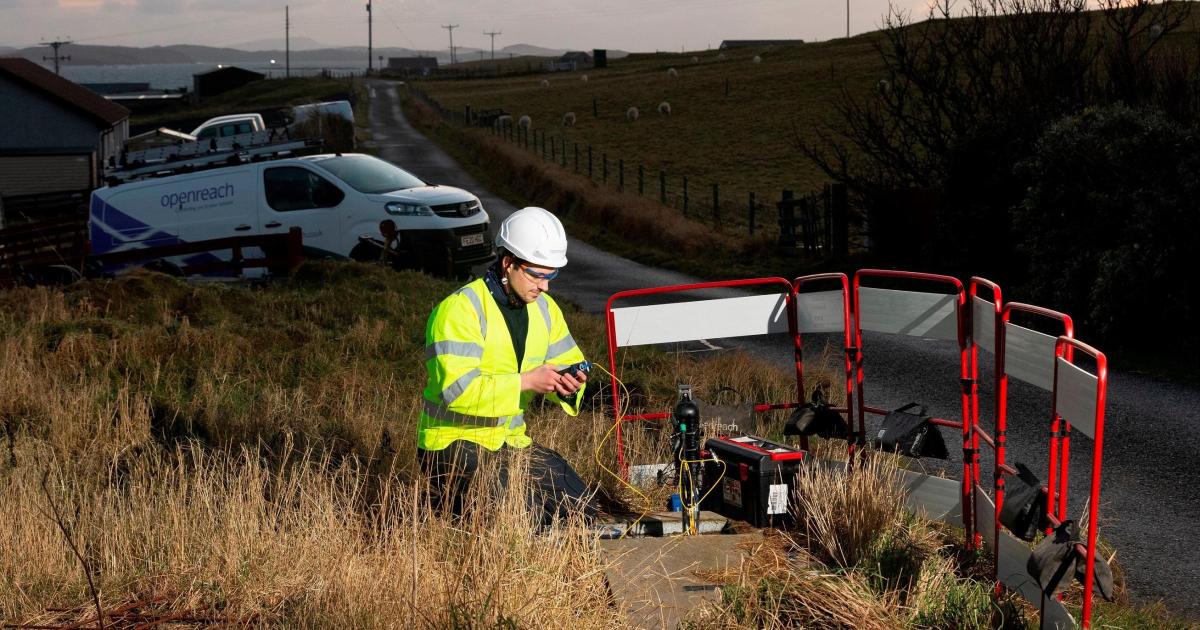
It found that only 54% of rural consumers have access to the fastest gigabit-capable broadband compared with 89% of urban consumers in Scotland – the largest urban-rural divide anywhere in the UK.
The UK Government has invested £800 million and the Scottish Government £600 million in the roll-out of gigabit-capable broadband over recent years.
Read More:
The Scottish Government’s National Islands Plan also includes important measures to monitor broadband delivery to identify gaps in gigabit-capability and inform discussions with providers, industry and the UK Government on future connectivity investments.
However, Consumer Scotland’s report found that significant gaps in access and coverage currently remain.
In Aberdeenshire, Argyll & Bute, the Western Isles, the Orkney Islands and the Shetland Islands, less than half of all premises have access to gigabit-capable broadband.
Angus, Dumfries & Galloway, Highland, Moray and Perth & Kinross also have lower levels of access, with fewer than 70% of premises able to access gigabit-capable broadband.
The report also showed that 51,211 premises in Scotland cannot access the minimum broadband speeds set out under the UK Government’s Universal Service Obligation (USO), with the vast majority (43,602) in rural areas.
Read More:
Challenges also remain in the mobile market, according to the study. Scotland has the highest proportion of landmass without 4G mobile coverage in the UK, with 9% lacking coverage compared with a UK average of 4%. 5G availability also lags behind other UK nations.
Fraser Stewart, head of Consumer Markets at Consumer Scotland, said people in rural areas risked being left behind.
“Telecommunications services are essential to how people access healthcare, education, banking, work opportunities and vital public services,” he said.
“They also enable businesses to operate efficiently, communicate with customers and suppliers, access digital markets and remain competitive in an increasingly online economy.
“While positive progress has been made in extending broadband and mobile coverage across Scotland, consumers in too many rural areas across Scotland continue to experience slower or more limited services that those in urban areas.”
He added: “As the range of goods and services that consumers can access through digital technology becomes rapidly more sophisticated, there is a risk these consumers are being left behind unless the technology roll out can keep up.
“Improving connectivity, strengthening digital inclusion and ensuring consumers can access fast, affordable services will help people participate fully and equally in Scotland’s economy and society.”
Consumer Scotland has made a series of recommendations including:
• An immediate review of the Broadband Universal Service Obligation by the UK Government, with minimum speeds increased to at least superfast broadband levels.
• Clearer information for consumers on plans to extend gigabit-capable broadband including when different technologies are expected to be available in their area.
• Better information and support for consumers during network upgrades and technology transitions.
• Action to improve access to affordable devices, connectivity and digital support.
• Consideration of free access to essential public service websites without using mobile data allowances.
The report also underlined a need for better support for consumers during the retirement of older telecommunications technologies, including the transition away from legacy landline services and older mobile networks.
Consumer Scotland is calling for clearer information and communications to help consumers understand upcoming changes and the actions they may need to take.
It also found that affordability of the service remains a concern with awareness and uptake around social tariffs support for some households remaining low.
In 2024 the UK Government committed £800 million toward achieving full gigabit coverage across Britain.
The UK Government’s Project Gigabit aims for 99% of premises to have access to a gigabit-capable connection by 2032.
The Scottish Government has committed £600 million investment as part of its Reaching 100% (R100) programme which aims to bring faster broadband, including gigabit-capable broadband, to hard-to-reach premises across Scotland.
Scottish Government Minister for Business and Fair Work Tom Arthur said: “While telecoms responsibility is reserved to the UK Government, the Scottish Government is acutely aware of the need to ensure people and businesses in rural areas can access good quality, reliable connectivity.
“It’s precisely why we are investing £600 million to roll out gigabit-capable broadband in some of the country’s hardest-to-reach communities through our R100 programme.
“We are also managing the delivery of Project Gigabit contracts in Scotland, working closely with the UK Government to align rollout with our R100 programme and maximise broadband coverage. This coordinated approach helps ensure public investment is targeted effectively and delivers the greatest possible benefit for communities across Scotland.
“Our ambitious 4G Infill programme brought life-changing 4G services to thousands of homes and businesses throughout the country, with the £28.75 million project delivering 55 mobile masts in some of Scotland’s hardest-to-reach communities.”
A UK Government spokesperson said: “Digital connectivity should be available across the UK, why is why we are bringing faster broadband and better mobile coverage to Scotland’s rural and island communities.
“Gigabit-capable broadband now reaches 82% of Scotland’s premises, while 22 Shared Rural Network masts have been activated in Scotland this year alone, helping bring better mobile coverage to rural island communities.”
Consumer Scotland is the statutory body for consumers in Scotland.















Leave a comment