
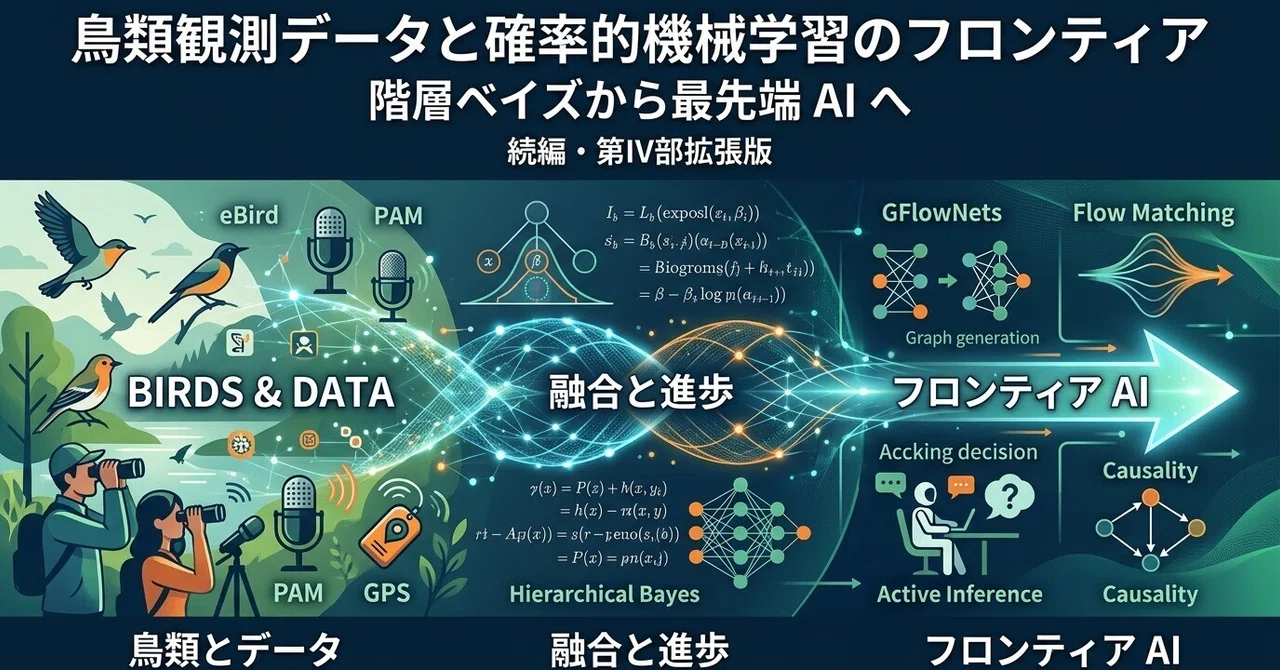
The Frontier of Avian Observation Data and Probabilistic Machine Learning
—From Hierarchical Bayes to Causal, Geometric, Active Inference, and Open-Endedness
Sequel: Part IV Extended Edition
Preface
Birds are one of the most well-observed biological groups on Earth. The reason for this is not merely their ecological appeal. Birds possess observational characteristics that make them “easy for humans to observe”: they are diurnal, vocalize, are relatively large, move, and above all, are accessible. This ease of observation, combined with the explosive growth of citizen science since the end of the 20th century, has created a multi-layered, multi-modal data infrastructure. This includes hundreds of millions of observation records represented by eBird, continuous acoustic data from Passive Acoustic Monitoring (PAM), individual trajectories from GPS bio-logging, wide-area migration observations via weather radar, and environmental descriptions from satellite remote sensing.
However, this data infrastructure does not provide ecological knowledge on its own. Avian observation data is inherently “incomplete.” The fact that something was not observed does not mean that a bird was not there. Observation effort is uneven in both space and time, observer skill and attention vary systematically, and detection probability fluctuates depending on species, weather, vegetation, time of day, and season. Therefore, inference from “observed counts” to “true distribution, population size, and dynamics” always requires a statistical bridge.
The classical framework for this bridge consists of hierarchical Bayesian models, occupancy models, and state-space models, which have been at the center of statistical ecology for the past 20 years. Part I of this book begins by reaffirming this classical foundation. However, the main focus of this book is not there. The main focus of this book lies beyond that.
The challenge of dealing with the incompleteness of observations is, in fact, structurally identical to the challenges being tackled head-on at the forefront of machine learning. Marginalization of latent variables, computability of posterior distributions, quantification of uncertainty for out-of-distribution data, generation in high-dimensional, non-Euclidean spaces, searching through combinatorially explosive discrete structures, and modeling agents that actively acquire information while interacting with their environment—these are all requirements for inference from avian observation data, and at the same time, they are what cutting-edge mathematical engines such as GFlowNets, Flow Matching, probabilistic circuits, active inference, and probabilistic foundation models are attempting to solve.
This book, “The Frontier of Avian Observation Data and Probabilistic Machine Learning,” aims to fuse these two intellectual traditions on the common data foundation of avian observation data. After establishing a three-layered foundation in the first half (Part I, Part II, and Part III)—observational incompleteness, generative models and modern inference engines, and the mathematics of structure and behavior—the second half (Part IV) ventures into five frontier domains: causality, rigor, geometry and thermodynamics, behavior and embodiment, and evolution and ecosystems.
This book is positioned as a sequel and an extended edition of Part IV. While the previous work covered the junction between hierarchical Bayes and modern generative models, this edition significantly expands Part IV and details three of the newest chapters as frontier chapters: causal graph discovery and counterfactual inference, Flow Matching on Riemannian manifolds and thermodynamic generation, and deep active inference and open-ended co-evolution.
Guide for the Reader
This book assumes three types of readers. First, graduate students and researchers who specialize in ecology and conservation biology and wish to learn statistical and machine learning methods systematically. Second, researchers and engineers who specialize in machine learning and are seeking applications grounded in real data (eBird, PAM, GPS). Third, practitioners involved in conservation policy and environmental assessment who require counterfactual evaluation and rigorous communication of uncertainty.
The first type of reader should read through from Part I. The second type of reader should start from Part II and refer to the notation in Part I as needed. For the third type of reader, it is also effective to read Chapter 10 (Causality and Counterfactuals) and Chapter 12 (Open-Endedness) first, and then return to other chapters according to their interests.
Notation Conventions
Throughout this book, random variables are represented in upright font (e.g., $Y$), their realized values in lowercase (e.g., $y$), and parameters in italics (e.g., $\theta$). Data sets are represented by $\mathcal{D}$, parameter spaces by $\Theta$, and latent variables by $Z$ or $z$. Manifolds are represented by $\mathcal{M}$, their tangent spaces by $T_x\mathcal{M}$, and Riemannian metrics by $g$. The intervention operator in the ladder of causation is represented by $\mathrm{do}(\cdot)$, and counterfactuals are represented by the subscript $y_{x}$ (the value of $Y$ “had $X=x$ been the case”). Free energy is represented by $\mathcal{F}$, and KL divergence by $D_{\mathrm{KL}}(\cdot,|,\cdot)$. Abbreviations used in figures and the text are collected in the list of symbols at the end of the volume.
Basic Concept of This Book
This book is a systematic academic text for applying the frontier mathematics of probabilistic machine learning to the four essential challenges faced by avian observation data (citizen observations eBird, passive acoustic monitoring PAM, GPS bio-logging, weather radar, and satellite remote sensing): “observational incompleteness,” “high-dimensional non-Euclidean nature,” “complex interspecies and environmental interactions,” and “the need for counterfactual conservation interventions.”
It bridges avian ecology to five frontier domains—causality, rigor, geometric thermodynamics, embodied behavior, and open-ended co-evolution—via advanced generative and inference engines such as GFlowNets, Flow Matching, active inference, and probabilistic circuits, starting from existing classical methods such as hierarchical Bayes, occupancy models, and state-space models.
Five Frontier Application Resolutions in Avian Observation Data
                       [ 鳥類観測・保全データ統合プラットフォーム ]
                                          │
    ┌─────────────────┬──────────────────┼──────────────────┬─────────────────┐
    ▼                 ▼                  ▼                  ▼                 ▼
【1. 因果の軸】    【2. 厳密性の軸】     【3. 幾何・熱力学の軸】 【4. 行動・身体性の軸】 【5. 進化・生態系の軸】
 構造的因果モデル   確率回路 × Deep      多様体 Flow Matching  深層 Active Inference  オープンエンド共進化
 × GFlowNet/PC     (Tractable Foundation) × 熱力学計算       × 形態形成             GFN × Active Inf.
    │                 │                  │                  │                 │
 観測バイアス補正   音響BioCLIPハルシ   地球球面/風向場多様体  GPSトラックに基づく    気候変動下における
 ・反事実保全介入   ネーションゼロ化    上の渡り軌跡推論     能動的ナビゲーション   鳥類相再編・群集遷移
The five axes are not independent. For the causality axis (Chapter 10) to address the “effects of interventions,” the computability provided by the rigor axis (Chapters 6 and 10) is necessary, and its estimation is performed on the spatial representation provided by the geometry axis (Chapter 11). The behavior axis (Chapters 8 and 12) connects the microscopic mechanism of individual decision-making to the macroscopic, open-ended co-evolution provided by the evolution axis (Chapter 12). The entire book attempts to penetrate the interconnections of these five axes from a consistent mathematical perspective—specifically, the perspective of “tractability of the posterior distribution.”
Mapping Mathematical Methods to Avian Observation Data and Ecological Challenges
| Frontier Domain | Mathematical Engine Employed | Corresponding Avian Observation Data Source | Essential Ecological Challenge Resolved |
|—|—|—|—|
| 1. Causal Frontier | SCM × GFlowNets × Probabilistic Circuits | Citizen Science Data (eBird, BirdGrid), Environmental GIS | Complete separation of observation effort bias, rigorous evaluation of counterfactual conservation effects such as protected area designation |
| 2. Rigor Frontier | BioCLIP / BirdNET × Probabilistic Circuits | Passive Acoustic Monitoring (PAM), Camera Trap Images | Elimination of foundation model misidentification (hallucinations), strict reliability guarantees based on logical constraints |
| 3. Geometry & Thermodynamics | Riemannian Flow Matching × Thermodynamic Calculation | GPS Biologging, Ultra-miniature Geolocators, Weather Radar | Accurate migration trajectory interpolation on spherical and wind-field manifolds, inference of metabolic energy minimization paths |
| 4. Behavior & Embodiment | Deep Active Inference × SE(3)-GFN | High-precision Accelerometer Loggers, 3D Drone Observations, Video Tracking | Elucidation of avian navigation decision-making mechanisms, spatial geometric modeling of flocking |
| 5. Evolution & Ecosystems | GFlowNets × Active Inference | Wide-area Ecosystem Monitoring, Phylogenetic Trees/DNA Metabarcoding | Prediction of future avian fauna and community open-ended reorganization due to climate change, transcending single static models |
Originality and Academic Value of This Book
Bridging Concepts (Ecology meets Frontier AI). It fully integrates ‘hierarchical models in statistical ecology’ and ‘cutting-edge probabilistic machine learning (GFlowNets, Flow Matching, Probabilistic Circuits, Active Inference),’ which have traditionally been discussed separately, on the common data foundation of avian observation data.
A Consistent Perspective on ‘Posterior Distribution Computability’. It systematizes everything from the computational limits of MCMC to the tractability of probabilistic circuits, the continuous transformations of Flow Matching, the combinatorial posterior sampling of GFlowNets, and thermodynamic calculations as a ‘spectrum of computability’ with high resolution.
A Practical Path from Field Data to Cutting-Edge Mathematics. Rather than merely listing mathematical methods, it presents concrete algorithmic expressions that derive causal inference and manifold calculations from specific data formats such as eBird, PAM (acoustic), and GPS loggers.
Overall Structure (4 Parts / 12 Chapters)
『鳥類観測データと確率的機械学習のフロンティア』
  ├── 第I部:古典的階層モデルと観測の不完全性(基盤)
  │     ├── 第1章:階層ベイズ・Occupancy Model による検出不完全性の補正
  │     ├── 第2章:状態空間モデル(SSM)による渡り・個体群動態推論
  │     └── 第3章:空間点過程(Spatial Point Process)と市民観測バイアス
  ├── 第II部:生成モデルと現代推論エンジン(確率的機械学習)
  │     ├── 第4章:変分オートエンコーダ(VAE)と Diffusion / Flow Matching による時空間補間
  │     ├── 第5章:GFlowNets による鳥類群集・食物網の離散構造生成
  │     └── 第6章:確率回路(Probabilistic Circuits)による周辺尤度の厳密計算
  ├── 第III部:構造と行動の数理(等変性と意思決定)
  │     ├── 第7章:SE(3) / SO(3) 等変 GFN による鳥類バイオロギングと 3D 空間構造
  │     ├── 第8章:能動的推論(Active Inference)による個体行動と移動のモデル化
  │     └── 第9章:マルチモーダル観測データ(音声・画像・レーダー)の確率的統合
  └── 第IV部:確率的機械学習のフロンティア(先端応用)
        ├── 第10章:因果グラフ発見と反事実確率回路(Causal Discovery & Counterfactual PCs)
        ├── 第11章:多様体上の Flow Matching と熱力学的生成モデル(Riemannian & Thermodynamic Flow)
        └── 第12章:深層能動的推論とオープンエンド共進化モデル(Deep Active Inference & Open-Endedness)














Leave a comment