
KEY POINTS
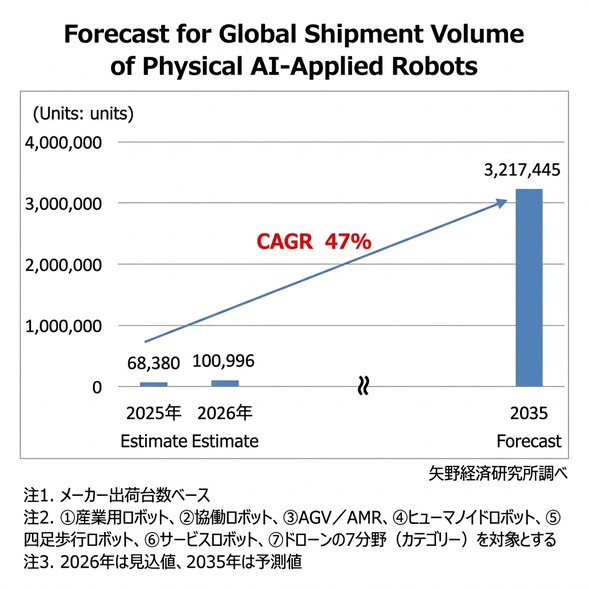
- Yano forecasts annual global physical AI robot shipments of about 3.21 million units in 2035.
- The 2026 forecast is about 100,000 units, up 47.7% from roughly 70,000 in 2025.
- System integration and the use of operational data are expected to play a growing role in competition.

Yano Research Institute Ltd.
Global shipments of robots equipped with physical artificial intelligence are forecast to reach about 3.21 million units in 2035, Yano Economic Research Institute said on November 13, 2026, as demand grows for machines that can adapt to changing environments and tasks.
The Japanese research firm projects shipments of about 100,000 units in 2026, up 47.7% from roughly 70,000 in 2025. Its longer-term forecast reflects demand to address labor shortages and rising personnel costs, improve productivity and maintain manufacturing competitiveness, particularly in tasks that conventional, fixed-pattern automation cannot readily handle.
The market remains largely at the demonstration and early commercialization stages, according to Yano. Pioneering suppliers and customers are testing performance and economics in specific tasks or restricted environments.
Yano defines physical AI as an autonomous system that perceives its surroundings, reasons and makes decisions, then translates those decisions into actions by robots or other machinery. Feedback from those actions informs subsequent decisions, enabling adaptation to environmental changes.
Industrial and collaborative robot developers are testing AI functions to extend automation. Developers of automated guided vehicles and autonomous mobile robots are improving autonomous navigation and task coordination. Trials and development of humanoids, quadruped robots, service robots and drones target environments where object positions, shapes and surrounding conditions vary.
The forecast covers these seven categories and measures annual manufacturer shipments, not the total installed robot population. It counts newly introduced robots from 2025 onward only if AI-based perception and decision-making directly inform physical actions or control at deployment. AI-capable chips or cameras alone do not qualify: AI output must affect activities such as movement, grasping, transport, assembly, flight or inspection.
Yano conducted the research from May through August 2026 using direct interviews, including online meetings, and literature research. It covered robot and component manufacturers, AI companies, systems integrators, robot users, government agencies, universities and research institutions.
Yano expects competitive advantage to depend increasingly on system integration rather than individual hardware performance or control precision. Linking sensing, AI inference, control and actuation allows robots to adjust their behavior to operating conditions. The ability to collect operational data and continually optimize hardware and software is also expected to become more important.













Leave a comment