
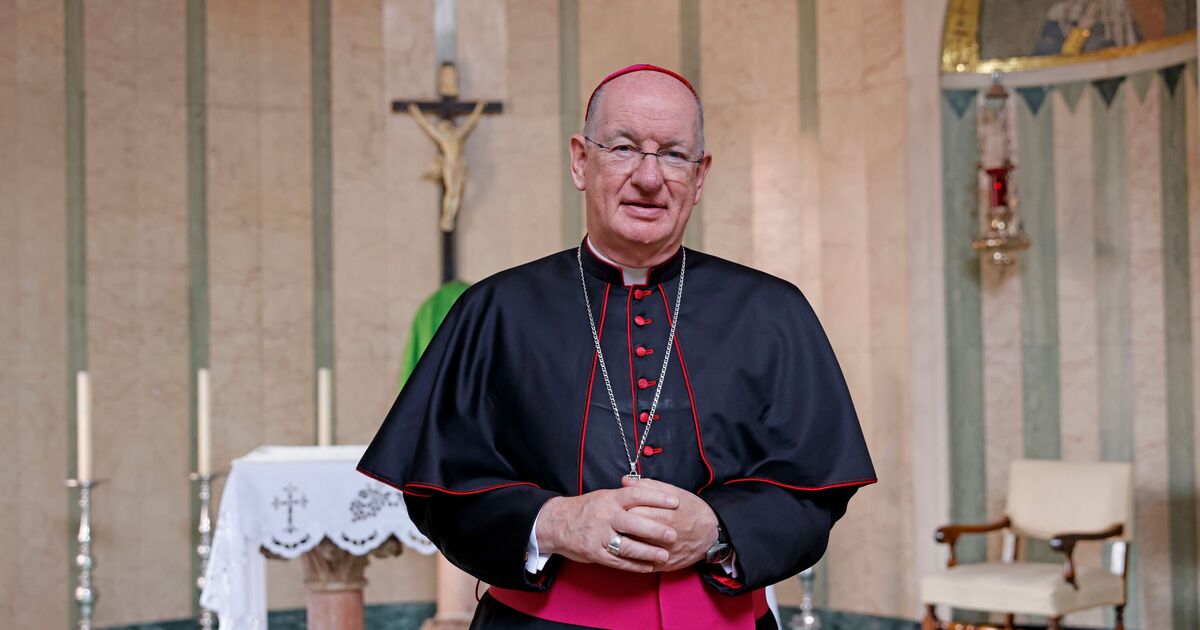

The new Archbishop of Westminster Richard Moth (Image: Jonathan Buckmasterr)
The UK’s new Catholic Church leader has told the Express how US President Donald Trump posing as an AI-version of ‘Jesus Christ’ left him “deeply sad”. But Archbishop Richard Moth, the new head of the Catholic Church in England and Wales, said the world must consider the “consequences” of artificial intelligence, as it must serve humanity: “Not the other way around.”
He is set to meet Andy Burnham, the UK’s first Catholic PM, and will raise his own concerns over homelessness but addressing all world leaders the archbishop stressed: “Governments are at the service of the people. “Those in politics need to use language carefully. Soundbites have an impact in the short term but won’t be impactful in the long term.”

Trump portrays himself as Jesus Christ with AI-generated image (Image: @realDonaldTrump/Truth Social)
Inside the sumptuous Archbishop’s House, by Westminster Cathedral in Victoria, London, Richard Moth looked relaxed as he greeted the us and offered to later pose in full ecclesiastical vestments and purple fascia and cassock.
Later sat in a cosy armchair, the newly-appointed Archbishop of Westminster discussed his fears over AI, social media and global conflict – but also his hope with Gen Zs seeking faith and church pews filling up again after Covid.
Last Monday, Pope Leo fired a shot across Trump’s bow by saying concerns AI could destroy the world are not “fake news” and slammed CEOs who want no guardrails on the technology.
Archbishop Moth agreed: “AI can help but it’s got to be at the service of humanity not the other way around. I fully understand that people are nervous about it.
“Someone said to me a while ago, do you use AI to write your sermons? I said absolutely not! Work itself has a dignity and that’s something you mustn’t lose sight of.”
So does he want an AI slowdown? He replied: “I think we need to be very considered. Yes, sometimes you can go too fast with things.
“When the printing press was invented they didn’t think about the consequences. We developed the World Wide Web. Who owns this stuff? This is something humanity always does. We don’t learn the lessons of our own history.
“And because AI will help us to do things even faster than we had before, we need to think about the consequences.”
In April, Trump posted an AI picture on his Truth Social account as Jesus Christ, wearing flowing red-and-white robes with glowing light coming from his hands, healing a sick man in hospital.
It came after Pope Leo attacked Trump’s threats to Iran that “a whole civilization will die tonight never to be brought back again” if a deal was not reached to open the Strait of Hormuz.

Archbishop Moth speaks to the Express (Image: Jonathan Buckmaster)
The archbishop told us he was “very saddened” about Trump’s Christ-like post which he hastily deleted the next day following a huge backlash.
He added: “I understand why people of any faith would say that is an inappropriate thing to do. It’s part of the use of social media that we’re seeing so often and used in all sorts of ways – quite a lot of it unfortunate and deeply sad. Some of it very damaging.
“But when I saw it, my initial reaction was I was deeply sad. I was saddened by it. It’s not what the Gospel is about. It was an abuse of the image of the saviour. That was pointed out to him and that’s why it disappeared relatively quickly!”
On Trump’s verbal sparring with Pope Leo, the archbishop said: “It’s very interesting that Pope Leo – when he makes statements relating to world peace or climate change – he doesn’t mention individuals.
“If a world leader recognizes that some of what the Holy Father has to say might be about him, then he’s taking the Pope’s message and applying it to himself.
“So, when President Trump was critical of Pope Leo, we had that statement ‘I’m not frightened of the President of the United States’.
“Everybody in politics is at the service of humanity. If you say something that is not at the service of our brothers and sisters, it’s not very helpful.
“Those engaged in politics at every level need to use language carefully and in a way that builds up and does not destroy.”
On Pope Leo he remarked: “Having met the Holy Father on a few occasions, he’s a very good listener. He’s obviously very bright, very quick-minded, but he listens very intently.
“And what he says is said in a very considered way. That in itself is a powerful way to act. The soundbite approach may have an impact in the short term but it won’t be impactful in the long term.”

Pope Leo XIV at St Peter’s Square (Image: Getty)
Explaining what persuaded him to first become a priest, Archbishop Moth said: “We had a wonderful parish priest when I was an early teenager.
“He was very pastoral, very good with the people, visiting the sick. My father’s mother was elderly, living with us. And he would come to her with communion.
“I thought, ‘you know what, this could be me’ That was how God worked, through him, so when I was 17 I applied for the seminary.”
The archbishop laughed when we hinted that most 68 year-olds are considering their pension pot, rather than leading the Catholic Church in England and Wales.
Still in touch with his old school friends he quipped: “One has just retired as a GP. He said ‘in most of the world, people of our age are slowing down, you’ve done the reverse!'”
I asked Archbishop Moth if he felt – with Ukraine and the Middle East polarising nations – if world feels very unstable right now?
He replied: “It is unstable. But because we live in a world where communication is instant, that sense of instability grows much faster.”
Archbishop Moth stressed that the actions of Hamas attacking Israel on October 7th 2023 were ” absolutely wrong” but the “response has been very heavy” leading to a crisis in Gaza.
He added: “I still hope that in the in the longer term a way forward can be found to enable the Israelis and Palestinians to live together.”
That led me to our own migrant crisis and I asked if he recognised some Britons’ concerns about the UK’s changing demographics and illegal migration.
He said: “All these people are human beings and we need to put that first. We need to hear their stories. Why are they here? Why have they spent a lot of money, put themselves in danger to do this?
“I wouldn’t want to cross the channel in a rubber dinghy. So why are they having to do it?”

Archbishop Richard Moth in his personal quarters (Image: Jonathan Buckmaster)
I asked if the government need to put more resources into finding out more why these people are making these dangerous journeys in the first place and he said: “Yes, we need to look at this better.”
But on the subject of people who might say ‘I look at my community now and it looks completely different. There’s some people here don’t speak English. It’s changed’, the archbishop added: “I recognize concern but this country has been welcoming people for centuries.”
Andy Burnham is the UK’s firstly openly Catholic prime minister and has tried to arrange a meeting with Archbishop Moth already.
On Labour and Burnham and the cost-of-living crisis, he said: “Governments are at the service of the people. Whether that is ensuring the country can live in peace, it’s economically sound, people have jobs, education – it’s all at the service of the community.
“How can we do the best for the people that we’re serving and bring them hope for the future? How can we enable families to be hopeful for their children?
“Those kinds of questions bring difficult answers and serious problems to solve, which may take time.
“But if any government keeps that vision before them, then even though the journeys might be uncomfortable, we’ll all be heading in the right direction.”
I asked the archbishop if he was meeting Andy Burnham today what one thing would he asked the PM to do?
He replied: “I would certainly look at the issues of homelessness at the moment. I think that’s becoming an increasing issue, certainly in the capital.”

PM Andy Burnham at the Labour Conference (Image: Andrew Stenning/REACH)
But despite the world’s misery and fast-changing tech, Archbishop Moth said he was hopeful for the future of the UK’s Catholic Church, thanks to young Gen Zs seeking out faith.
He explained: “What we’re experiencing at the moment is a re-engagement with faith.
“I’m quite sure that the huge uncertainty around the pressures of social media are prompting people to think ‘is this all there is to it? Is this what life’s really about? Is this the only answer?’
“We are seeing an increasing number of people coming to faith, with mass attendances back to pre-Covid levels or higher.
“Quite a lot of them are young men – so something is afoot here. I think there are probably a whole host of reasons why people are engaging in faith.
“Ultimately, it’s the prompting of the Holy Spirit so I’m genuinely very hope-filled and can see so much possibility.”

The Archbishop has hope for the future with young Gen Zs joining the church (Image: Jonathan Buckmaster)











Leave a comment