
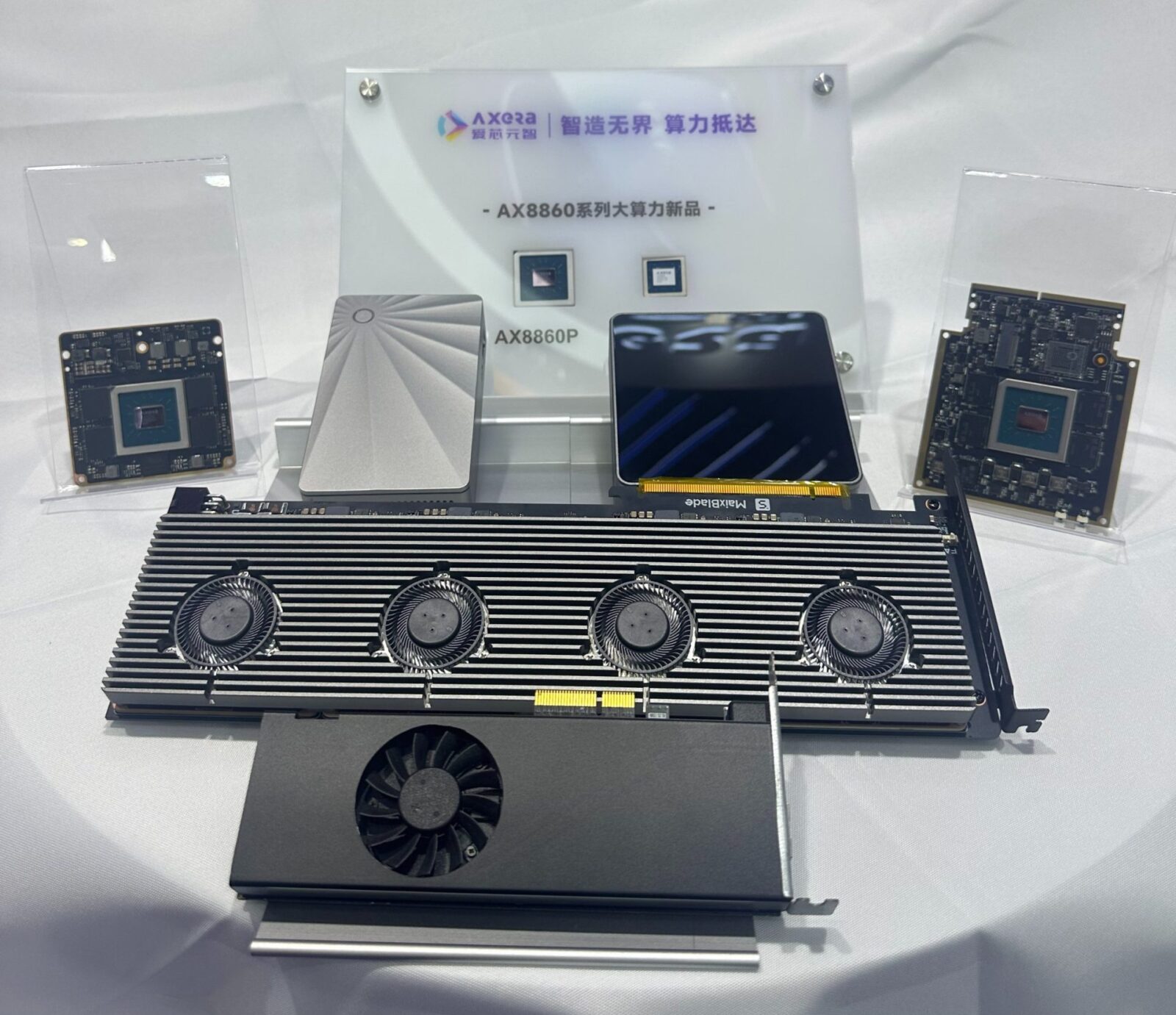
Axera has unveiled its latest AI chip, the AX8860, which is being claimed to offer a 25% speed-up over the DGX Spark at half the price & at 40W.
Axera’s AX8860 AI Chip Offers 128 GB Memory At Half The Price of The DGX Spark & Runs AI LLMs 25-30% Faster
Chinese AI company Axera has unveiled its next-generation solutions designed to run AI LLMs and AI agents. The chip is the AX8860, which is based on a 16-core Arm Cortex-A55 CPU, an NPU with up to 256 TOPS of compute, and a 256-bit LPDDR5/5X controller. The chip has been designed on a 6nm process technology and features PCIe 5.0 connectivity.

The 256 TOPS figure is derived from pure FP4 without any sparsity involved. Additionally, the chip can be configured with up to 128 GB of LPDDR5X memory across the aforementioned 256-bit bus interface, driving a bandwidth of up to 273 GB/s, which puts it next to NVIDIA’s DGX Spark and AMD’s Ryzen AI Halo platforms.

There’s also support for clustered configurations using a 256 Gbps networking interface on many devices, which is faster than the DGX Spark’s 200 Gbps interface. With a 2x clustered config, Axera can push the compute output to 512 TOPS, and with a 4x cluster, they claim to achieve 1024 TOPS with a scaling efficiency of 80%.
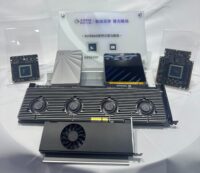
Now moving on to the devices. The Axera AX8860P/8860 will come in various product designs. The first is a dedicated module with a power rating of 40W.
There’s also a single-slot PCIe card with a networking and display interface. It uses a Gen5x4 connector and houses an auxiliary fan for heat dissipation. Then there’s a quad-chip solution which comes in a single-slot form factor, and houses four fans across a large heatsink. This quad ASIC is powered by a standard 8-pin power connector. There are also Mini PCs and Pocket PCs being developed with the same chip.
Axera isn’t stopping at the AX8860 chip, though. The company has a roadmap in which it shows off upcoming solutions such as the Axera 8950, which will boast up to 500 TOPS of AI compute & then the next-generation 8970 chip, which will offer over 700 TOPS of AI compute.

Sipeed has shared some interesting figures on the performance and cost aspects of the AX8860 AI chip. They claim to have tested Qwen 27B at 25% faster prefill and 30% faster decode speeds than the NVIDIA DGX Spark. They also claim that the chip will be almost half the price of the DGX Spark, though we don’t know if that’s comparing to the 128 GB configuration, which retails for over $7000 US, or the 64 GB configuration, which retails for $4999.
Nevertheless, if these claims are true, then the Axera AI chip will definitely be seen as a solid option for SFF LLM and Agentic AI machines. Sipeed also mentions that they will have a pre-order page for their devices, such as the MaixStation, open in 24 hours, and that it will be available within this year. On the software side, the chip supports many LLM development frameworks such as vLLM, SGLang, PyTorch, etc.
| Spec / Feature | Axera AX8860 (module/chip) | NVIDIA DGX Spark (GB10 system) | AMD Ryzen AI Halo (Max+ 395 / newer PRO 495) |
|---|---|---|---|
| Architecture / Process | 6 nm; 16-core Arm Cortex-A55 + proprietary NPU | GB10 Grace Blackwell (Arm CPU + Blackwell GPU) | Zen 5 x86 (16 cores/32 threads) + RDNA 3.5 iGPU + XDNA 2 NPU |
| Peak AI Compute | Up to 256 TOPS FP4 (no sparsity); 2× ≈512 TOPS, 4× ≈1024 TOPS (80% scaling) | Up to ~1 PFLOP FP4 (with sparsity) | NPU 50–55 TOPS; GPU ~60–61 TFLOPS FP16 |
| CPU | 16× Cortex-A55 | 20-core Arm (10× Cortex-X925 + 10× Cortex-A725) | 16 Zen 5 cores (up to ~5.1–5.2 GHz) |
| Memory | Up to 128 GB LPDDR5/5X | 64 GB or 128 GB unified LPDDR5X | 128 GB (common) or up to 192 GB LPDDR5X unified |
| Memory Bandwidth | Up to 273 GB/s (256-bit) | 273 GB/s (256-bit) | ~256 GB/s (128 GB configs) or 273 GB/s (192 GB configs) |
| Power | ~40 W (dedicated module) | SoC TDP ~140 W; system peak ~240 W (PSU); real inference often much lower | Platform TDP ~120 W; wall power often ~80–120 W under load |
| Networking | 256 Gbps interface | ConnectX-7 up to 200 Gbps (clustering-friendly) + 10 GbE + Wi-Fi 7 | 10 GbE + Wi-Fi 7 |
| Connectivity / Form | PCIe 5.0; module, single/quad PCIe cards, future mini/pocket PCs | Compact desktop (~150×150×50 mm); partner variants | Compact desktop (~150×150×45 mm); Windows + Linux |
| OS / Ecosystem | Supports vLLM, SGLang, PyTorch (vendor tools) | DGX OS (Linux only); full CUDA / NVIDIA stack | Windows 11 or Linux; ROCm / Vulkan / broader x86 support |
| Claimed LLM Perf. (vs DGX Spark) | +25% prefill / +30% decode on Qwen 27B | Baseline | Generally competitive or slightly behind on pure decode (bandwidth-limited); often behind on prefill/compute-heavy tasks; stronger on CPU and Windows flexibility |
| Pricing (approx. 2026) | Claimed ~half the price of DGX Spark | 128 GB: ~$4,700–$6,950+; 64 GB from ~$4,999 | 128 GB: ~$3,999; 192 GB newer: ~$7,299 |
| Strengths | Very low power, high claimed efficiency, clustering density, cost | Mature CUDA ecosystem, strong prefill/batch/clustering, official NVIDIA software | Windows + Linux, strong general-purpose CPU, lower entry price (128 GB), good for mixed workloads |
| Caveats | New/claims-based; software maturity TBD; A55 cores are efficient but not high-IPC | Linux-only; higher system power envelope; pricing rose with memory costs | Prefill often slower than GB10; ecosystem (ROCm) less mature than CUDA for some AI stacks |
Backed by up to 256 TOPS (FP4), 128 GB of high-bandwidth LPDDR5X memory, strong clustering support, and a clear roadmap toward higher-performance chips, the platform positions itself as a practical, cost-effective alternative for compact LLM & agentic-AI systems, provided its pricing and performance claims hold up in independent testing.

About the author: A Software Engineer by training and a PC enthusiast by passion, Hassan Mujtaba serves as Wccftech’s Senior Editor for hardware section. With years of experience in the industry, he specializes in deep-dive technical analysis of next-generation CPU and GPU architectures, motherboards, and cooling solutions. His work involves not only breaking news on upcoming technologies but also extensive hands-on reviews and benchmarking.
Follow Wccftech on Google to get more of our news coverage in your feeds.












Leave a comment