
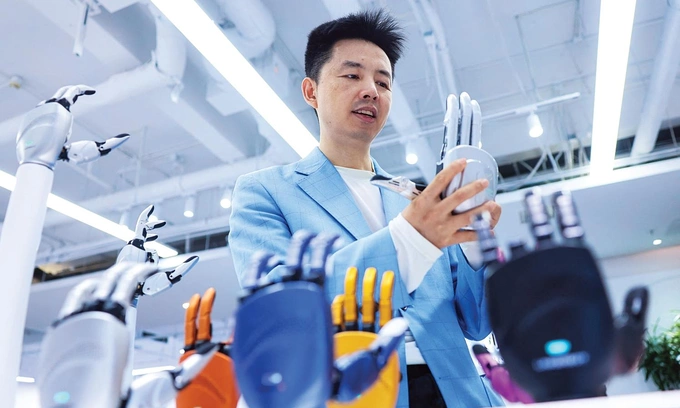
Zhou, whose Chinese name is Zhou Yong, likes to ask people a simple question to illustrate the complexity of human hands: How many things did you touch in the first minute after waking up? An alarm clock, a phone, a glass of water or a toothbrush.
These everyday actions require intricate finger movements that even the most advanced robots struggle to reproduce. “The hand,” Zhou said in an April interview with Chinese technology news outlet Pandaily, “is the last great hardware problem in robotics.”
The 40-year-old entrepreneur is tackling that problem through Linkerbot, a company he founded in 2023 to develop robotic hands capable of matching the dexterity of human hands. Linkerbot supplies robotic hands used in Chinese factories to grasp objects and assemble components. Zhou wants to take the technology further, enabling robots to cook, clean and handle delicate objects, potentially making humanoids useful household assistants.
“The core of what we do is letting robotic hands have the skills of a top craftsman,” Zhou said in an August interview with Forbes. “We aren’t just trying to make the hand perform a single task like cooking. We are bestowing upon it the entire skill set of a human hand.”
 |
|
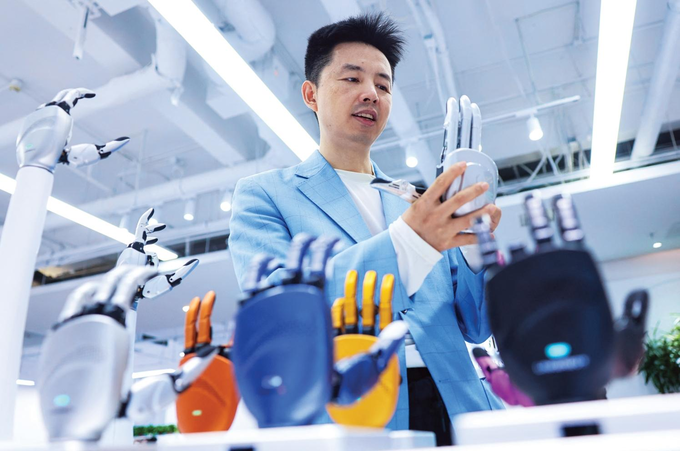
Linkerbot CEO Alex Zhou demonstrates robotic hand capabilities to a Reuters journalist during an interview at the company’s office in Beijing, China, April 27, 2026. Photo by Reuters |
From cartoon inspiration to robotics entrepreneur
Zhou’s fascination with robots began during childhood, when he became captivated by “Doraemon,” the Japanese cartoon about a robotic cat whose magical pocket produces an endless assortment of gadgets. He later came to believe that the real source of humanity’s ability to invent and create things was not a magical pocket, but the versatility of human hands.
At 14, he entered Huazhong University of Science and Technology, one of China’s leading engineering universities, to pursue interdisciplinary studies, including AI and robotics, under a nationwide program for gifted students. After university, he spent two years at Chinese technology giant Lenovo, developing software used in smartphone design. He later co-founded two startups, one specializing in gaming and the other in autonomous driving, before selling his stakes in both.
The proceeds helped finance Linkerbot during its first year. Rather than build complete humanoid robots, he decided to focus on their hands, drawing inspiration partly from Apple co-founder Steve Jobs’ emphasis on concentrating on a single goal. “The world doesn’t need another simple gripper company,” Zhou said. “The world needs a company that redefines what a hand can be.”
The decision placed him at the center of one of robotics’ most difficult engineering challenges. Humanoid robots have become increasingly capable of walking, running and performing coordinated movements, but manipulating everyday objects remains far more difficult. At a technology summit last year, Tesla CEO Elon Musk said developing the hands of the company’s Optimus humanoid accounted for the “majority of the engineering difficulty of the entire robot”.
Humans perform these actions almost instinctively, relying on their sense of touch and precise muscle control. Robots must achieve similar results using miniature motors, mechanical joints, sensors and software. A human hand has approximately 27 degrees of freedom, referring to the different ways its joints can move independently. Linkerbot’s advanced models offer more than 20, allowing their fingers to manipulate small screws, handle tools and play musical instruments.
Building a $3 billion robotics business
Linkerbot’s technology has attracted major investors. An April funding round valued the company at $3 billion, according to Forbes, which estimated Zhou’s personal fortune at $920 million based on his 31% ownership stake. The company is pursuing another financing round targeting a $6 billion valuation. If achieved, that could make Zhou a billionaire.
Linkerbot produces several models of robotic hands priced from 6,666 yuan to 99,999 yuan (US$980 to $14,700). Its entry-level models can grasp objects such as smartphones, while more advanced versions can use tools such as tweezers to handle tiny components. By comparison, some advanced robotic hands made by overseas competitors cost more than $100,000.
Zhou believes China’s extensive manufacturing supply chain gives his company an advantage in producing sophisticated hardware at lower prices. Linkerbot makes nearly all its components in-house, helping it control costs and improve its products more quickly.
“Linkerbot has one of the cheapest and best hands you can buy right now,” Dermot McGrath, founder of robotics consultancy ZenGen Labs, said. “They make their own parts and components, which means they control the cost, and they can iterate faster.”
The company shipped more than 10,000 robotic hands in 2025, becoming China’s second-largest manufacturer by shipments, behind Beijing-based Inspire Robots, according to research firm Gaogong Industry Research Institute. Its customers include Stanford University, Tsinghua University, Samsung Electronics and German industrial giant Siemens, according to Linkerbot.
Following the opening of a new production line in Beijing in August, the company operates four factories across China and aims to increase annual output to as many as 100,000 hands in the coming years.
Competition is intensifying as other manufacturers develop increasingly affordable and sophisticated robotic hands. Chinese companies AgiBot and Inspire Robots are among its rivals, while Singapore-based Sharpa has demonstrated a robotic hand capable of peeling an apple, a task requiring precise control of movement and pressure.
 |
|
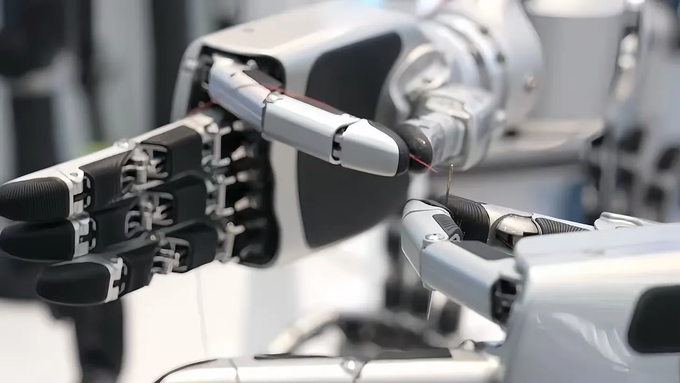
Linkerbot’s dexterous robotic hand performs a high-precision fine-motor task by threading a needle. Photo from Linkerbot |
Teaching robotic hands human skills
For Zhou, producing sophisticated robotic hands is only half the challenge. The other is teaching them how to perform useful tasks. Linkerbot has developed an AI-powered skills library called LinkerSkillNet, which contains more than 500 skills involving movements such as threading needles, chopping vegetables and manipulating small objects.
Zhou believes that expanding the company’s library of movements will eventually allow robotic hands to acquire a broader range of human skills. He has set a goal of producing one million dexterous hands capable of mastering one million skills, from household activities to manufacturing and medical assistance.
His ambitions extend beyond supplying components to robot manufacturers. Zhou wants Linkerbot to develop automated factories where robotic hands assemble more robotic hands, allowing the company to expand production with less human involvement. He also hopes to make advanced prosthetic hands more affordable for amputees, targeting a price of around $1,000 per hand, compared with the tens of thousands of dollars that some sophisticated devices currently cost.
Despite the technological obstacles, he envisions a future in which robots take over difficult, repetitive and physically demanding tasks, giving people more time for other activities.
“We are not creating robots to replace labour,” he said. “We are creating robots so that humans can live a better and more prosperous life.”













Leave a comment