
AI may be making robots smarter, but the harder problem is increasingly one of orchestration. As robotics and automation systems move into more complex environments, motion, controls, software and sensing must work together seamlessly at scale.
It is a complexity that stems partly from the industry’s growing push toward automating higher-mix, lower-volume production, where flexibility and throughput carry equal weight. In this transition, engineering teams are forced to think across mechanical design, electronics, controls and electronics software from the outset, according to Kyle Thompson, Global Robotic Automation Manager, Regal Rexnord, Linear Motion Division.
“That pushes suppliers like us to deliver systems that don’t live in isolation but are designed to integrate into a broader control ecosystem,” he said. “As those systems mature, the motion platforms around them need to be smarter at synchronizing with robot controls, more configurable and better able to support collaborative safety expectations without complex tuning.”
For motion suppliers that means embedding connectivity, configurability and interoperability directly into hardware and control architectures. These advancements are happening alongside vision-enabled robotics and edge intelligence from companies such as Teradyne Robotics, which are expanding the operational envelope of collaborative and mobile systems, while industrial computing platforms from providers such as Teguar are pushing more processing power closer to the machine.
At the same time, precision motion specialists such as maxon are advancing high-efficiency motors and compact actuation systems that support increasingly space- and energy-constrained designs. As Thompson puts it, “motion solutions must be easier to deploy, easier to connect and more capable of working as part of a multi-axis, multi-vendor automation system.”
The implication for product developers is to ensure that motion systems function as part of an increasingly tightly coupled automation stack, where hardware performance, software orchestration and system interoperability are designed together from the outset. For Thompson, that systems-oriented approach is becoming more important. “We expect that systems-ready mindset to matter more each year,” he said.
The products and technologies in this roundup sit at the center of that transition. Across motion systems, embedded computing, robotics platforms and precision actuation, companies are reflecting how motion engineering is moving from a supporting role to one of the defining technologies of the next generation of automation.
1. Integrated Automation in Action
Regal Rexnord will showcase applications that bring together technologies from its Industrial Powertrain Solutions, Power Efficiency Solutions and Automation & Motion Control businesses. Booth spotlights include a series of application-focused demonstrations designed to showcase the company’s integrated approach to automation.
Highlights include a Smart Factory demo featuring seventh-axis systems, motors, linear units, couplings, gearing and software; an Adaptive Packaging application combining seventh-axis gantry systems, conveying technologies and predictive maintenance capabilities; an Autonomous Workflow exhibit integrating software, motors, brakes, gearing and linear motion technologies; and a Next-Generation Motion display highlighting advances in seventh-axis systems, linear units, motors and braking solutions.
Together, the demonstrations illustrate how the company is bringing motion, power transmission, controls and software technologies together to address increasingly complex automation challenges.
Three products to check out at their booth:
(i) Collaborative Seventh-Axis Motion
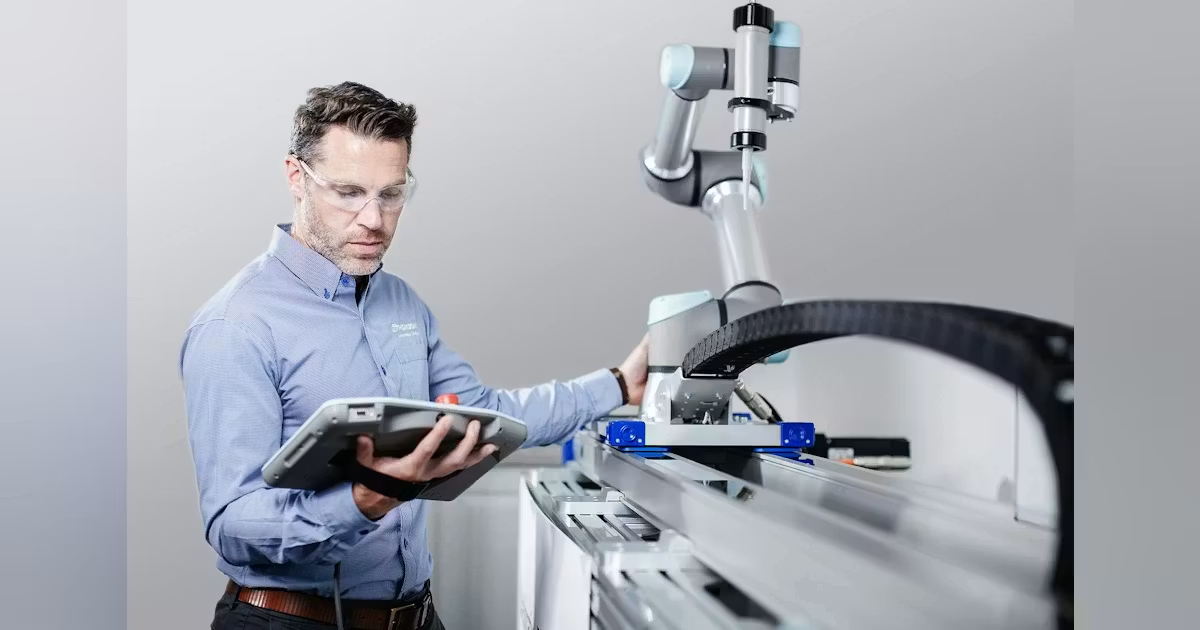
Thomson, a Regal Rexnord brand, will showcase its Movotrak Cobot Transfer Unit (CTU), which the company describes as the industry’s first collaborative seventh-axis system for cobots. Designed as a plug-and-play solution, the CTU incorporates collision-detection capabilities and extends a cobot’s horizontal working range by up to 10 m. This will enable robots to serve multiple workstations and applications from a single installation.












Leave a comment