
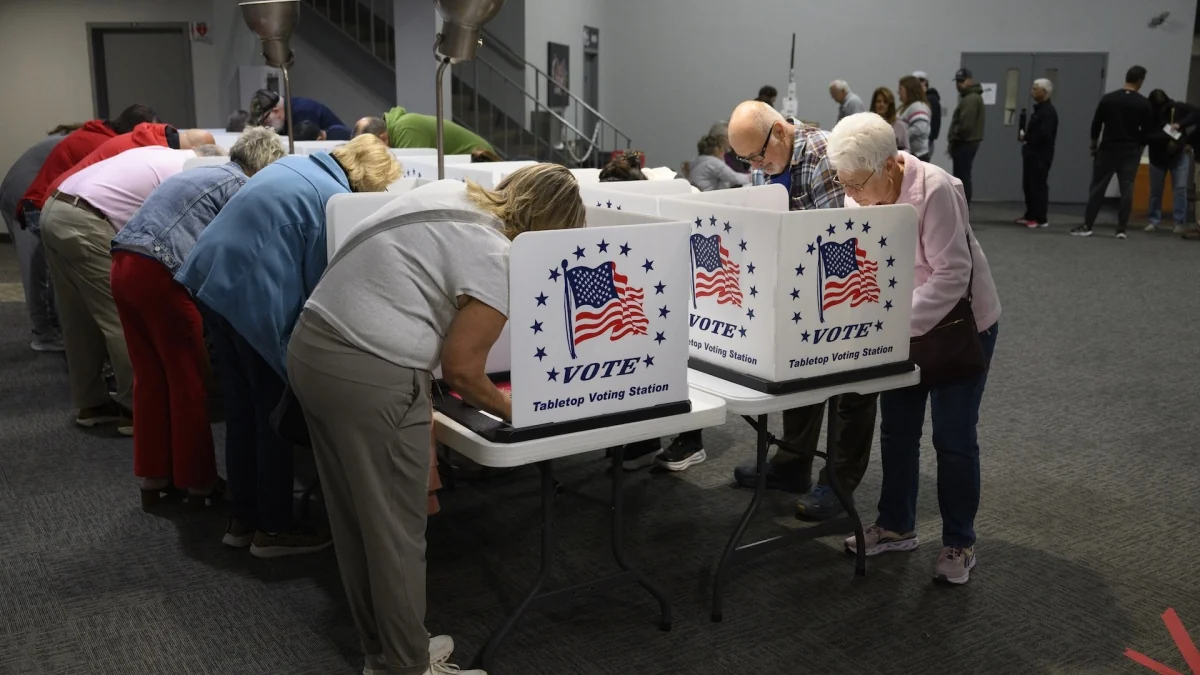
Hours before polls closed on Tuesday, news broke that Google effectively refused to turn off AI search for every school in America that uses its classroom products.
The controversial development proved a surprisingly fitting prelude to the revelation that voters actually care a lot about artificial intelligence.
Exit polling showed bipartisan concern over AI and data centers. In NBC News’ national exit poll, 65 percent of Democrats and 39 percent of Republicans said both topics were a crucial or major factor for their Congressional ballot.
Voters ultimately approved more than 40 measures to slow or ban data center growth. Candidates calling for AI regulation, like Michigan senator-elect Abdul El-Sayed and South Carolina senator-elect Dr. Annie Andrews, defeated Republican competitors who championed AI.
Experts say this midterm thrashing of Republicans is a rebuke of their pro-AI policies, along with the Silicon Valley executives who aligned themselves with President Donald Trump or donated hundreds of millions of dollars to help the GOP.
“Voters have had enough: they want strong and effective guardrails now, and they’re demanding accountability,” Michael Kleinman, head of US policy for the Future of Life Institute, said in a statement. “The AI reckoning is here.”
The AI backlash had been brewing
Though some Republicans initially seemed determined to wave off voter sentiment about AI, the angst was clear as early as May 2025 when the One Big Beautiful Bill Act included language that would ban states from regulating AI. One survey found registered voters overwhelmingly disliked the moratorium. Even former Republican Congresswoman Marjorie Taylor Greene opposed it.
The measure was dropped from that legislation, but the Trump administration didn’t stop trying to prohibit states from regulating AI. In Dec. 2025, Trump signed an executive order that would, among other things, punish states for passing “onerous” AI laws by withholding certain types of federal funding.
Meanwhile, AI executives like OpenAI CEO Sam Altman and Anthropic CEO Dario Amodei talked openly about possible doomsday scenarios wrought by out-of-control AI. Communities living alongside data centers began reporting concerns about public health, electricity prices, and environmental pollution.
AI lawsuits and legislation
A string of lawsuits on behalf of children and adult AI users gave a haunting and heartbreaking look into how AI chatbots could allegedly talk them into exploitative sexual experiences, dangerous medical decisions, so-called psychosis, and even suicide.
Mashable Light Speed
Still, states across the nation continued to pass AI regulations. Roughly a week before the election, New York governor Kathy Hochul signed what some advocates believe is the strongest AI chatbot legislation in the U.S.
The best tech deal this week
Products available for purchase through affiliate links. If you buy something through links on our site, Mashable may earn an affiliate commission.
Outrage over AI in classrooms
Over the last year, an army of parent and education activists have lobbied to get Big Tech out of their kids’ classrooms, including through various AI bans.
Google’s decision to withhold search from schools that ban AI, because the company will not provide a version of the product without AI Mode or AI Overviews, only further rankled advocates who feel they’re David fighting Goliath.
“Schools should use this opportunity not only to turn off AI, but to teach students that ‘Google’ isn’t a verb, but the name of a surveillance and advertising company whose presence in schools has nothing to do with learning and everything to do with developing lifetime brand loyalty,” Josh Golin, executive director of the advocacy group Fairplay, said in a statement.
New York Mayor Zohan Mamdani accused Google in a Bluesky post of using its “monopoly power” to force public schools into using its AI products.
“No corporation should have the power to dictate how we teach our children,” he wrote.
Where we go from here
There are loud calls for Democrats to use their newfound electoral power to hold Silicon Valley executives accountable and to pass meaningful regulation that reflects growing concern about data centers and the economic and social threats posed by AI.
Alvaro Bedoya, a former commissioner of the United States Federal Trade Commission, offered a few strategies Wednesday on social media, including a subpoena of Google “for cramming AI down our kids[‘] throats,” and subpoenas for health insurers using AI to automatically deny valid claims and triage mental health emergencies.
The elected Democratic candidates themselves may look to quickly deliver on their campaign promises. Amy Acton, Gina Hinojosa, and Keisha Lance Bottoms, Democrats who won their gubernatorial races in Ohio, Texas, and Georgia, respectively, supported data center moratoriums or greater accountability for data center developers.
Criticism of AI and data centers made multiple appearances in Democratic victory speeches Tuesday night, suggesting the party is just getting started.
Virginia Senator Mark Warner acknowledged this in his own address after defeating a Republican challenger.
“From data centers to AI safety, to the notion that we’ve got to make sure that we create jobs for that next generation of college students coming out that are going to be meaningful…this is too important to be left to Donald Trump and a few of these tech bros making all the rules,” Warner said.
Disclosure: Ziff Davis, Mashable’s parent company, in April 2025 filed a lawsuit against OpenAI, alleging it infringed Ziff Davis copyrights in training and operating its AI systems.















Leave a comment