
Hello, this is Techtrage.
“We post job openings, but no one applies.”
“Will we be able to maintain current production levels after our veterans retire?”
“I’m interested in robots, but can they be used in our factory where product numbers change almost daily?”
Even if you see robots quickly grabbing parts at a trade show, it can be confusing when you try to apply it to your own work. Who will change the setup when the product number changes? Who will handle it if the robot stops? Thinking about these everyday tasks helps you see which jobs can be delegated.
Even in high-mix low-volume production, robot adoption is practical if you narrow it down to tasks that repeat under the same conditions. This time, we will look at domestic and international adoption status, consider which tasks to examine first, and think about what to measure in tests.
How much are industrial robots being used?
According to data published by the International Federation of Robotics (IFR) in September 2026, there were approximately 5 million industrial robots operating in factories worldwide in 2025. In the same year, 36,219 units were newly installed in Japan, a 19% decrease from the previous year. The global figure is the total number in operation, while the Japanese figure is the number of new installations in one year. IFR published data
In a survey published by the Japan Institute for Labour Policy and Training in March 2026, 25.6% of responding companies that use digital technology cited “robots” as a technology they utilize. The survey was conducted in 2023 and targeted companies with 30 or more employees in 11 manufacturing industries, such as metal products and machinery. The 25.6% figure is based on the conditions of this survey, and to think about applications that suit your company, you need to look at on-site tasks one by one. Survey results from the Japan Institute for Labour Policy and Training
Looking for tasks with high repetition and consistent conditions
One candidate is loading materials into and unloading processed items from machining centers or NC lathes. In a case study of Yokota Corporation published by Universal Robots, a collaborative robot handles the loading and unloading of workpieces into NC machines. Universal Robots adoption case study
When looking for candidates within your company, write down the task name and the conditions for stable repetition as a set.
-
Loading/unloading to machine tools Can the orientation of the material and the gripping position be aligned? Can the door and chuck be linked?
-
Boxing/palletizing Can it handle differences in weight and shape? Can it prevent load collapse with a fixed placement method?
-
Welding Can parts be aligned with jigs? How will you check for variations in gaps and quality after welding?
-
Transport between processes Where does it intersect with people or carts? What happens if the handover position is full?
For example, even if unloading can be automated, if a worker has to remove chips around the chuck every time it is processed, it remains difficult to leave the equipment during that time. Checking where human hands are needed, including the preceding and following processes makes the points to look at in tests more concrete.
In high-mix low-volume production, start with product numbers that can share setups
In contract manufacturing, the gripping position, jigs, material arrangement, and programs may change every time the lot changes. For example, if you can reduce 1 minute of manual work per piece for a 10-piece run, but the additional setup associated with automation takes 15 minutes, the manual work for that lot increases by 5 minutes. Setups should be measured by lot unit along with processing time.
At first, choose one product number that is ordered repeatedly. Next, look for product numbers that are close in outer diameter and length and could use the same hand or jig. If you check the necessary replacements and readjustments every time you add a product number, it becomes easier to judge how far you can expand the scope.
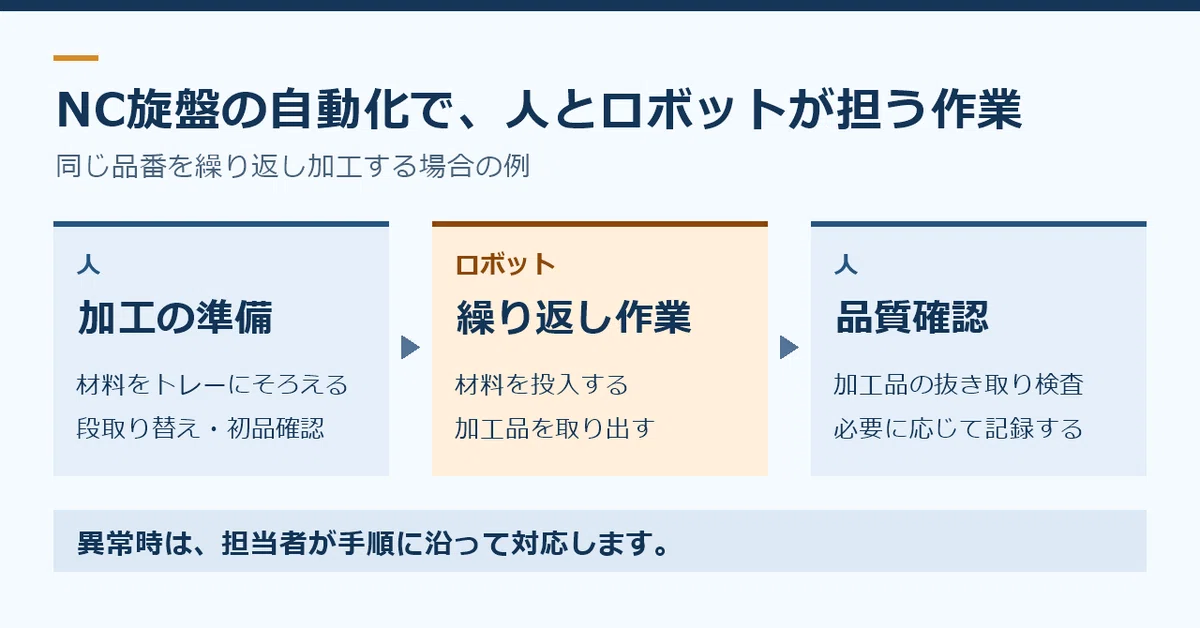
For example, with an NC lathe, the worker arranges materials on a tray and is responsible for setup changes and first-piece inspection. For repetitions after the first piece passes, the robot handles material loading and unloading of processed items. The worker performs sampling inspections, and if there is an abnormality, the person in charge responds according to the procedure.
Before requesting a quote, check equipment, space, safety, and recovery procedures
Connection with existing equipment and peripheral devices
Prepare the hands, jigs, and sensors to grip the workpieces, and verify whether you can receive processing completion signals from the machine tool and link the operation of doors and chucks. NEDO also cites the integration of equipment, software, and sensors to operate as a single system as a difficulty in building robot systems. When obtaining quotes, also confirm the scope of design, installation, adjustment, training, and maintenance. NEDO Project Overview
Material storage areas and worker traffic paths
On the equipment layout diagram, mark the storage areas for materials and finished products, the width of paths for carts, and where people stand during cleaning or tool changes. In addition to normal operation, confirm with on-site staff where people will approach from during setup changes and maintenance inspections.
For collaborative robots, confirm safety across the entire operation
Even when using collaborative robots, conduct a risk assessment that includes the shape of hands and workpieces, potential entrapment with peripheral equipment, and tasks other than normal operation, and determine necessary safety measures. The business using the equipment should share actual working conditions with the robot manufacturer and system integrator to consider protective measures such as safety fences. Ministry of Health, Labour and Welfare Enforcement Notification
Personnel and contact information for when the system stops
If the system stops due to a failure to grip a material, what should the on-site staff record and who should they contact? Who will verify the cause, ensure safety, and decide to resume? Decide this along with recovery procedures and share it among multiple people so that it can be handled even on days when the person in charge is off.
In tests, measure the ‘time freed up for other tasks’
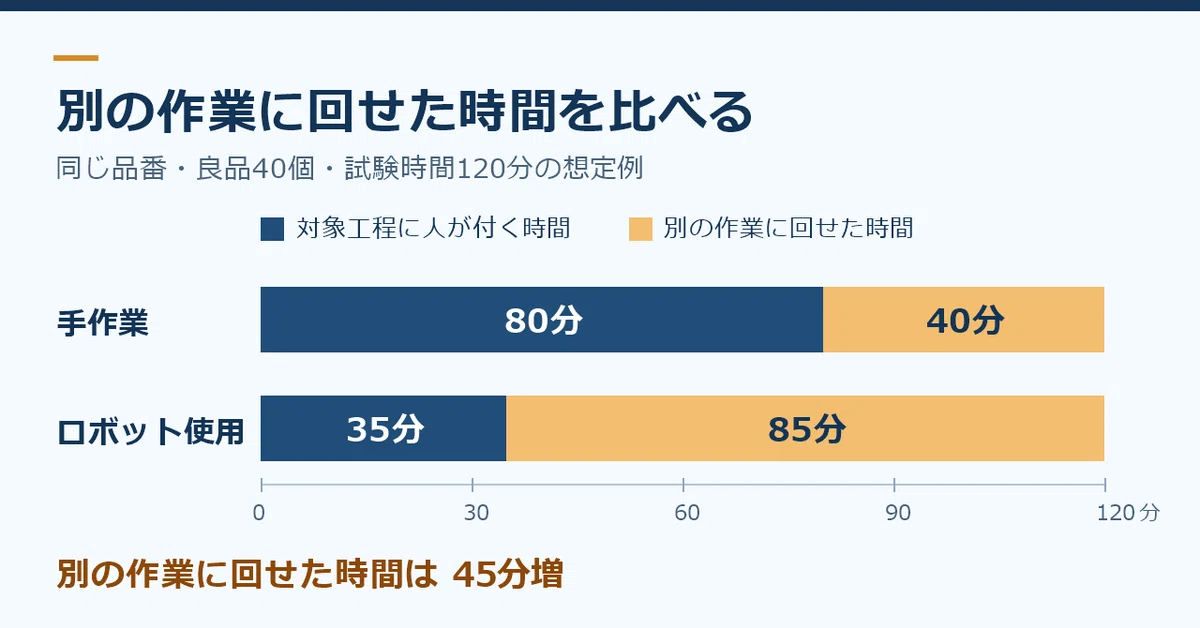
Using actual materials and jigs, compare manual work with robot usage under the same part number, lot size, and quality standards. From the start to the end of the test, record setup, material replenishment, inspection, stops and recovery, and the number of good products.
For example, suppose it took 120 minutes for both to produce 40 good products of the same part number. If the time a person spent on the target process decreased from 80 minutes to 35 minutes, and the time available for other tasks increased from 40 minutes to 85 minutes, it can be determined that 45 minutes were freed up for other work.
At this time, also verify whether this is time that can be used in a block or a accumulation of short gaps. For example, with 5-minute gaps, it may be difficult to start setting up other equipment. If you decide in advance how to use the freed-up time, such as for inspection, preparation for the next job, or reducing overtime, it becomes easier to estimate the investment effect. Check how many lots of the target work exist in both normal months and months with fewer orders.
First, record one part number that is ordered repeatedly
Before consulting on adoption, have on-site staff record the part number, drawing version, lot size, jigs, and setup time. If a stop occurs, leave a record of the reason for the stop, the time taken to respond, and what was observed to make the decision.
For example, if you record ‘Used Jig A. Setup 12 minutes. One redo due to incorrect material orientation. Worker checked orientation by looking at the groove on the end face,’ you can discuss specifically with the adoption support company whether the orientation can be aligned with a tray or if it needs to be checked on the robot side. This is a record example for explanation.
Mieruka Server and Mieruka Board can be used to share such working conditions between the office and the site. Office staff can organize drawings and procedure manuals in a library and leave notes on the drawings using electronic sticky notes. On-site workers can check drawings and procedures on the Mieruka Board. When reviewing how much work to entrust to the robot, the materials actually in use become the basis for consultation. Mieruka Board Official Product Page
First, try measuring once with the next recurring item that comes in. If you record the time taken for loading/unloading and the time when human intervention was required for setup or abnormality response, you can think concretely about how on-site work will change when a robot is introduced.
*Statistics and public materials were confirmed in November 2026.















Leave a comment