
November 13, 2026
3 min read
Key takeaways:
- One model used 18 variables to predict 30-day asthma ED remissions, whereas the other used 12.
- Area under the curve during testing ranged between 0.539 and 0.711 in the four machine learning algorithms.
PHOENIX — In statistical models and machine learning algorithms, a model using 12 variables was comparable to a model using 18 variables in predicting 30-day pediatric asthma ED readmission, according to results presented here.
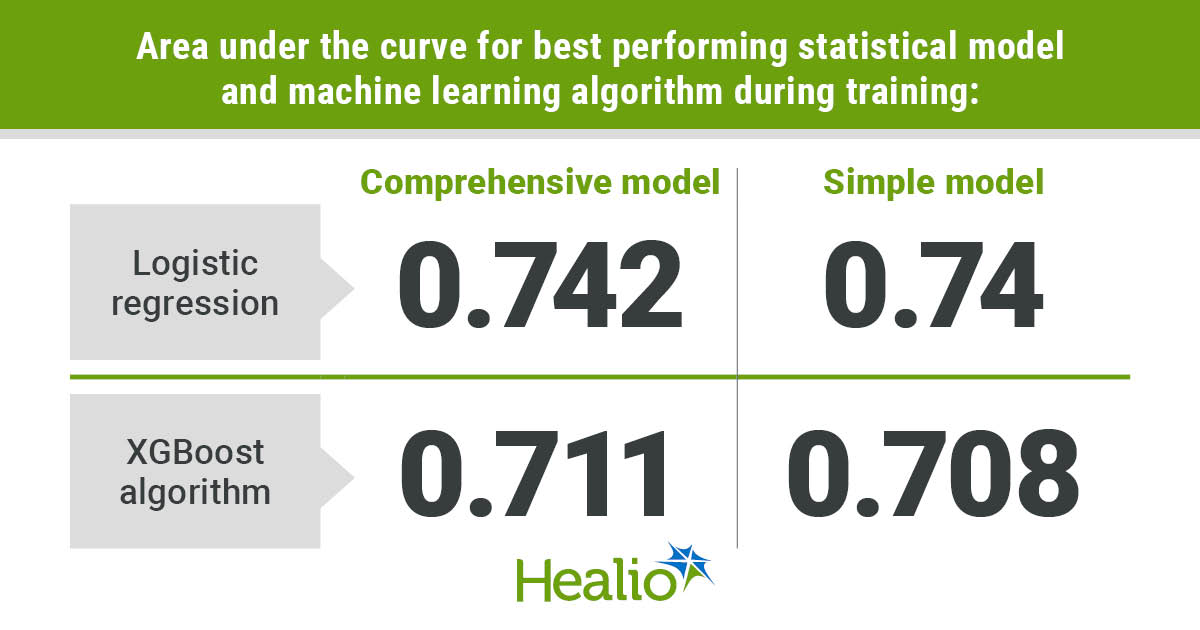
Further, the best performing machine learning algorithm during testing had areas under the curves (AUCs) of 0.708 and 0.711, which fell only slightly below the AUCs of 0.74 and 0.742 with the best performing statistical model, according to the poster presented at the American College of Allergy, Asthma & Immunology Annual Scientific Meeting.

Data derived from Lee R, et al. R147: Development of a machine learning algorithm to predict 30-day emergency department readmissions for asthma exacerbations. Presented at: ACAAI Annual Scientific Meeting; Nov. 12-16, 2026; Phoenix.
“Our AUCs for 30-day ED readmission rates demonstrated moderate accuracy and are comparable or slightly better than the AUCs reported in the literature for ED asthma admission rates for adults,” Rina Lee, MD, who recently completed an allergy and immunology fellowship at the University of Cincinnati, said in a prerecorded presentation.
This is one of three projects that received a Community Gant from the Allergists’ Foundation.
In a retrospective analysis, Lee and colleagues developed four statistical models and four machine learning algorithms using deidentified data from 69,749 asthma-related ED encounters for 31,779 patients in a quaternary pediatric center. Models and algorithms were developed to predict 30-day pediatric asthma ED readmissions via comprehensive and simple feature sets.
This population included 1,759 patients (5.54%) with an asthma-related ED visit less than 30 days after their first visit, according to the poster.
“Few studies have applied machine learning algorithms to predict pediatric asthma exacerbations,” Lee said. “Furthermore, 30-day ED readmission rates are an important and intervenable metric for at-risk patients.”
Most data (80%) were used for training, and the remaining 20% were used for testing.
The comprehensive model used 18 predictors including patient characteristics (age, sex, race, BMI and insurance group), medications and clinical factors (albuterol only, albuterol plus other medications, systemic steroid administration at first ED visit and atopic comorbidities) and seasonal and environmental factors (encounter during flu season, temperature, air quality index, humidity, barometric pressure, pollen count, mold count and Hamilton County influenza-like illness ED visit).
The simple model only used 12 predictors, including patient characteristics, medications and clinical factors, encounter during flu season, temperature and air quality index.
Training
In training, researchers found that the statistical model with the highest AUC for predicting 30-day asthma ED readmissions with the comprehensive set and the simple set was the logistic mixed-effects (LGMIX) model (comprehensive = 0.902; simple = 0.897).
The three other statistical models — logistic regression (LR), elastic net (EN) and least absolute shrinkage and selection operator (LASSO) — had lower AUCs, but each value was above 0.7 in both the comprehensive and simple set.
In terms of the four machine learning algorithms, the greatest AUC with the comprehensive set was observed in the K-nearest neighbor (KNN) algorithm (0.828), and the greatest AUC with the simple set was found in the support vector machine (SVM) algorithm (0.837). The remaining algorithms — neural network (NN) and XGBoost — had lower AUCs in both sets, but the values did not fall below 0.7.
Testing
In testing, researchers noted that the statistical model with the highest AUC for predicting 30-day asthma ED readmissions with the comprehensive set and the simple set was the LR model (comprehensive = 0.742; simple = 0.74).
The remaining statistical models had lower AUCs: EN (comprehensive = 0.726; simple = 0.725), LASSO (comprehensive = 0.726; simple = 0.725) and LGMIX (comprehensive = 0.726; simple = 0.737).
The machine learning algorithm with the greatest AUC for predicting 30-day asthma ED readmissions with the comprehensive set and the simple set was the XGBoost algorithm (comprehensive = 0.711; simple = 0.708).
The other machine learning algorithms had lower AUCs: NN (comprehensive = 0.653; simple = 0.674), SVM (comprehensive = 0.539; simple = 0.542) and KNN (comprehensive = 0.642; simple = 0.636).
During testing, AUC values from the simple feature set did not significantly differ from AUC values from the comprehensive feature set in any of the statistical models or machine learning algorithms.
Important predictors
When evaluating predictor importance, Lee reported that albuterol only was the most important in predicting ED revisits within 30 days, as it was counted as important in all eight models/algorithms. Predictors counted as important in all but one model/algorithm included first ED steroid use, atopic allergy and age at encounter.
“A predictor was counted as important if P was less than 0.01 for LR and LGMIX, if it ranked in the top five by absolute standardized coefficient as a cross-validated lambda for LASSO and EN, and if it ranked in the top five by mean absolute value of SHAP on the test data for NN, XGBoost, SVM and KNN,” Lee said.
Albuterol plus other medications was counted as important in five models/algorithms, flu season, insurance group, average temperature and BMI were counted as important in two models/algorithms, and average air quality index was counted as important in one.
No models/algorithms counted race or sex as important predictors.
“Further work combining these models through ensemble methods may further improve prediction,” Lee said. “Our simple model has the potential to serve as a clinical decision support tool to predict ED readmission risks.”
Sources/Disclosures
Source:
Lee R, et al. R147: Development of a machine learning algorithm to predict 30-day emergency department readmissions for asthma exacerbations. Presented at: ACAAI Annual Scientific Meeting; Nov. 12-16, 2026; Phoenix.
Reference:
Disclosures:
Healio could not confirm Lee’s relevant financial disclosures at the time of publication.

Ask a clinical question and tap into Healio AI’s knowledge base.
- PubMed, enrolling/recruiting trials, guidelines
- Clinical Guidance, Healio CME, FDA news
- Healio’s exclusive daily news coverage of clinical data














Leave a comment