
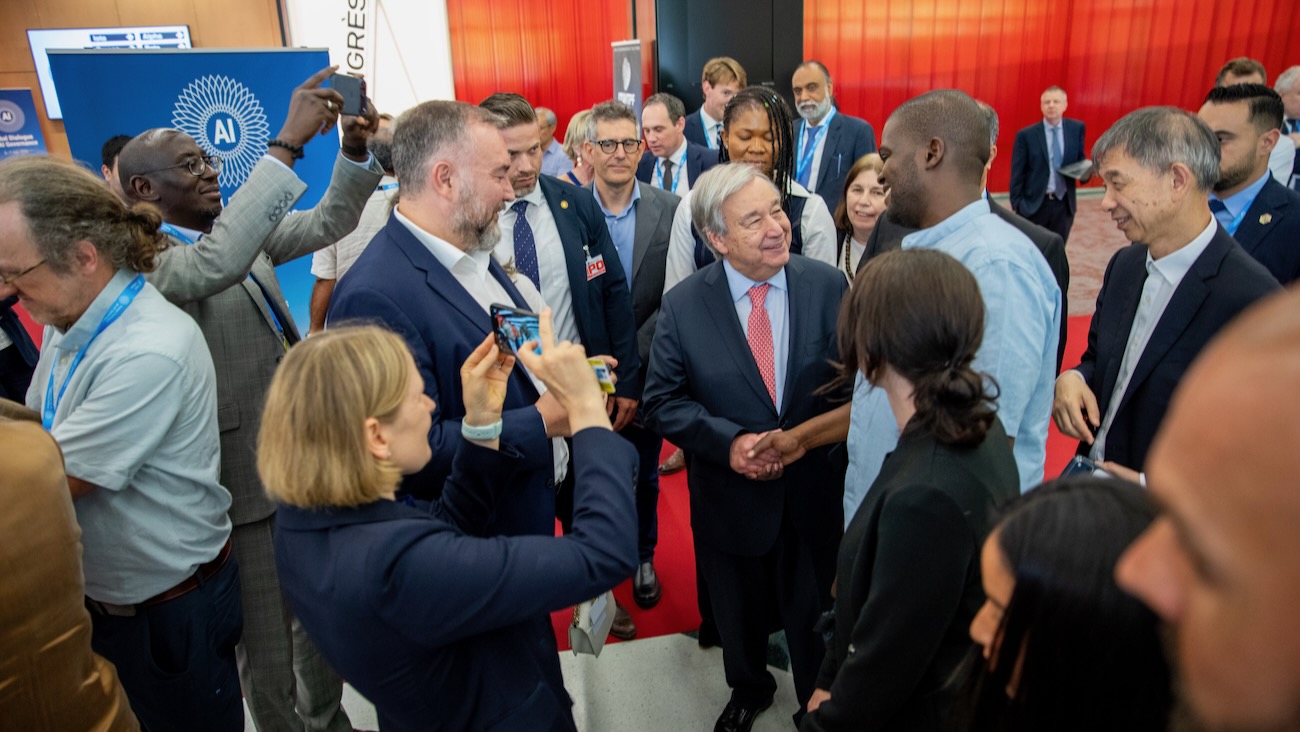
Members of the Independent International Scientific Panel on AI meet with Secretary-General António Guterres at the inaugural Global Dialogue on AI Governance in Geneva, July 6, 2026. UN Photo/Elma Okic.
Taking office in January 2027, ahead of the UN’s Global Dialogue on AI Governance in New York in May and the Geneva AI Summit in June, the new secretary-general will have an early opportunity to engage major powers on emerging security risks of artificial intelligence (AI) and lay the groundwork for concrete practical diplomatic initiatives.
Make AI a Priority for Preventive Diplomacy
The Security Council has already episodically discussed AI’s implications for international peace and security, including its effects on military decision making, cybersecurity, and nuclear stability. The next secretary-general could work with Council members, including successive Council presidencies, to establish more regular briefings on emerging risks and use the office’s reporting and diplomatic functions to sustain engagement and encourage practical measures to reduce risks to international stability.
An immediate initiative could tackle crisis communication among major AI powers. Prospects for a formal agreement on military AI remain limited, given strategic competition and the sensitivity of military capabilities, but there is space for a voluntary protocol setting out how governments should communicate when an AI-related incident threatens to escalate. Initiating more thinking around options for procedures and mechanisms for responding when AI agents go rogue could be an important confidence-building measure and starting point.
An informal AI safety and security protocol among Security Council members and other member states could clarify national points of contact, establish procedures for urgent communication through existing diplomatic or military channels, and provide ways to seek clarification when an AI-enabled cyber operation, military system malfunction, or erroneous warning raises concerns about another state’s intentions. This protocol could also involve the emerging cadre of AI safety and security institutes that provide advice and assistance.
As first step, the new secretary-general could explore the scope for such arrangements through confidential consultations with the United States, China, and other militarily powerful states. Initial discussions on such procedures might motivate further collective thinking on multilateral cooperation on AI in capitals and permanent missions in New York. A practical entry point for discussions could be a tabletop exercise in which officials from willing governments work through a hypothetical AI-related security incident. Academic partners could provide a space for such a crisis simulation. Participants would have the chance to deliberate on how to respond when an AI-supported warning system produces misleading information during a period of heightened international tension, including how governments would verify information, communicate uncertainty, and avoid escalation.
As in other policy domains, governments have little incentive to disclose sensitive capabilities or operational procedures. Even so, just discussing possible scenarios and becoming familiar with crisis procedures could help increase confidence and trust. Of course, continuing business as usual is an alternative, but an equally uncertain one. The secretary-general’s good offices could provide a discreet setting for these exchanges and help sustain contacts when political relations become strained.
The UN system has already built some foundation for advancing this work. For instance, the UN Office for Disarmament Affairs (UNODA) and the UN Institute for Disarmament Research (UNIDIR) have advanced research and intergovernmental discussions on military AI, while the Department of Political and Peacebuilding Affairs (DPPA) and the Department of Peace Operations (DPO) are increasingly engaging with emerging technologies in their work on conflict prevention and peace operations. The Office for Digital and Emerging Technologies (ODET) could contribute wider perspectives on developments in AI governance and scientific research.
Raising the prominence of AI-related security risks across international and regional institutions would send an important signal to member states and the multilateral system at large. This is especially important within the peace and security architecture as it continues to evolve under the UN80 reform initiative. The new secretary-general could include AI-related security risks in the priorities set for new incoming departmental leadership and ask for closer cooperation between UN entities and personnel focused on technology, disarmament, and political affairs.
Build Diplomatic Momentum Ahead of New York and Geneva
The new secretary-general should also use the first 100 days to prepare a focused agenda, including personal commitments and concrete deliverables from the UN system for member states, ahead of the scheduled international AI meetings in New York on May 3rd and 4th and Geneva on June 21st and 22nd. They could engage with the co-chairs of the Global Dialogue, the organizers of the Swiss summit, and other interested governments to identify political prospects for cooperation on international AI safety and concrete options for sharing computing resources, scientific expertise, and technical capacities. The secretary-general’s personal engagement would be particularly valuable in identifying where agreement is possible, encouraging governments to arrive at these meetings with concrete commitments, and discerning areas where further diplomatic engagement could make a difference after the summit.
The outputs of the UN’s Independent International Scientific Panel on AI could help contribute to a shared understanding among governments of emerging AI capabilities and risks. While safeguarding the Panel’s independence and recognizing that its mandate excludes military applications of AI, the next secretary-general could bring its findings and scientific conclusions more directly into the work of the Security Council and the wider UN membership. For example, thematic briefings that decomplexify academic findings or conversations with civil society groups on the impact of AI could enable member states to better understand technological trends and stress-test scientific uncertainties. This would ensure that scientific evidence informs diplomatic discussions beyond specialist technical forums.
A measure of success for the new UN leadership will be what governments are willing to agree to do and whether their promises actually translate into practical arrangements that help reduce the risks of AI to international peace and security. Even modest progress could help prevent misunderstandings and escalation at a time of growing geopolitical tension and technological revolution while demonstrating the UN’s continuing value in bringing governments together.
Martin Wählisch is an Associate Professor of International Relations at the University of Birmingham and a member of its Centre for AI in Government. His research focuses on international affairs, AI governance, and multilateral cooperation. He recently co-edited the open-access Palgrave Handbook of Science Diplomacy (2026) with Jan Lüdert, examining how science and emerging technologies can advance international cooperation amid growing geopolitical tensions and contestation.















Leave a comment