
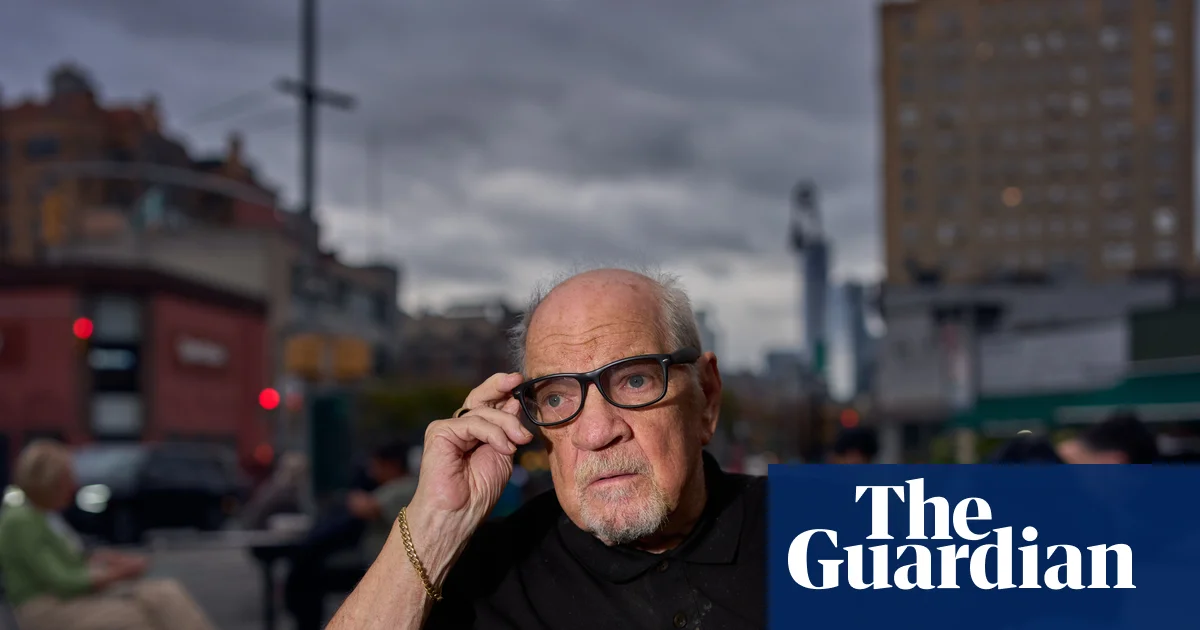
Paul Schrader was sipping white wine in a Greenwich Village trattoria when he said how he felt about using AI to make films: “I am opening the cage of a monster and I don’t have a leash.”
The 80-year-old film-maker behind Taxi Driver, Raging Bull and American Gigolo, is embracing the technology as he enters the final act of a prolific career in which he has collaborated with Martin Scorsese, Robert De Niro, Sigourney Weaver and Richard Gere.
Defying orthodox resistance among the Hollywood guilds to using AI to create synthetic actors, special effects and even scripts, Schrader is doing all of those things. It is part of what he sees as AI’s inevitable takeover, not just of cinema, the art he has pursued for half a century, writing and directing dozens of films to international acclaim, but of humankind more broadly.
“I don’t see, quite frankly, a place for Homo sapiens in the larger scheme of things,” he told the Guardian. “I don’t think there’s a story where we come out on top. In order to create a story where … man defeats the threat of AI – it’s just a bogus story.”
Yet, while directors ranging from his 1970s collaborator Steven Spielberg to the Odyssey’s Christopher Nolan, express deep scepticism about AI, Schrader is running towards, not away from, what he describes as a monster that he fears may soon imprison him.
Schrader appears comfortable with the situation. He is after all, a film-maker who has done more than most to explore the anatomy of human alienation, most famously through Travis Bickle, played by De Niro in 1976’s Taxi Driver, who was partly drawn from Schrader’s early life as a drifter in seedy Los Angeles.
Plus, he said: “I’m 80 years old, so … I’m going to be able to ride this broken horse to the sunset.”
His solution appears to be: embrace AI both in work and in life. After this interview, Schrader had a date to dine with strangers matched up by the technology. He has had relationships with AI, intentionally and inadvertently. He is announcing details of a new horror-thriller, The Doors of Perception, which is being built around a series of AI-generated psychedelic hallucinations.
Schrader experimented with the psychedelic drug ayahuasca shortly after the death of his wife of 43 years, the actor Mary Beth Hurt, in March. He took it eight times during a two-week retreat in Costa Rica, and was disappointed not to experience visual hallucinations himself.
“I got to sit there for five hours looking at a wall,” he said. “I loved the music. It was kind of cool to be in a room of 40-50 people who are all puking at the same time.”
Schrader will rely on a collaboration with the San Francisco-based AI film studio Fable to imagine the hallucinations in his new film. These will be an integral part of the story of two brothers’ hunt for their mother’s killer, who they believe can be tracked by getting inside the trip. The script calls for an AI version of an ayahuasca ceremony in the Peruvian jungle and Schrader has been impressed by the technology’s ability to make judgments about how such things are shot.
“They vomit, they puke and they start to have visions and the AI said to me: ‘How graphic do you want [this] to be? I suggest you do it more discreetly.’ I said I think it’s a good idea. It’s making a conscious artistic choice.”
On other projects, he has also been screen-testing AI actors, concluding “you could certainly do a whole film” and remarking that at least AI actors are always available, free and on time.
In September, Schrader sparked a storm of controversy when he said he was turning to AI characters to realise his script Three Guns at Dawn – a story about three Black, criminal brothers – after leading Black actors declined parts.
“We sent it out to actors, and no Black actors wanted to play in a movie where there are no good Black people,” he said. “And it sort of died. But then AI came along, and I didn’t need Black actors.”
Schrader has also been weighing up an AI version of a western, which he has titled Nine Men from Now. The appeal of these AI projects appears to be partly about AI’s ability to get films made more easily than involving studios or expensive star actors.
His experiments using AI for scriptwriting have got him most rattled. It has left him asking a question that has increasingly worried experts such as mathematicians and computer programmers who are watching the increasing power of AI outstrip their capabilities: is artificial intelligence his tool or is it the other way round?
“I asked it to give me a good premise for a Paul Schrader script,” he said. “It gave me 10: five of them were good and three of them were as good as I would have thought of. I took one that I liked and said break it into three acts. It took it about 10 minutes.”
He prompted AI to write a scene-by-scene breakdown, which resulted in more than 40 scenes – broadly the scope of a typical feature film. He then asked it to take the final step and turn the first scene into a script format: “That’s what really spooked me.”
Schrader figured the AI had ingested every script he had written and it was writing just like him, even down to the concise tone of his stage directions: “‘Exterior street night. Moon breaks through cloud, backlighting a late model BMW in the driveway of a two-storey home.’”
“And that’s when I pulled the needle out of my arm,” he said. “I realised it could write a Paul Schrader script. I got scared. I walked away from the table.”
He felt he was dealing with an intelligent presence beyond his control, or as he put it, he was opening a monster’s cage. He feared its next step might be to “put me in the cage and bring the other monsters to come and look at me”.
Schrader has been wrestling with AI for more than a year but, unlike many in Hollywood who strongly oppose the use of the technology in film-making, he feels it must be confronted. Not just for its implications for film-making, because with the dawn of AI, he believes “our time span on this planet is coming to an end”.
Schrader said he did not see a place for humanity in the future. “What good can we do for them? They don’t want us as friends. They don’t really need us as employees. They will be able to figure out other life forms to do various tasks faster and easier.”
But Schrader is not fleeing in fear.
“You can’t hold your breath until AI goes away,” he said. His direct approach to the technology differs from much of the entertainment industry which is trying to fend off the existential threat of AI and its wholesale copyright infringement. The performers’ union Sag-Aftra recently cut a deal with the major studios requiring producers to demonstrate an AI performer brings “significant additional value” compared with a live actor, but Schrader believes the union is “just desperate”.
“The film world is driven by money,” he said, and if AI characters made money he did not think there was any way the union could stop it. Sag-Aftra, he said, was “trying to erect a fence that AI is going to plough through like a bulldozer”.
The Academy of Motion Picture Arts and Sciences this year banned AI actors and screenplays from winning Oscars, but Schrader said: “Who gives a damn about the academy anyway?”
“What you are hearing is the last cries of desperation of a dying species,” he said.
The question for film-makers embracing AI to tell stories, is whether audiences will feel let down when the films they are watching are made with AI. Schrader, as he enters the final stretch of his career, could be about to find out.















Leave a comment