

image:
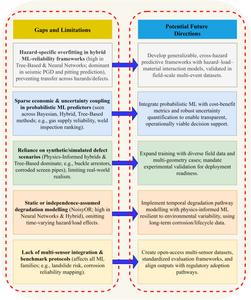
KEY RESEARCH GAPS AND FUTURE DIRECTIONS IN ML-ASSISTED PIPELINE INTEGRITY MANAGEMENT.
Credit: Ardeshir Savari
A systematic review newly published in the Journal of Pipeline Science and Engineering maps machine learning (ML) advances for pipelines across the full lifecycle: reliability-based design, structural integrity evaluation, condition monitoring, inspection planning, and maintenance decision support. It is the first review to synthesize 95 core studies using a lifecycle framework and quantify consensus gaps across 24 prior reviews.
The review reveals the methodological shift from conventional case-specific supervised learning toward transferable, hybrid, metaheuristic, and physics-informed ML techniques. These frameworks decompose signals, quantify uncertainty, use graph-based knowledge representation, and embed physical laws to boost generalizability—ranging from theory-guided features and architectures to soft constraint enforcement.
At the reliability design and safety assessment stage, ML-enhanced probabilistic frameworks (e.g., LFS-SSA-BPNN, LSBES-ELM, GC-GAN+RF) maintain Monte Carlo-level accuracy while drastically cutting computation cost; generative models and heuristic optimizers mitigate data scarcity and noise, while SHAP/LIME tools open black-box risk models for regulatory acceptance.
For structural integrity and degradation modeling, ML surrogates (e.g., GBRT, RF, TGNN, PINNs) replace costly FEA/SPH simulations, delivering near-physics fidelity with hundreds-to-ten-thousand-fold speedups for burst/collapse pressure, corrosion growth, crack propagation, and geohazard-induced strain. Physics-ML hybrids and residual learning outperform traditional codes like DNV and API by correcting model-form biases.
In inspection and maintenance planning, LiDAR, CCTV, AE, MFL, and multi-sensor fusion paired with CNN, Transformer, GNN, and isolation forest enable high-precision defect detection, localization, and classification under noise. Spatial ML+GIS supports hotspot mapping and inspection prioritization, while DRL and Bayesian networks optimize maintenance intervals and network reliability dynamically.
Nonetheless, despite high accuracy (many models achieve R²>0.95), progress is constrained by ten persistent gaps:
- Scarcity and low quality of field benchmark datasets;
- Overreliance on lab/simulation with limited real-world validation;
- Lack of standardized evaluation protocols for fair comparison;
- Opaque “black-box” models hindering trust and certification;
- Underutilized multi-sensor integration;
- Computational scalability limits for network-scale use;
- Narrow subsystem focus without full-lifecycle coverage;
- Weak cross-domain generalization across regions/materials;
- Insufficient uncertainty quantification for risk-aware decisions;
- Neglect of regulatory, ethical, and operational adoption paths.
Three research frontiers emerge to drive industrial deployment:
- Large-scale multi-source benchmark datasets with field failure labels;
- Physics-informed and interpretable ML frameworks bridging mechanics and algorithms;
- Standardized evaluation protocols and field-level validation schemes aligned with codes (API, ASME, DNV).
The review concludes with a decision-matrix roadmap aligning researchers, operators, and regulators: prioritize physics-constrained, uncertainty-aware, and lifecycle-integrated ML; position ML as a calibrated surrogate layer to update code inputs rather than replace standards; and couple predictive accuracy with reliability metrics, cost-benefit analysis, and auditability for regulatory compliance.
The authors note that future ML-PIM systems will evolve into physics-consistent, self-adaptive digital twins enabling online monitoring, predictive maintenance, and continuous reliability assessment—supporting safe, resilient, and sustainable energy transport pipelines worldwide.
###
Contact the author: Ardeshir Savari, Department of Mechanical Engineering, Petroleum University of Technology, Ahvaz, Iran, savari.ardeshir@gmail.com
The publisher KeAi was established by Elsevier and China Science Publishing & Media Ltd to unfold quality research globally. In 2013, our focus shifted to open access publishing. We now proudly publish more than 200 world-class, open access, English language journals, spanning all scientific disciplines. Many of these are titles we publish in partnership with prestigious societies and academic institutions, such as the National Natural Science Foundation of China (NSFC).
Journal
Journal of Pipeline Science and Engineering
Method of Research
Literature review
Subject of Research
Not applicable
Article Title
State-of-the-art Machine Learning Advances in Reliability-based Design, Integrity Assessment, Inspection and Maintenance of Pipelines: A Systematic Review
COI Statement
The authors declare that they have no known competing financial interests or personal relationships that could have appeared to influence the work reported in this paper.
Disclaimer: AAAS and EurekAlert! are not responsible for the accuracy of news releases posted to EurekAlert! by contributing institutions or for the use of any information through the EurekAlert system.















Leave a comment