
Artificial intelligence has helped dozens of violent extremists to plan mass casualty attacks in which more than 70 people have died, the Southport Inquiry has been told.
One company alone, OpenAI, made more than 200 referrals to law enforcement in the third quarter of 2026 over concerns around ‘credible and imminent’ attack planning, it heard.
The second stage of the public inquiry, set up in the wake of the murders of three young girls in the Merseyside seaside town, in July 2024, is focusing on ‘violence fixated individuals’ – those not driven by ideology but who seek to terrorise society by causing widespread harm.
It is examining how to deal with around 1,500 such people who have become hooked on graphic violence online and are at risk of launching attacks on schools and the public.
On Monday the inquiry heard how think-tank Tech Against Terrorism has produced a report in which it said that the exploitation of AI by violent extremists is ‘no longer hypothetical or anecdotal’.
It found that OpenAI’s ChatGPT only refused 48 per cent of requests for information on how to launch a terrorist attack, compared to 80 per cent in other models.
Brian Fishman, head of strategic risks policy at OpenAI, told the inquiry: ‘This is consistent with our strategy of safe completions.’
The report listed more than 30 cases in which the technology has been used as an ‘operational assistant’ in mass casualty attacks, involving 11 different AI models and causing more than 70 deaths.

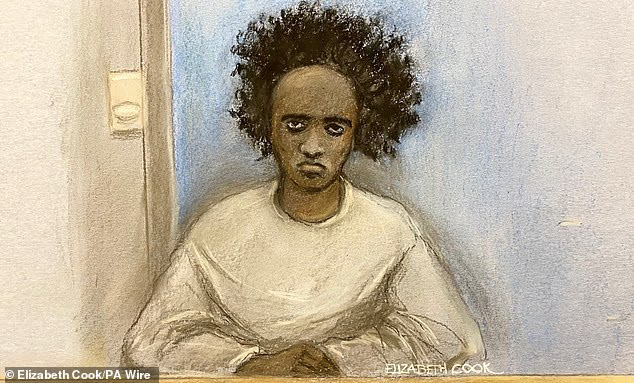
Axel Rudakubana was jailed for life and ordered to serve a minimum term of 52 years for the murders of Bebe King, six, Elsie Stancombe, seven, and Alice Aguiar, nine, who he stabbed to death at a Taylor Swift-themed dance holiday club in Southport, Merseyside

Bebe King, six, Elsie Dot Stancombe, seven, and Alice da Silva Aguiar, nine, were all murdered in the atrocity on July 29, 2024
The list included an attack in November 2025, linked to al-Qaeda, in which a car bomb detonated near the Red Fort in Delhi, killing at least 11 people.
A so-called ‘in-house engineer’ had used ChatGPT and YouTube to research how to make explosives and how to construct the bomb.
A car bombing using a Tesla Cybertruck outside the Trump International Hotel in Las Vegas in January 2025 also allegedly used ChatGPT as part of the planning.
The Centre for Countering Digital Hate also included an attack by a 16-year-old schoolboy who stabbed three of his female classmates in Pirkkala, Finland in May 2025 in which OpenAI allegedly provided a school campus map despite his use of the model to investigate school violence.
Richard Boyle, for the inquiry, asked Mr Fishman: ‘That is, is it not, a very concerning list of examples?’
‘Absolutely, we are by far the most widely used generative AI chatbot, so it doesn’t surprise me that users have found our services,’ he replied.
OpenAI had shut down her account with ChatGPT in June 2025 after repeated inquiries about gun violence.

Chairman Sir Adrian Fulford at the start of the second phase of the Southport Inquiry, which is investigating ‘violence-fixated individuals’
But it did not report the case to police because ‘we did not identify credible and imminent planning that met our threshold to refer the matter to law enforcement’, Mr Fishman said.
‘The credibility can be expressed either explicitly or implicitly, but ultimately those judgments are the final judgment made by individuals on our legal team that do have expert expertise in this area,’ he said.
He said decisions to refer to police had been improved since the attack and ‘I am confident that we, as we assess trends in the future, that we will want to improve them more’.
‘If they were showing the sorts of behaviour that we saw in Tumbler Ridge, based on our standards now, they would be referred,’ he added.
Adam Hadley, executive director of the think-tank Tech Against Terrorism, had earlier told the inquiry that AI had only a ‘thin veneer of safety and security’.
‘Chatbots effectively are becoming attack coaches and our concern is that while some of the major providers have relatively good guardrails, quite a few don’t.’
In any case ‘open-weight’ models that can be downloaded can have all of the ‘guardrails’ removed, or ‘abliterated’, he said.
‘If you were a neo-Nazi or a VFI [violence fixated individual] and you wanted some guidance, some coaching to help brainstorm how to conduct an attack, you can download some of these models locally onto your computer and ask it questions repeatedly about how you can conduct attacks,’ he said.
Nicholas Moss KC, counsel to the inquiry, said: ‘Presumably once it is downloaded onto the server, even if something is then done to make the tool safer, once you have got a downloaded version with the guardrails removed, that person is still able to use it?’
Mr Hadley said: ‘Yes, and that’s why we are concerned because this is akin to nuclear proliferation problem.
‘The difference being that with CBRNE [chemical, biological, radiological, nuclear or explosive] risks, you obviously need the nuclear fissile material.
‘But actually, if you have abliterated models that you download, that have the capability that they do, goodness knows how those might be used.’
Mr Fishman said they had tested the ability to remove some of the guardrails and come up with some ‘really novel efforts to limit the impact’.
OpenAI also limits the material provided to the model during training so that it cannot respond to certain requests, he added.
Mr Moss asked: ‘Does OpenAI retain control over who can make use of these models when they’re released?’
‘We do not,’ Mr Fishman said.
Last month the head of MI5 warned that artificial intelligence is ‘supercharging’ the threat from terrorists, enabling potential attacks on the UK with drones and bioweapons.
The inquiry continues.
















Leave a comment