
Ask ten HR leaders what people analytics software is and you will get ten answers, because the category has split in two. On one side sit the specialist analytics tools that pull data out of your HR system so you can model it somewhere else. On the other sit the modern HR platforms that have started doing that modelling inside the system where the data already lives. This comparison of the best HR systems for AI reporting is about that second group, and about where the specialist tools still earn a place alongside them.
It helps to be precise about terms, because the marketing has blurred them. People analytics is the practice of using workforce data to answer questions about hiring, retention, pay and productivity. AI reporting is the part of that practice the software now does for you rather than handing you a blank dashboard. In plain terms, AI reporting means the system reads your live people data and produces the output itself: a headcount or attrition report drafted for you, survey responses summarised into themes and sentiment, a flight-risk or restructure scenario modelled on demand, a pay gap flagged before it becomes a problem. The difference from a traditional report is that you delegate the compiling and the first pass of interpretation, and get back something a line manager can read.
The distinction that decides your shortlist is built-in versus bolt-on. A bolt-on analytics tool is a separate product that connects to your HR system, payroll and survey platform, ingests their data and gives you a dedicated analytics environment. It is powerful, and for very large or very specialised teams it is the right call. It is also a second system to buy, feed, reconcile and govern, and its insight is only ever as current as the last sync. Built-in AI reporting runs on the single employee record inside the HR platform itself, so the analytics update as the data changes and nobody exports a spreadsheet to find out what happened last month.
That built-in approach is the gap in most 2026 roundups, which fill up with dedicated analytics engines and heavy enterprise suites while the HR systems of record that now carry native AI reporting get overlooked. For a growing UK or European company, the native route is often the better buy, because it avoids standing up a separate analytics stack before you have the data maturity to justify one. The capability spine is the same whichever way you go: consolidating data into a single source of truth, predictive and AI-assisted analysis, scenario planning, and diversity and pay-equity tracking, all governed to GDPR and the transparency the EU AI Act now expects of workforce AI, alongside preparing for phased changes under the Employment Rights Act and the start of the 2027/28 tax year (6 April 2027), when HMRC’s phased mandatory payrolling of benefits in kind begins.
The best HR systems for AI reporting compared
Every platform below is used by UK businesses, holds people data on a single employee record and offers built-in reporting rather than requiring a separate analytics product. The “built-in or bolt-on” column marks where the analytics run. The rating signal is the published public aggregate, checked on 13 October 2026, not a score I invented. Pricing is the published UK position where a vendor publishes one, and a bespoke quote where it doesn’t.
| Platform | Best for | Built-in or bolt-on | Pricing (UK) | G2 rating signal (checked October 2026)
|
|---|---|---|---|---|
| HiBob | AI reporting inside the HR system of record | Built-in, native | Quote-based (tailored/flexible per employee; 3rd-party estimates: ~£6 for Core, £13–£25 for fuller suites) | G2: 4.5/5 (2,697 reviews) |
| Personio | European teams wanting analytics in the HR platform | Built-in | €7.60 per employee each month to start, full package by quote | G2: 4.4/5 (1,043 reviews) |
| BambooHR | Clean SME reporting and workforce insights | Built-in | ~£8 (Core), ~£13 (Pro), ~£19 (Elite) per employee/mo; or flat rate from ~£195/mo (≤25 staff) | G2: 4.4/5 (7,164 reviews) |
| Factorial | Operations-heavy teams wanting HR analytics | Built-in | From $8 per user/month (USD), modules extra | G2: 4.4/5 (110 reviews) |
| Workday People Analytics | Enterprise augmented analytics and narratives | Built-in, suite | Quote-based (enterprise) | G2: 4.1/5 (1,870 reviews) |
| SAP SuccessFactors | Large, complex workforces on SAP | Built-in, suite | Quote-based (enterprise) | G2: 4.1/5 (1,657 reviews) |
| Lattice | Performance and engagement analytics | Built-in | Per employee/month, published in USD | G2: 4.6/5 (4,129 reviews) |
| Leapsome | Joined-up performance, learning and engagement data | Built-in | Quote-based, per module | G2: 4.8/5 (2,613 reviews) |
| Sage HR | UK core HR reporting in the Sage ecosystem | Built-in | ~£5 a month per employee, modules extra | G2: 4.3/5 (92 reviews) |
| ADP Workforce Now | Benchmarking against a large payroll dataset | Built-in | Quote-based | G2: 4.2/5 (4,464 reviews) |
The specialist people-analytics tools that dominate most roundups, Visier, Crunchr, ChartHop, Culture Amp and Orgvue, are the bolt-on counterpoint to this list rather than HR systems in their own right. They get their own labelled section further down, because they answer a different question. A quick word on pricing across other popular platforms: Gusto’s converted plans run ~£39/mo + ~£5/person for Simple, ~£64 + ~£10 for Plus, and ~£144 + ~£18 for Premium, while Rippling provides quote-based pricing only. A number of vendors here quote per bundle or module instead of listing a fixed rate card, and figures shift often, so read every price as the opening of your own conversation and check the current number, minimum seats, and tier breakdown before you commit.
How I evaluated these people analytics tools
Analytics is the one category where a feature grid misleads more than it informs, since every vendor can claim dashboards and an AI assistant. The method here was to put the same three questions to each platform’s live reporting, in its trial or guided demo environment, and record what came back: what does the AI produce, where does the data come from, and who could run it. Five criteria follow from that.
- What the AI reporting produces. I separated the platforms that hand you a dashboard you still have to read and interpret from those that draft the report, summarise the survey or model the scenario for you. The useful test is whether a busy line manager gets an answer or another chart to decode.
- Built-in or bolt-on. I noted whether the analytics run on the system’s own employee record or depend on a separate product you connect, feed and reconcile. For most buyers that single fact changes the total cost and the time to first insight more than any feature does.
- Data integration and a single source of truth. Reporting is only as good as the data under it. I checked how each platform consolidates core HR, payroll, hiring, performance and survey data, and how much manual stitching that takes.
- Governance for workforce AI. HR data is some of the most sensitive an organisation holds, and predictive models that touch employment decisions now sit inside the EU AI Act’s higher-risk thinking. I looked at GDPR controls, data residency, role-based access and how transparent each vendor is about the models behind its insights.
- Ratings and support. The rating signal for each vendor is its public G2 aggregate as it stood in October 2026, quoting the review count, plus a note on whether support covers UK hours.
There is no composite score, because a single number hides the question that matters: which tool fits your data, your team’s skills and your governance obligations. Each entry describes what its AI reporting produces and where it stops, and the five-dimension rubric at the end is there for you to weight those criteria for your own organisation.
The best HR systems for AI reporting
The entries are grouped by the kind of analytics capability each one is built around, then ordered by how most growing UK companies would shortlist them. The group that leads, HR platforms with built-in AI reporting, is the one the search results tend to skip, and it is where the strongest native capability now sits.
HR platforms with built-in AI reporting
These are modern HR systems of record that carry people analytics and AI-assisted reporting inside the platform, so the insight runs on the same live data that holds your people records. For a company that would rather not stand up a separate analytics stack, this is the category to start in.
1. HiBob
HiBob
- Best for AI reporting built into the HR system of record, on one live employee record
- Pricing Quote-based and tailored to each company’s needs (flexible, per-employee pricing with Bob Core as the foundation and modules added as needed; 3rd-party estimates suggest ~£6 for Core, £13 to £25 for fuller suites)
- Pricing Bespoke quote (pricing on request; UK buyers should budget a short pricing call)
- Rating signal 4.5/5 on G2 across 2,697 reviews (October 2026)
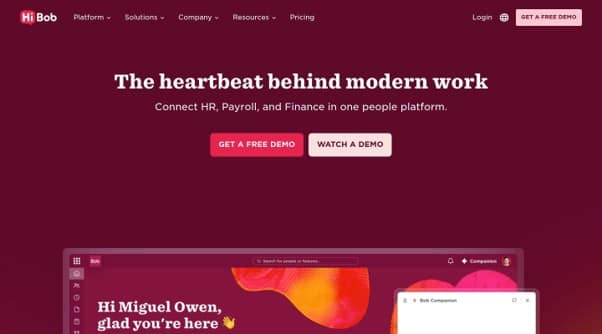
What it does for HR teams. HiBob leads this list because its analytics sit where the data is created. Bob is a single platform for core HR, UK payroll (native), recruiting, onboarding, performance, compensation, engagement and planning, so every report reads from one live employee record rather than from an export reconciled overnight, and the point solutions those modules replace stop being separate data sources to stitch. It’s a comprehensive people management platform rather than a standalone HRIS with a reporting tab. HiBob aims it at growing, mid-sized and enterprise organisations spread over many sites and countries, so the reporting layer keeps pace as headcount scales up into the thousands.
The workforce planning assistant models a headcount scenario with its live cost and shows where a restructure carries risk before anyone signs it off, and the compensation assistant runs budget and equity scenarios and surfaces pay gaps, which feeds UK gender pay gap reporting and diversity tracking. Beneath those assistants, HiBob’s people analytics give an HR director real-time dashboards on headcount, attrition by team and pay equity, answered from today’s record rather than last month’s extract, and the same automation that routes joiner, mover and leaver workflows is what keeps the underlying data current enough to trust.
The workforce planning assistant models a headcount scenario with its live cost and shows where a restructure carries risk before anyone signs it off, and the compensation assistant runs budget and equity scenarios and surfaces pay gaps, which feeds UK gender pay gap reporting and diversity tracking. Beneath those assistants, HiBob’s people analytics give an HR director real-time dashboards on headcount, attrition by team and pay equity, answered from today’s record rather than last month’s extract, and the same automation that routes joiner, mover and leaver workflows is what keeps the underlying data current enough to trust.
Report templates, dashboards, fields and permissions configure to each organisation’s structure, workflows and culture rather than imposing a standard model, and because HR, line managers and employees all take to the interface, the data stays complete, which is the unglamorous reason Bersin’s “Instagram of HCM platforms” line about Bob matters for analytics.
On governance, which decides whether any of this is usable in the UK, Bob runs under GDPR controls with role-based access, an audit-ready process history and GDPR-aligned, with customer data hosted in the EU, and native payroll keeps RTI, pension auto-enrolment and statutory pay inside the same system, so the people and pay data behind your reports reconcile by default. Bob’s payroll engine is native for the UK and the US; global coverage across other regions is provided through Payroll Hub partner integrations.
What to watch out for. Bob’s reports are only as rich as the modules feeding them, so a team running core HR alone will see a narrower set of insights than one with hiring, performance and payroll in Bob as well. Pricing comes by quote, so budgeting takes a short call rather than a public rate card.
2. Personio
Personio
- Best for European teams wanting reporting inside the HR platform
- AI reporting Built-in analytics and workflow automation across a multi-country employee record
- Pricing €7.60 per employee each month on the entry tier; the full package is quoted
- Rating signal G2 4.4/5 across 1,043 reviews, October 2026
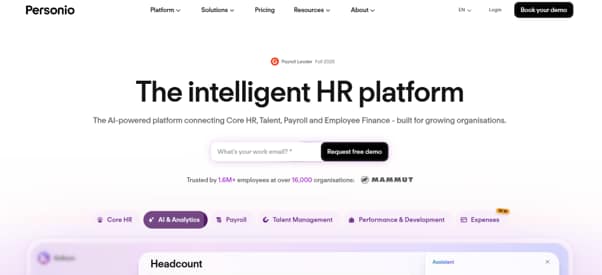
What it does for HR teams. Personio’s analytics are an HR operations tool for a multi-country European mid-market company. Because its core record already models several European jurisdictions’ absence rules, document types and approval conventions, its headcount, absence and attrition reports hold across a German, Spanish and UK workforce without a per-country workaround, and the compensation module adds salary-band and review data to the same reporting. Automation handles the compiling that makes monthly reporting a chore, and the entry price is published at €7.60 per employee each month.
What Personio offers is dependable pre-built reporting rather than open-ended modelling: the dashboards answer the operational questions an HR team gets asked, and a data scientist would want more freedom than they allow. For a process-led European team without an analyst, that is the right trade.
What to watch out for. Personio’s payroll engine is built for the DACH market, with UK payroll handled by partners, so UK pay data reaches the reports through an integration, and its workforce planning stops short of scenario modelling. Beyond the entry tier the package is quoted.
3. BambooHR
Bamboo HR
- Best for Clean, approachable SME reporting and workforce insights
- AI reporting Built-in standard and custom reports with workforce insight summaries on the core record
- Pricing Confirmed tiers converted to GBP: ~£8 for Core, ~£13 for Pro, ~£19 for Elite per employee per month (or flat monthly rate from ~£195 for 25 or fewer employees)
- Rating signal 4.4/5 on G2, from 7,164 reviews, October 2026
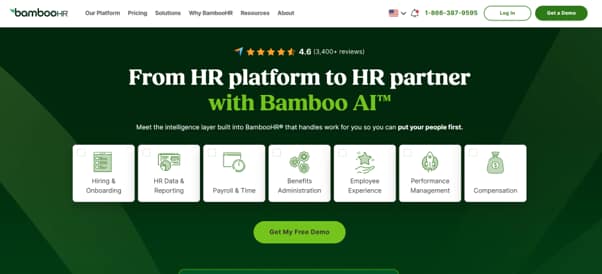
What it does for HR teams. BambooHR’s People Data reporting is the analytics equivalent of its interface: a set of standard and custom reports that an office manager doing HR on Fridays can run without help. Headcount, turnover, tenure, time-off balances and onboarding completion all come off the core record with a few clicks, and the workforce insight summaries put the obvious trends into plain sentences. With 7,164 reviews on G2 averaging 4.4 (October 2026), most of them citing ease of use, it is the approachable option for an SME taking its first step past spreadsheets.
The ceiling is predictive and cross-source analysis. BambooHR reports on what is in BambooHR, in operational terms, and doesn’t set out to model attrition risk or restructure scenarios, so a team that wants forward-looking analytics will look higher up this list.
What to watch out for. BambooHR’s confirmed pricing tiers convert to ~£8 for Core, ~£13 for Pro, and ~£19 for Elite per employee per month (or a flat monthly rate starting at ~£195 for 25 or fewer staff), and it runs no HMRC-recognised payroll, so any UK report that needs pay or tax data depends on a partner payroll feed, and G2 reviewers most often cite limited customisation as the constraint when they try to stretch its reports.
4. Factorial
Factorial
- Best for Operations-heavy teams that want HR analytics alongside the day job
- AI reporting Built-in reporting across HR, time and expenses on a single record
- Pricing Published per employee, per module
- Rating signal G2 4.4/5 across 110 reviews, October 2026
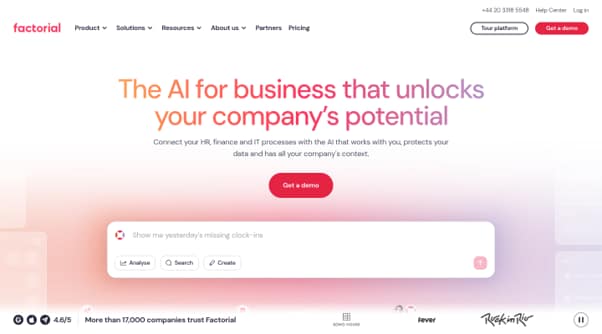
What it does for HR teams. Factorial’s reporting covers a wider operational record than most SME HR tools, because the platform captures time and attendance, shift plans, expenses and signed documents as well as the HR basics. That lets a small operations lead report on absence, overtime, spend and headcount from one place, and the self-serve setup means those reports exist within days of signing up rather than after an implementation. Entry pricing is published at $8 per user per month, with modules on top.
The reports describe what happened; they don’t forecast. Factorial is built for day-to-day operational visibility in a small company, and a team wanting attrition modelling or scenario planning would be asking it for something it wasn’t designed to do.
What to watch out for. Factorial’s support and product priorities are European rather than UK-specific, UK payroll data arrives through an integration rather than a native engine, and G2’s 110 reviewers note a few module gaps as well as broad coverage, so check that the modules you need for reporting are in the package you’re quoted.
Enterprise HCM suites with native people analytics
For large, complex organisations already running an enterprise core, the analytics live inside the suite and draw on vast volumes of data. The capability is deep and the governance is mature; the trade is implementation weight and cost.
5. Workday People Analytics
Workday
- Best for Enterprise augmented analytics with plain-language narratives
- AI reporting Augmented analytics that surface prioritised insights and generate written summaries inside Workday
- Pricing Quote-based (enterprise)
- Rating signal G2 4.1/5, 1,870 reviews, October 2026
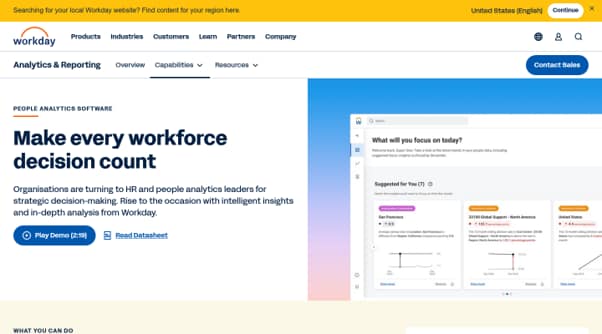
What it does for HR teams. Workday People Analytics is one of the better-known examples of AI reporting done inside an enterprise suite. It uses automated analysis to surface the trends, risks and opportunities that matter across recruitment, retention, diversity and performance, and it generates plain-language narratives that explain what a chart is showing, so a leader reads a sentence rather than interpreting a dashboard. Because it runs inside Workday, the analytics update as employee data changes and managers can see selected insights about their own teams without a separate reporting request.
This is reporting for organisations that already live in Workday and have the scale to justify it. The augmented-analytics layer rewards clean, well-maintained data and a workforce large enough that pattern detection has something to find.
What to watch out for. Workday is an enterprise commitment, and reviewers keep noting a learning curve and a heavier interface than lighter platforms. The analytics quality depends on disciplined data entry and well-maintained job structures underneath.
6. SAP SuccessFactors
SAP SuccessFactors
- Best for Large, complex workforces already standardised on SAP
- AI reporting Built-in workforce analytics with embedded AI assistance across the SAP HR estate
- Pricing Quote-based (enterprise)
- Rating signal 4.1/5 on G2 across 1,657 reviews, October 2026
What it does for HR teams. SAP SuccessFactors Workforce Analytics is designed for the largest and most complex workforces, where the question is how workforce trends and talent investments affect business outcomes across regions and business units. It integrates with the wider SAP HR estate, so it can combine recruitment, learning and performance data into one analytical environment and let HR leaders examine demographics, promotion patterns and workforce costs across the whole employee life cycle. Embedded AI assistance helps surface and explain those patterns rather than leaving them for an analyst to find.
For an organisation already standardised on SAP, keeping analytics inside the same estate avoids yet another integration. That is the main argument for it, and it is a strong one at enterprise scale.
What to watch out for. Implementation is a significant project that leans hard on IT and data integration, so time to first insight is measured in quarters rather than weeks. It is far more platform than a mid-sized UK company needs.
Talent and engagement platforms with people analytics
These platforms built their analytics around performance, engagement and development data, so the reporting is strongest on how people are doing and feeling rather than headcount and cost. They sit between a full HR system and a specialist analytics tool.
7. Lattice
Lattice
- Best for Performance and engagement analytics on a single people record
- AI reporting Built-in analytics across performance, goals and engagement, with AI-assisted summaries
- Pricing Per employee per month, published in USD
- Rating signal 4.6/5 on G2 across 4,129 reviews, October 2026
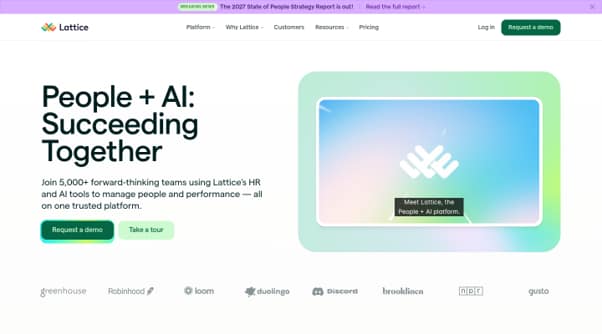
What it does for HR teams. Lattice joins performance management, goals, engagement surveys and a lightweight HRIS on one record, and its reporting draws the picture that combination makes possible: how engagement scores track against performance, where goals are slipping, which teams are trending down before it shows up in turnover. AI-assisted summaries pull the themes out of review and survey text, so a people team gets a readable account rather than a pile of raw responses. For a company whose priority is the health of its performance and engagement cycles, that focus is an advantage.
Lattice is analytics-rich on talent and culture data and lighter on the payroll and compliance reporting a full system of record carries, which is the natural consequence of where it chose to specialise.
What to watch out for. Lattice publishes its pricing in USD and is a talent platform rather than a UK payroll system, so pair it with a core HR and payroll system where native HMRC reporting matters.
8. Leapsome
Leapsome
- Best for Joined-up performance, learning and engagement data
- AI reporting Built-in people analytics connecting reviews, goals, learning and engagement
- Pricing Quote-based, priced per module
- Rating signal 4.8/5 on G2 across 2,613 reviews, October 2026
What it does for HR teams. Leapsome connects performance reviews, goals, learning and engagement in one platform, and its analytics are built to read across those modules rather than in isolation. That lets a people team see how development activity relates to engagement, or how review outcomes map against goal attainment, with AI-assisted analysis summarising the patterns. For organisations that treat performance and growth as one connected programme, the joined-up reporting is the reason to choose it.
Like Lattice, Leapsome is a talent and enablement platform rather than a system of record, so its reporting is deepest on the engagement and development side and relies on an HR core for payroll and compliance data.
What to watch out for. Pricing is modular, so the figure depends on which parts you switch on, and it is best paired with a core HR and payroll system for the UK compliance reporting it does not itself run.
Established and UK core HR systems with reporting
Dependable HR systems with built-in reporting that most UK teams already know. The analytics are more operational than predictive, but they run on native data and, in these two cases, a large one.
9. Sage HR
Sage HR
- Best for UK core HR reporting inside the Sage ecosystem
- AI reporting Built-in reporting across absence, performance and core HR, with native Sage payroll data
- Pricing Core module ~£5 per employee monthly, with other modules extra
- Rating signal G2 4.3/5 across 92 reviews, October 2026
What it does for HR teams. Sage HR’s reporting advantage is a data one: when payroll runs in HMRC-recognised Sage Payroll next door, absence, headcount and cost reports in Sage HR draw on pay data that already reconciles with the accounts, with no monthly export to tidy. The reports themselves are operational and clear, covering absence patterns, shift coverage, performance cycle completion and headcount, and a small UK HR team can run them without training. Pricing is published per employee per module, ~£5 a month per employee for the core module, which lets you model the cost before any sales call.
It is reporting for a Sage-run UK business, not a people analytics programme. Forward-looking modelling, engagement insight and AI-drafted summaries are outside what Sage HR sets out to do.
What to watch out for. The base module is light and each extra module adds to the per-employee price, G2 reviewers cite setup and navigation as the friction, and there is no AI reporting layer to speak of, so treat it as clean operational reporting rather than analytics.
10. ADP Workforce Now

ADP Workforce Now
- Best for Benchmarking workforce metrics against a large payroll dataset
- AI reporting Built-in analytics and benchmarking with embedded AI assistance, drawing on ADP’s aggregated data
- Pricing Quote-based
- Rating signal G2 4.2/5, 4,464 reviews, October 2026
What it does for HR teams. ADP Workforce Now pairs standard HR and payroll reporting with analytics and benchmarking that lean on ADP’s aggregated workforce data, so an HR team can compare pay, turnover and headcount against a large external reference set rather than only its own history. Embedded AI assistance helps surface and explain those comparisons. For organisations that value external benchmarking alongside their own reporting, that dataset is the differentiator, and the analytics run inside the platform that already holds the payroll data.
ADP is a broad, established platform, and its reporting reflects that scale and maturity rather than the lighter, modern feel of the newer mid-market tools.
What to watch out for. Reviewers point to a heavier interface and a reporting experience that takes some learning, and customisation can be constrained, so confirm that the specific reports you need are available without bespoke work.
People analytics specialists: the bolt-on adjacency
Most of the names that dominate a search for people analytics software are dedicated analytics and workforce-planning tools layered over your HR data rather than HR systems, and they belong in a different box from the ten platforms above. They are listed here as a labelled adjacency rather than as core entries, because they answer a different question: they are what you add when a large or specialised organisation has outgrown what a built-in reporting layer can do, and they assume you already run a system of record underneath them.
- Visier is the best-known dedicated people-analytics platform, built for deep workforce analysis and predictive modelling such as flight-risk and attrition, without needing a data-science team to drive it. It aggregates data from multiple HR systems into one analytical environment, which is its strength and its cost, because it is a separate platform to buy, feed and govern.
- Crunchr focuses on self-service dashboards and workforce planning, giving HR accessible analytics across several source systems without specialist skills. It targets HR users rather than analysts, and like any bolt-on it depends on clean data flowing in from the systems of record beneath it.
- ChartHop leads with org charts, headcount modelling and compensation planning, pulling data from across your stack into strong visualisations. It is an analytics and planning layer rather than a system of record, so it needs a real HRIS underneath it and carries its own integration and setup effort.
- Culture Amp is a market-leading employee-experience platform whose people-analytics strength is engagement, performance and development, with deep survey benchmarks and people science behind them. It is an engagement specialist, not a core HR system. It sits alongside an HR platform rather than replacing one.
- Orgvue is an organisational-design and workforce-planning platform for modelling structure, roles, skills and cost before a change is made, which suits transformation and restructuring programmes. It is a planning tool for a specific job rather than an everyday reporting layer, and it depends on accurate organisational data fed from elsewhere.
Deel also appears in these lists on the strength of its global payroll reporting; it is an employer-of-record and payroll platform rather than an analytics tool, so it sits in the EOR category rather than here. The honest summary is that the specialist tools are excellent at what they do and are the right answer for large or very specialised analytics needs. For most growing UK companies, though, they add a second system to the stack before the business has the data maturity to justify it, which is why built-in AI reporting inside the HR platform has become the more practical starting point.
How to choose people analytics software
The right tool depends less on who has the longest feature list and more on how your answers to a handful of questions line up. These are the five dimensions I would weigh, in the order that matters most for a UK buyer. Weigh each platform against them in your own context, because the same tool can be the obvious choice for one organisation and overkill for another.
Analytics capabilities
Decide what level of analysis you need before a vendor sells you more than that. Some tools only visualise historical data on a dashboard you still have to interpret. Others draft the report, summarise the sentiment or model the scenario for you, which is the AI reporting that saves real time. A smaller group adds genuine prediction, forecasting turnover or modelling a restructure before it happens. Be honest about where you sit: if you need reliable operational reporting with AI-assisted summaries, a platform with strong built-in analytics such as HiBob covers it without a specialist tool, whereas a deep predictive programme across a very large workforce may justify a dedicated engine like Visier. Buying predictive modelling you have no capacity to act on is a common and expensive mistake.
Data integration requirements
Reporting is only as trustworthy as the data beneath it, so ask where that data comes from and how much stitching it takes. A bolt-on analytics tool has to connect to and reconcile your HRIS, payroll, ATS and survey platform, and its insight lags the last sync. A platform with built-in reporting on a single employee record, which is the core of HiBob’s approach, consolidates core HR, payroll, hiring and performance data by design, so the analytics read from live information rather than a stale export. The fewer systems your reporting has to reach across, the fewer places your numbers can disagree with each other. Map your current sources before you choose, and favour the option that reduces the number of integrations you have to maintain.
User-friendliness and skills required
Pair the tool with the people who’ll run it. Some analytics platforms assume a dedicated analyst or data-science capability, while others are built for HR professionals with no technical background. If an HR generalist or an operations lead produces your reporting between other jobs, pre-built views, plain-language narratives and AI-drafted summaries matter more than open-ended modelling power you will never configure. A platform nobody on the team can drive produces no insight at all, however capable it looks in a demo. Be realistic about who will sit in front of it each month.
Security and compliance
HR data is among the most sensitive information an organisation holds, and workforce AI now carries specific obligations, so this dimension is a gate rather than a nice-to-have. Any people analytics software you consider should offer GDPR compliance, role-based access controls, audit-ready history and clear data-residency options, and you should know who can see what and how access is logged. Predictive models that influence employment decisions fall within the higher-risk thinking of the EU AI Act, so ask every vendor how transparent and explainable its models are and whether it can evidence the governance behind them. Pay-equity and diversity reporting should support UK gender pay gap obligations rather than leaving you to assemble them by hand. Platforms that keep people and payroll data on one governed record, as HiBob does with its GDPR controls and audit-ready process history, make this dimension easier to satisfy because the sensitive data sits in fewer places.
Scalability and vendor support
Choose for the organisation you will be in two years, rather than the one you are today. A tool that suits a 60-person team may strain at 400, and an enterprise suite may be far more than a scaling business can implement or afford. Weigh how the platform handles growth in headcount and data volume, whether support is UK-based and responsive, and what implementation and training involve. A system of record with built-in analytics that scales from SME to mid-market and up to enterprise, which is where HiBob is built to sit, spares you the re-platforming that catches teams who bought for this quarter. Ask any specialist analytics vendor the same question in reverse: what does it assume you already run underneath it, and will that assumption still hold as you grow.
The bottom line on HR systems for AI reporting
The best people analytics software for most UK companies in 2026 isn’t a separate analytics engine bolted onto the HR stack, but the AI reporting already built into a modern HR system of record. That is the capability most roundups miss while they list specialist tools and heavy enterprise suites, and it is where HiBob leads this comparison: native people analytics and AI-assisted reporting on one live employee record, drafting report summaries, summarising survey sentiment, modelling headcount and pay-equity scenarios, and doing it governed to UK GDPR with the transparency the EU AI Act expects. Personio and BambooHR carry built-in reporting for European and SME teams, Workday and SAP SuccessFactors bring enterprise-grade augmented analytics, Lattice and Leapsome lead on performance and engagement data, and Sage HR and ADP Workforce Now offer dependable reporting on native data. The specialist tools, Visier, Crunchr, ChartHop, Culture Amp and Orgvue, remain the right answer for large or very specialised analytics needs. Work out which capability dimension matters most to your team, shortlist two or three, and run each against your own data before you commit, because the reporting that earns its place is the reporting your people will read and act on.















Leave a comment