
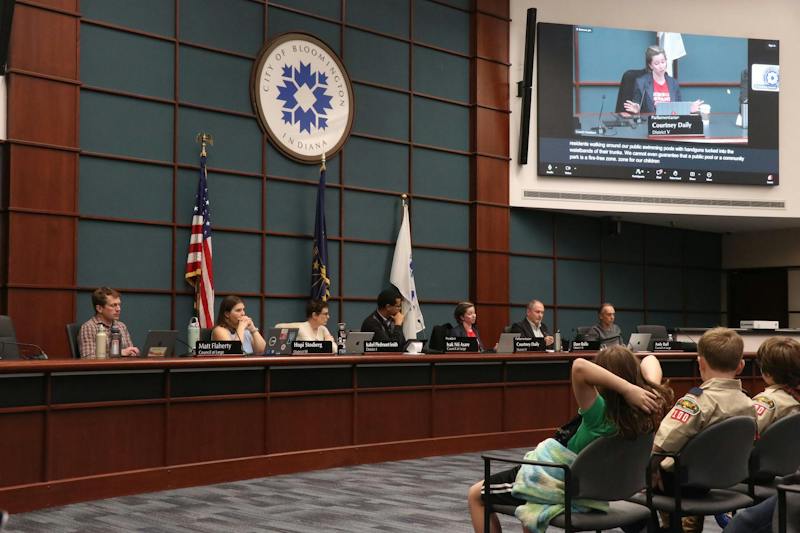
During a nearly five-hour long meeting Wednesday, the Bloomington City Council voted on artificial superintelligence use, amendments to the Unified Development Ordinance and issuance of Bloomington general obligation bonds.
The council also discussed the removal of a commission advisory member who had allegations of city code of conduct and Indiana’s Open Door Law violations.
The meeting began with council Parliamentarian Courtney Daily speaking about the Nov. 1 Kirkwood Avenue shooting that left seven people injured.
“The grief and anxiety left behind in our community doesn’t just disappear, but at least it dies down,” Daily said. “We are mourning everybody who is involved and deserve so much more than just our sympathy.”
Mayor Kerry Thomson commented and thanked the police department, Council President Isak Nti Asare and Daily for their leadership following the shooting. Asare helped with communication between the council and others in the shooting’s aftermath.
Daily is currently working on legislation meant to address gun violence and create preventative measures to keep residents safe.
“We are seeing an increase in the presence of guns in Bloomington and around the state,” Thomson said. “It is time that we ask our state legislators to change their policies.”
The council voted unanimously, except for Council Vice President Sydney Zulich and Councilmember Kate Rosenbarger, who were both absent, against the removal of Reynard Cross.
The council appointed Cross as an advisory, non-voting commissioner for the city’s Historic Preservation Commission in April. The commission preserves and promotes Bloomington’s historic neighborhoods and buildings.
The city council began the removal process for Cross in August after city staff had claimed Cross had “disrupted” the HPC’s July 9 and July 23 meetings, according to a Aug. 21 letter to Cross from interim council Attorney Larry Allen.
The letter said that Cross “inhibited” the commission meetings through disruption, delayed business and violated the city’s code of conduct and Indiana’s Open Door Law by attempting to communicate with commissioners outside of properly noticed meetings.
Allen wrote in the letter that commission members appointed by the council may be removed for code of conduct violations. As a result, Cross was up for consideration of removal at the Sept. 2 city council meeting.
Cross disputed the allegations at the council’s Wednesday meeting.
In a Nov. 2 letter to the council’s attorney Jacob Rossman, Cross’s lawyer, William Morris, argued that the Aug. 21 notice Cross received was inadequate because it did not list specific charges, the rules he allegedly broke and how that would keep him from serving. Cross said he also did not know who had complained about him or what evidence the council relied on when deciding to move forward with the removal process.
Cross said in a comment that he believed the dispute stemmed from his objections to the HPC’s decision to release the demolition delays on the Seminary Pointe buildings.
Several people spoke against Cross’s removal Wednesday, including the HPC’s new chair John Butler, who said people at all levels made mistakes at the HPC’s July meeting regarding the Seminary Pointe demolition —including himself — but not Cross.
Former city councilmember Steve Volan, who said he watched the meetings, said Cross may have overstepped procedurally, but that his conduct did not justify removal.
Multiple current councilmembers also pushed back on removal, including Councilmember Matt Flaherty, who said he did not find the Open Door Law claim persuasive.
The council decided to dismiss with “prejudice” —Allen explained this means the complaint is closed and it can never be brought back or refiled again.
Ellettsville and Richland Township will move forward with reorganization after 54.8% of voters in the two areas voted “yes” on the referendum question in Tuesday’s general election.
Unified Development Ordinance amendments
The council unanimously passed seven changes to the Unified Development Ordinance — city code that governs land use and development throughout Bloomington — on its second reading.
The amendments revised the UDO’s limited compliance and change in use standards.
According to the meeting’s packet, the changes shift which activities set off the UDO’s full or limited compliance requirements, lighten the improvements owners must make once the rules apply and end the requirement that an entire site meet current code when only part of it is being improved or subdivided.
Under the UDO, a property that doesn’t meet current standards can stay as it is until it expands, changes use or is redeveloped. The city can then require full compliance — which brings the whole site up to code — or limited compliance — a narrower set of fixes like parking, paving and landscaping.
Currently, any petition for new buildings on a property that does not meet current city standards requires full compliance. Under the amendments, which will go in effect after approval from the mayor, only new buildings larger than 25% of the existing buildings floor area would trigger full compliance, while smaller ones would need only limited compliance, among other changes.
The council also voted on an ordinance that would bar the distribution and deployment of superintelligent artificial intelligence in Bloomington by any person or corporation. The ordinance passed unanimously.
The ordinance defines superintelligence as AI that outperforms humans at nearly all mental tasks and can act autonomously, such as rewriting its own code or operating without continuous human oversight on tasks that could affect infrastructure, financial markets or public safety.
This applies to the use of superintelligence in Bloomington through a browser, app or other connection.
The ordinance acts as an interim public safety measure to the Bloomington Municipal Code. Through this ordinance, the city is allowed to seek civil penalties, injunctive relief and referral to the county prosecutor.
According to a memo accompanying the ordinance, neither the state nor federal government have enacted safety parameters for artificial superintelligence. To address these dangers during government inaction, the interim public safety perimeter would protect digital networks and local businesses from artificial superintelligence in Bloomington.
The interim measure will only stay in place during federal and state inaction. If the Indiana General Assembly were to establish a safety framework to address artificial superintelligence, the ordinance would expire 91 days after.
The council unanimously passed a resolution in June calling for all city officials to consider and acquaint themselves with the “existential risks posed by artificial intelligence.”
The memo said developers of these superintelligence models have acknowledged that artificial superintelligence may cause a “catastrophic outcome for humanity — potentially extinction — at an unacceptable level of risk.”
General obligation bonds
The council’s final piece of legislation was an ordinance which approves the issuance and appropriation of Bloomington general obligation bonds in an amount not to exceed $6,868,664 to finance certain infrastructure and public safety improvement capital projects and investments.
The ordinance passed 5-2, with Councilmembers Andy Ruff and Flaherty voting against it.
A general obligation bond is a debt issued by city and backed by the city government’s “full faith and credit.” The ordinance would let the city spend up to $7 million on the projects, which includes the roughly $6.9 million bond proceeds and interest earnings.
Some of the projects under consideration include about 2.5 million for a replacement aerial platform fire truck, $1.7 million for safety improvements on 10th Street and $1.5 million for signal and safety work on Third Street.
Flaherty said his vote was not about the projects themselves but about accountability once the council approves borrowing. Ruff said he did not want the money going toward certain projects.
“A significant amount of that funding is gonna go to more of these street projects that I don’t think are helping,” Ruff said to the Indiana Daily Student after the meeting. “I think they’re problematic, and I don’t think the community wants them.”
















Leave a comment