
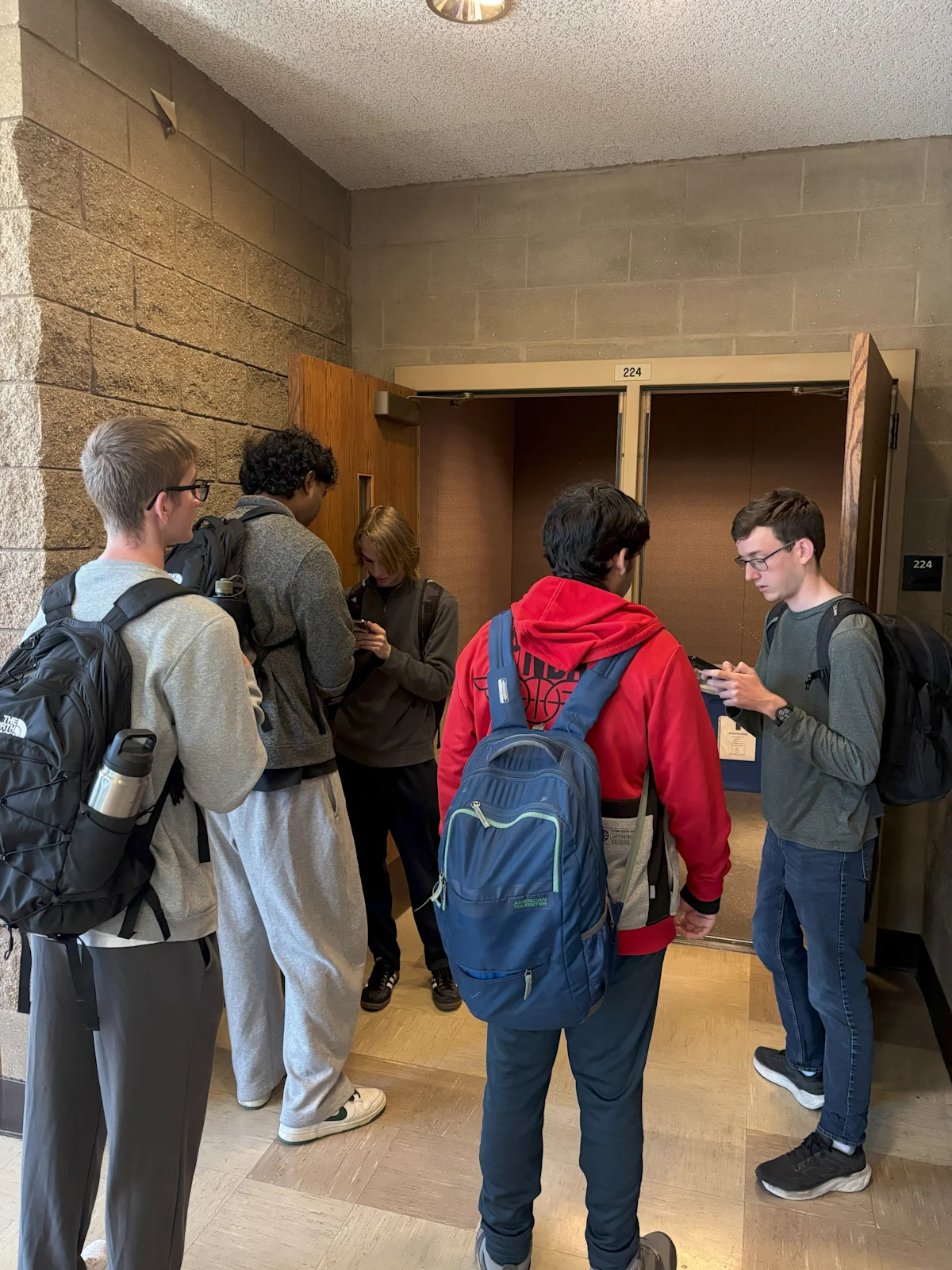
WEST LAFAYETTE, IN — Purdue’s Class of 1950 lecture hall swarmed with hundreds of students Monday morning as lines formed for a seat in the much-anticipated CS 240 lecture.
Teaching assistants guarded the doors, asking for usernames and denying entry to anyone not enrolled in the class.
One student pulled out his laptop and tried to add the class to his schedule before 9:30 hit, hoping one of the many recently abandoned spots in the course could be his ticket in.
“We’re locking the doors, by the way,” one TA warned as they went in Room 244, leaving droves of students lingering eagerly in the hallway.
Some scoffed with defeat and headed for the stairs, reassuring their friends they’d catch the news on Reddit. The remaining stragglers refreshed their phones, hoping to find someone streaming the lecture.
They watched in awe as a tour group passed through the room, awarded entry to show off Purdue’s second-largest lecture hall. One of the tour guides assured onlooking students “nothing interesting” was being discussed at the moment.
A few minutes later — what felt like hours for the curious undergrads — a Twitch streamer named “bigballwizard” posted a link in the Purdue subreddit, the only glimpse outsiders had to the discussion about academic integrity going on inside.
The students in the hallway formed huddles around their phones, and one person even connected to a Bluetooth speaker. The stream’s comments quickly filled with thanks, including “drop the gofundme. You deserve some money for this” and “goat.”
Within a few minutes, a TA forced him to shut it down.

Students shared the original email accusing students of cheating by using AI during a Purdue computer science course.
Inside CS 240
The chaos is credited to a “cheating scandal” that blew up on social media over the weekend and caught the attention of the entire computer science department and students from across campus.
Computer science professor Jeffrey Turkstra sent an email to more than 200 students in his CS 240 class last week, alleging he had caught them cheating on assignments with AI tools. He included a form questioning AI use on each assignment, giving accused students a chance to admit or deny the allegations.
“Failure to respond will result in a grade of ‘F’ for the course,” the email reads. “Failure to respond will also result in an unfavorable letter being sent to the dean of students along with further disciplinary action.”
Sent on the deadline for dropping a class, students went into a frenzy, and more than half the class unenrolled.
As the news hit Purdue’s subreddit and other social media, computer science majors past, present and future chimed in.
Alumni railed against students reliant on AI, reminiscing on the long hours they put in manually coding 10 years ago when alternatives weren’t an option.
Prospective students littered the forum, too, anxious about what the situation could mean for the department as a whole.
The majority of students in the class, including many who admitted online to using AI, are not upset that potential cheaters were caught, they said. They’re upset about how it was handled.
“The main issue that almost everybody has with this is the way that Turkstra went about it,” one student, who asked to remain unidentified to protect his grade, told the Journal & Courier. “The way he tries to fear-monger us without telling us which ones we used AI on, his detection methods, his timing.”
The first step in alleging academic dishonesty, according to Purdue’s guide for faculty, is a one-on-one meeting with the student to discuss the issue. If the professor still believes it is “more likely than not that the student committed academic dishonesty,” they may then resolve the issue with punitive grading, up to a failing grade for the course.
But it’s unclear whether the informal meeting — which Turkstra seems to have bypassed — is required or merely suggested.
Turkstra did not respond to a request for more information.
The Office of Student Rights and Responsibility’s academic integrity page says the meeting is “encouraged,” leaving possible leeway for professors.
OSSR and a Purdue spokesperson did not respond to questions attempting to clarify the process.
The CS department head sent an email over the weekend announcing that Monday’s lecture would be a “class discussion,” to hear concerns and create a plan moving forward.
It seems they unofficially ruled in students’ favor, with Monday’s “discussion” amounting to a big “never mind.”
Turkstra told students that after talking with department heads, he understood the timing could be seen as “coercive,” though that was not his intention, the unidentified student said.
Monday morning, it was announced that allegations of cheating and AI use thus far in the semester are dropped, and anyone can re-enroll in the course. Turkstra said he’ll still use the AI detection tool going forward.
“My goal is not to flunk a bunch of you. That’s not what I want,” the professor said in class Monday morning. “I want you guys to graduate from Purdue. I want you to leave this course as good programmers and good computer scientists. If you’re using ChatGPT, that’s not going to happen.”
Is AI inescapable?
Though the incident that sparked the conversation has largely been resolved, questions remain about how AI tools can and should be integrated into college classes.
Purdue has been on the front lines of embracing AI, going so far as to add an AI literacy requirement for graduation.
Though Turkstra has a strict no-AI policy for his class, others have started incorporating it into assignments, encouraging students to become familiar with the tool without entirely outsourcing their work.
“It’s a tool. Just like Google used to be a tool,” said another CS student who asked to not be identified for fear of retribution. “There are people who are going to rely on it too much. There’s people who are going to be behind the curve.”
Her friend, also a CS student, agreed that the integration of AI into coding is a question of “when,” rather than “if.”
“The industry itself is moving to push as much of AI code development as possible,” he said, “to make work faster, more productive, easier, less costly for companies. That’s just how markets are working out.”
The sentiment was shared by the majority of posters online, especially alumni. Most people invested in the situation seem to agree that using AI to write code is cheating and fundamentally diminishes the learning experience.
But they also agree that AI does have a place in the classroom, even if it’s not clear exactly how yet.
“What the university should be doing is teaching us how to use the tool,” one student said, “instead of slapping us on the wrists every time we try.”
This article originally appeared on Lafayette Journal & Courier: ‘Cheating scandal’ in Purdue class sparks debate over AI’s place in college















Leave a comment