
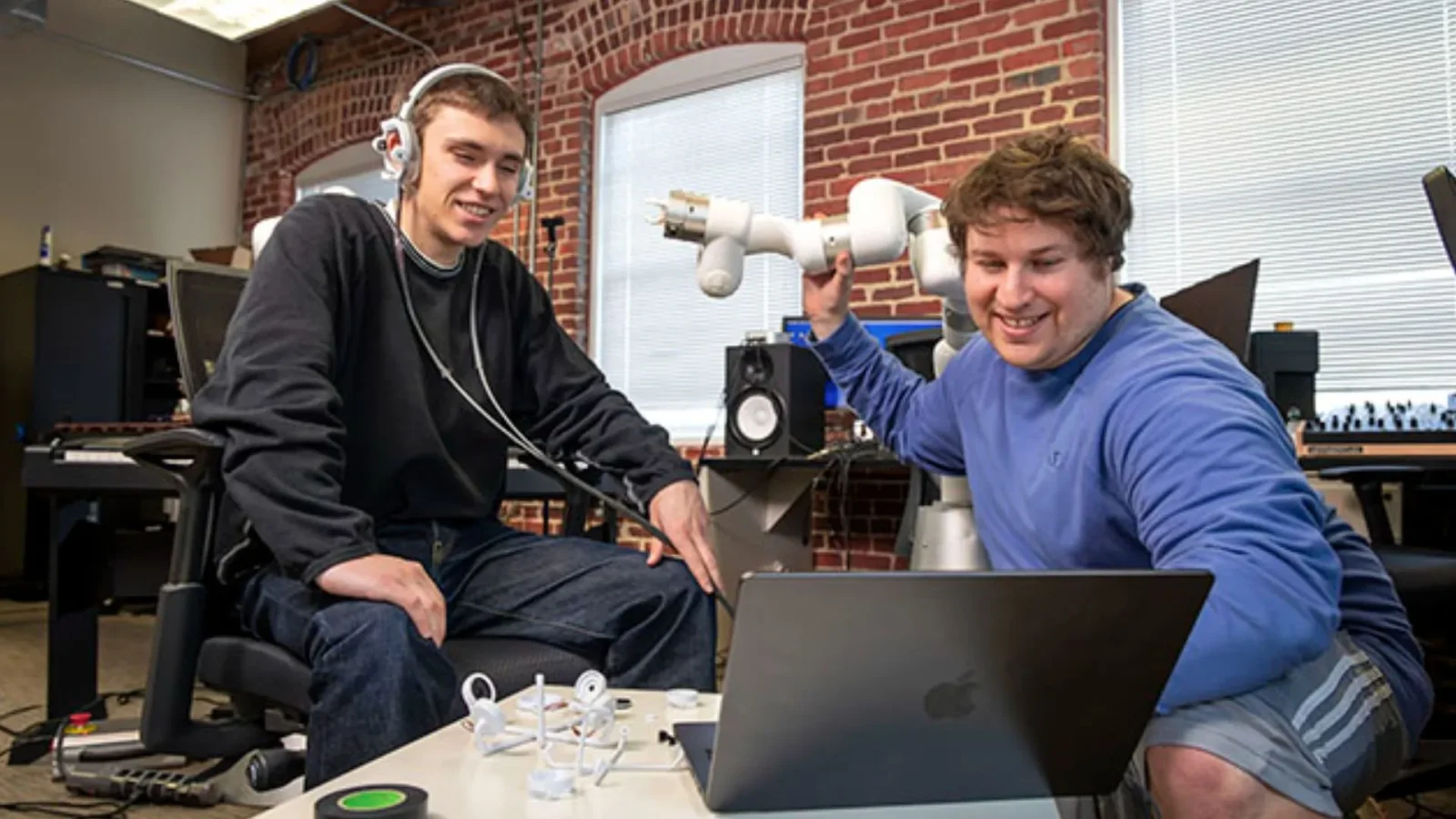
Researchers at Georgia Tech have developed a wearable audio system that converts nearby robot movements into dynamic warning sounds.
Inspired by the suspense-building music used in horror films, the technology alerts workers to approaching robotic actions before they become safety hazards.
The system is designed to improve situational awareness and reduce workplace accidents in environments where humans and robots work together.
Recently, Italian researchers developed a wearable robotic exoskeleton that provides real-time haptic feedback, helping musicians improve synchronization, coordination, and timing during collaborative performances.
Robots sound safer
The wearable audio system converts nearby robot movements into dynamic warning sounds, helping workers anticipate robotic actions without interrupting their tasks. Inspired by the suspense-building music used in horror films, the technology, called Spherephones, is designed to improve workplace safety in environments where humans and robots work side by side.
The system was developed by a team at Gil Weinberg’s Robotic Musicianship Group at the Georgia Tech Center for Music Technology. Rather than relying on conventional warning alarms, Spherephones uses computer-generated music to communicate a robot’s location, direction, and arrival time.
According to the researchers, traditional alarms often grab workers’ attention without providing enough context about the source or urgency of a hazard. Over time, repetitive alarms can also become easy to ignore. Spherephones instead provide continuous audio cues that remain in the background while allowing workers to stay focused on their tasks.
The wearable uses an open-ear headset equipped with four speakers positioned around each ear—at the front, back, above, and below. This arrangement enables three-dimensional sound placement that allows users to perceive where a robot is moving in relation to their body. A speaker positioned below the ear provides vertical sound positioning that is not possible with conventional headphones.
Immersive robot awareness
As a robot approaches, the system generates a melody that changes over time. Users can judge how close the robot is by listening to the progression of the music, enabling them to anticipate when it will arrive without having to look away from their work. In early tests, participants continued assembling and sorting objects while responding naturally to the changing audio cues.
The music itself is generated in a low-fi style commonly used as background study music. Researchers say the audio communicates not only the robot’s direction but also whether it presents a potential hazard, creating an intuitive method of interaction between humans and machines.
Earlier versions of the concept relied on speakers placed around a workspace, but every worker heard every warning, creating confusion in busy environments. The team addressed this by making the system wearable, giving each worker a personalized stream of audio linked only to nearby robots.
Beyond industrial settings, the researchers believe the technology could also enhance virtual reality and gaming. The team tested Spherephones in a virtual reality environment. Participants reacted instinctively to sounds approaching from behind, even when no visual object was present.
Unlike conventional gaming headsets that primarily separate audio into left and right channels, Spherephones reproduces sound from above, below, behind, and in front of the user. The open-ear design also allows wearers to remain aware of their surroundings, offering potential benefits for both immersive entertainment and real-world safety applications.
















Leave a comment