
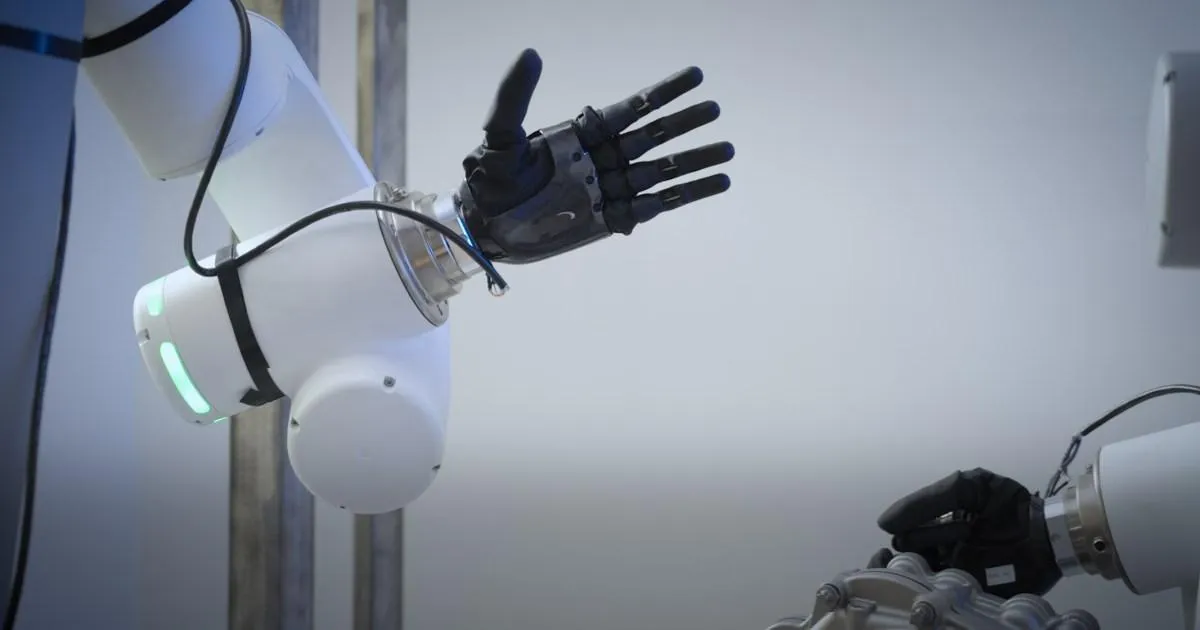

People with prosthetic arms are teaching robots how to feel and touch like humans.
It is hoped the tests will improve their dexterity for delicate tasks, like gripping, using real-world data from humans.
ABB Robotics announced a collaboration with California-based bionics company PSYONIC.
ABB’s GoFa collaborative robot – or cobot – will use PSYNOIC’s Ability Hand prosthetic.
It will explore how touch and motion data generated through prosthetic use can help train robots perform variable tasks that are difficult to automate.
Marc Segura, president of ABB Robotics, said: ‘Human dexterity and the instinctive understanding of how to handle different objects is one of the most difficult things to replicate in industrial-grade robotics, but it’s a fundamental need for truly autonomous and versatile robots.

‘As we develop the next generation physical AI, robots will learn and understand the world as we do. This collaboration with PSYONIC will help to close the long-standing gap between human and robot dexterity, opening up new possibilities for a wide range of industries.’
The firms say grasping and dexterity are key components of ABB Robotics’ vision for Autonomous Versatile Robotics, in which robots are capable of sensing, reasoning, moving and manipulating objects with precision in dynamic settings.
Putting robots to work
The technology is also seen as an important step towards advancing physical artificial intelligence in industry, enabling robotic systems to learn from real-world interactions and apply that knowledge reliably in industrial environments.

ABB and PSYONIC believe the technology could eventually be used across a range of sectors, including automotive manufacturing, aerospace, packaging and logistics, and life sciences.
The companies say it could allow robots to take on repetitive tasks, physically demanding work and jobs that are difficult to perform consistently on a large scale, helping to improve productivity, flexibility and workplace safety.
Originally developed as a prosthetic device, the PSYONIC Ability Hand combines myoelectric control, touch sensing, and compliant mechanics in a lightweight design featuring multiple articulating joints.

The hand incorporates pressure sensors and vibration feedback technology that enable users to detect contact, grip strength and object release. Its flexible fingers can also adapt naturally to irregularly shaped and deformable objects.
Dr. Aadeel Akhtar, Founder and chief executive of PSYONIC, said: ‘Dexterous manipulation is ultimately a data challenge as much as a hardware challenge.
‘By using the same Ability Hand on people and on robots, we can capture high-fidelity real-world data on movement, contact and grip force, then use that to train robotic systems more effectively.’
He added: ‘Integrating with ABB Robotics’ robotics platform allows us to expand into more environments and unlock the level of dexterity needed to take on the hardest challenges in automation.’
ABB said its GoFa cobot provides the precision and repeatability needed to translate human-derived manipulation data into consistent robotic actions.
The company believes this level of accuracy is essential for reliably reproducing subtle variations in grip force, finger positioning and movement across complex industrial tasks.
The collaboration will assess how the combined technologies could be applied in situations where conventional robotic grippers struggle, particularly when handling fragile, irregularly shaped or highly variable objects.
MORE: This common email apology makes your co-workers hate you
MORE: ‘Starmer’s AI jobseeker chatbot wrote my pet cat a CV and said she’s employable’
MORE: Metre-long scorpions with six inch pincers once roamed Britain














Leave a comment