
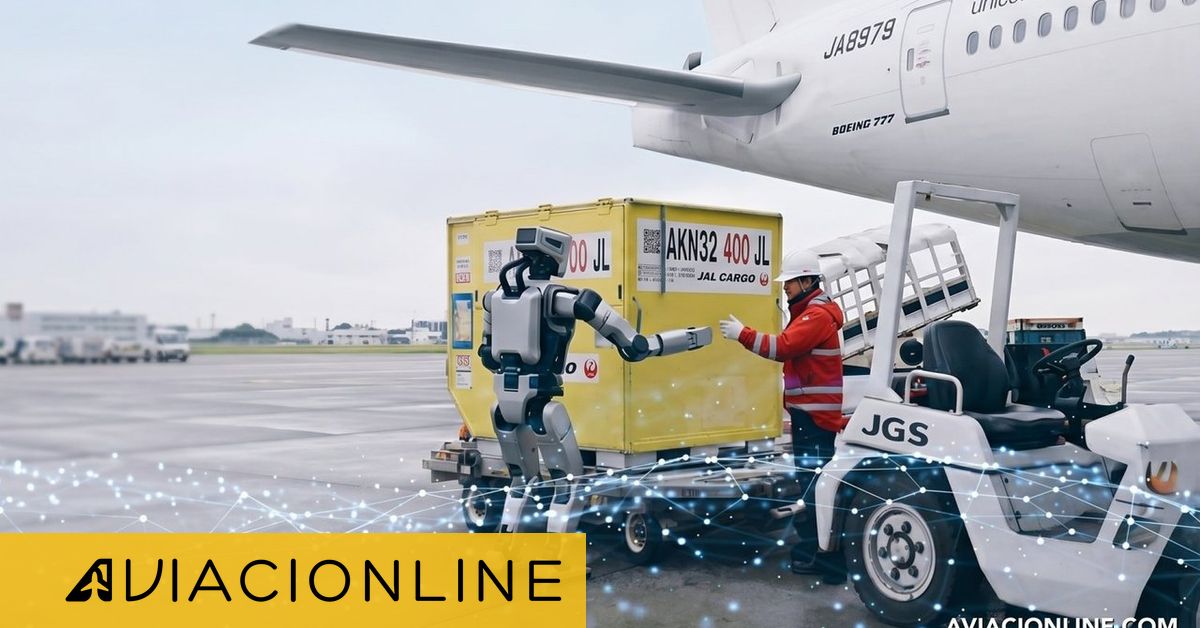
Airport ground handling in Japan is entering a new era of automation. JAL Grand Service, in partnership with GMO AI & Robotics Trading, will begin testing humanoid robots in real-world operating environments starting May 2026. This deployment aims to assess the technology’s viability in critical tasks such as baggage loading, cargo movement, and aircraft cabin cleaning.
The implementation of this technology addresses a structural necessity. Japan’s working-age population continues to shrink while inbound tourism hits record highs, creating a critical gap in flight dispatch capacity. According to JAL, traditional fixed automation systems have struggled to adapt to the complexity and dynamism of the airport tarmac, where space is limited and turnaround times are demanding.
To meet this challenge, the selected robots feature an anthropomorphic structure, allowing them to operate within existing infrastructure without requiring modifications to aircraft holds or ground support equipment. These devices integrate torque sensors in every joint and LiDAR-based vision systems, ensuring safe interaction with human personnel and aircraft integrity.
- What will the humanoid robots be used for?
They will perform baggage loading, cargo movement, ULD handling and aircraft cabin cleaning in real ramp and cabin environments.
- When will the trials start?
Real-world trials are scheduled to begin in May 2026.
- How do the robots operate safely around people and aircraft?
They use torque sensors in every joint and LiDAR-based vision systems to ensure safe interactions and protect aircraft integrity.
- Why use humanoid robots instead of AGVs?
Humanoid robots can navigate stairs and access cabins, operate within existing infrastructure and handle unstructured ramp environments better than AGVs, improving turnaround times.
- What is the role of GMO AI & Robotics Trading?
They will program motion algorithms, coordinate the robot fleet, and run research from their Shibuya center.
- How will this affect airport workers?
JAL Grand Service plans to reassign staff toward supervisory and operational management positions, reducing repetitive and injury-prone manual tasks.
The success of this technological undertaking lies in the robots’ ability to execute fluid movements in unstructured environments. Unlike automated guided vehicles (AGVs), these humanoids can navigate service stairs and access passenger cabins for hygiene tasks—an advancement that would optimize turnaround times at the country’s most congested hubs.
GMO AI & Robotics Trading, which recently opened a specialized research center in Shibuya, will handle motion algorithm programming and fleet coordination. The company has defined this period as the beginning of an era where collaborative robotics will be the standard in the transportation sector.
Integrating robots into the ramp not only eases the physical burden on current staff but also standardizes operational safety processes. In airports with extreme weather conditions or high flight density, such as Osaka-Kansai (KIX), consistency in handling ULDs (Unit Load Devices) and checked baggage is essential to avoid delays in flight schedules.
This technological transition is viewed as a sustainable long-term solution. By delegating the most repetitive and injury-prone tasks to automatons, JAL Grand Service aims to retain its technical personnel in supervisory and operational management roles, improving working conditions in a historically demanding industry.
















Leave a comment