
Inside the gut, on the surface of the skin, and lining your ears, mouth and nose are colonies of millions of microbes. For every human cell you have, there are at least as many microbial cells associated with your body.
At Lawrence Livermore National Laboratory (LLNL), researchers are asking an important question: how does the microbiome affect human health? And can it be used to predict, treat or prevent disease in military service members and civilians?
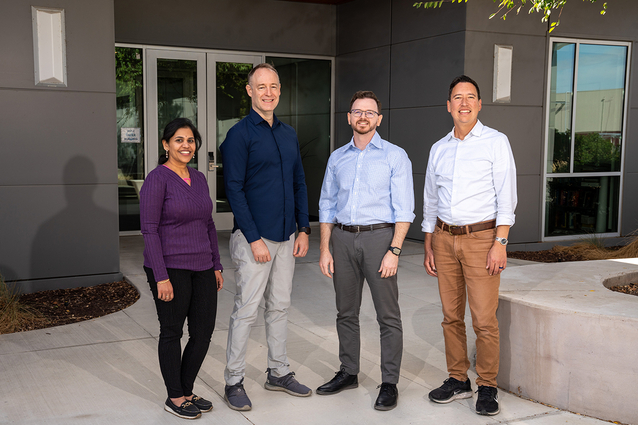
“If we’re thinking about how we can improve human health, I think it stands to reason that we should also pay attention to the other half of the human body, which is our microbiome,” said LLNL scientist and principal investigator Nicholas Be. “We want to leverage the microbiome as a broader diagnostic or prognostic indicator for human health and resilience.”
To accomplish this goal, Laboratory scientists are deploying tailor-made machine-learning tools on microbiome data.
Many challenges arise in the process. To apply machine learning, the team had to compile and curate large volumes of sequence data from many independent studies. Most microbiome studies are relatively small, with only a few hundred samples. Techniques for collecting that data can vary from study to study. And the data is sparse, like a tree missing many of its branches.
“We use what we call a microbiome profile, which basically says how much you have of each particular organism in a given sample,” said LLNL scientist Andre Goncalves, who leads the machine-learning aspect of the research.
Traditionally, that profile looks like a long but skinny spreadsheet: tens of thousands of rows, one per species, with the microbe’s name in one column and its quantity in the other. However, only a small fraction of the species actually turn up in a given sample, so most of the quantities are zero. This makes it hard for machine-learning algorithms to find real patterns.
Beyond that, there is uncertainty when mapping a DNA sample to a specific organism.
“A lot of the DNA sequencing data is fairly short, so trying to infer what organism these sequences are coming from is a technical challenge. It’s kind of like trying to match a few words to a long paragraph,” said LLNL scientist Car Reen Kok, who is part of the data-curation team.
To deal with these complications and uncertainties, the team developed several machine-learning approaches.
The first, called a hierarchical Bayesian model, predicts if a person has a specific disease or not. It knows from the start that the data is uncertain, and it propagates that uncertainty throughout the model. Instead of a black box, the results are interpretable – a particular disease, like traveler’s diarrhea, can be mapped back to see what microbes are associated with it.
Another approach makes use of computer vision models to predict human health. Instead of looking at microbiome data as rows in a spreadsheet, it converts it into an image. Each pixel represents one microbe, and its brightness tells you the microbe’s abundance.
“You can think of it as a Google Maps of all bacteria. Big borders represent neighborhoods of bacteria,” said LLNL scientist Camilo Valdes, who led the model’s development. “The idea is that different sets of microbes in a particular microbiome are going to create different visual patterns, and these visual patterns can be learned by a computer vision program.”
Those visual patterns differ depending on the microbiome (gut, nose, mouth, etc.), but they also change with geographical location and many other factors.
“Depending on your lifestyle or your diet, the data might look different. For example, if you have a dog at home, that changes your microbiome. Everything affects you, and it’s not only about the human body itself, but where it is and what situation it is in,” said Goncalves. The team continues to explore how studying these variables could help predict disease.
The researchers are actively using these models to examine military service member health during deployment and at home. They aim to determine which microbiome signatures can predict resilience versus susceptibility to gut disruption and wound infection, among other conditions. Another project, led by Kok and Be, collaborated with Tripler Army Medical Center to monitor microbiomes and identify infection risks during overseas deployment.
In an aligned effort, LLNL engineers are also building experimental systems, like a gut-on-a-chip, to test exactly how perturbations in the microbiome impact health.
“This work reaches into every part of the Laboratory,” said Be. “These are questions that require really robust data engineering, frontier compute capabilities and the ability to bring that into the real world with complex experimental systems.”
The work was funded through a Laboratory-Directed Research and Development Strategic Initiative.














Leave a comment