
 Image courtesy by QUE.com
The dawn of the third decade of the 21st century has witnessed a metamorphosis in the field of robotics, transitioning from the rigid, programmed arms of automotive assembly lines to fluid, intelligent systems capable of navigating complex environments and collaborating with humans in real-time. Robotics is no longer a niche pursuit of science fiction or specialized industrial laboratories; it has become a fundamental pillar of the global economic infrastructure. As we stand at the intersection of advanced materials science, artificial intelligence, and precision engineering, the trajectory of robotics is pointing toward a total integration of automated systems into the fabric of daily life.
The Shift from Industrial Automation to Collaborative Robotics (Cobots)
For decades, the primary objective of industrial robotics was the replacement of human labor in dull, dirty, and dangerous tasks. These robots were isolated in safety cages, operating on fixed paths with zero tolerance for deviation. While highly efficient for mass production, this model lacked flexibility. The emergence of Collaborative Robots, or Cobots, has fundamentally altered this dynamic. Cobots are designed with integrated sensors and software that allow them to work alongside human operators without the need for safety barriers.
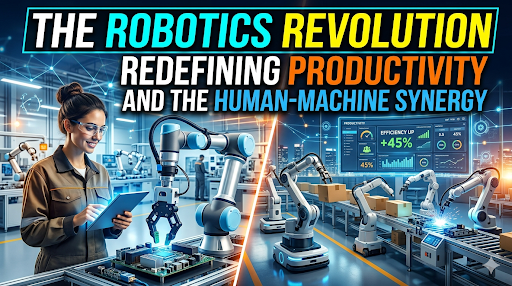
The synergy between human intuition and robotic precision is the new gold standard for productivity. In modern electronics assembly, for instance, a cobot may handle the repetitive placement of microscopic components with sub-millimeter accuracy, while a human technician provides the critical oversight and qualitative judgment necessary for final inspection. This partnership doesn’t just increase throughput; it elevates the role of the human worker from a manual laborer to a system orchestrator, reducing physical strain and cognitive fatigue.
The Integration of AI and the Rise of Autonomous Mobile Robots (AMRs)
The most significant leap in robotics has been the integration of sophisticated AI, specifically machine learning and computer vision. Traditional robots were blind and deaf, following hard-coded instructions. Modern Autonomous Mobile Robots (AMRs), however, utilize SLAM (Simultaneous Localization and Mapping) technology to perceive their surroundings and make real-time navigational decisions.
In the realm of logistics and warehousing, the impact of AMRs has been seismic. The transition from automated guided vehicles (AGVs), which required magnetic strips or wires in the floor, to AMRs that navigate via LIDAR and camera-based vision systems has unlocked unprecedented agility. These systems can dynamically reroute themselves to avoid obstacles, optimize picking paths, and manage inventory with an efficiency that exceeds human capability. The result is a compressed supply chain where the “last mile” of delivery is becoming increasingly automated, paving the way for drone deliveries and autonomous sidewalk couriers.
Robotics in Healthcare: From Surgical Precision to Elder Care
Perhaps the most profound impact of robotics is being felt in the healthcare sector. Robotic-assisted surgery has moved beyond a novelty to become a standard of care for many complex procedures. Systems like the da Vinci surgical system allow surgeons to perform minimally invasive procedures with a degree of precision and stability that transcends human physical limitations. By translating a surgeon’s hand movements into smaller, more precise movements of tiny instruments deep inside the body, these robots reduce patient trauma, shorten recovery times, and minimize the risk of infection.
Beyond the operating theater, the application of robotics in geriatric care is addressing one of the most pressing social challenges of the century: an aging population. Socially Assistive Robots (SARs) are being deployed to provide cognitive stimulation, remind patients of medication schedules, and combat the loneliness epidemic among the elderly. While these robots cannot replace human empathy, they provide a critical layer of support, monitoring health vitals and alerting medical professionals to emergencies in real-time, thereby ensuring a higher quality of life for the elderly in their own homes.
The Ethics of Automation: Navigating the Labor Displacement Paradox
As the capabilities of robotics expand, so does the debate surrounding labor displacement. The fear that robots will steal jobs is a persistent theme in public discourse. However, a more nuanced perspective reveals a Labor Displacement Paradox: while specific tasks are automated, the demand for new, higher-level skills increases. The robotics revolution is not eliminating work; it is evolving the nature of work.
The challenge for policymakers and business leaders is to facilitate a just transition through aggressive reskilling and upskilling programs. The workers of tomorrow will not be competing with robots; they will be managing them. Proficiency in robot programming, maintenance, and human-robot interaction (HRI) will become as fundamental as basic literacy. The goal is to create a future where automation handles the mundane, freeing humans to engage in creative, strategic, and empathetic endeavors that machines are fundamentally incapable of replicating.
Soft Robotics and the Next Frontier of Material Science
The future of robotics lies in the departure from the metallic archetype. Soft Robotics, utilizing elastomeric materials and fluidic actuators, is opening new possibilities in environments where rigid robots are too dangerous or ineffective. These robots mimic the biological systems of octopuses and worms, allowing them to squeeze through tight gaps, handle delicate biological tissues, and interact safely with humans in unpredictable settings.
The convergence of soft robotics and biotechnology is leading toward the development of prosthetic limbs that feel and respond like natural skin, and nanobots capable of delivering targeted medication to individual cancer cells within the bloodstream. We are moving toward a world where the boundary between the biological and the mechanical becomes increasingly blurred, leading to an era of augmented human capability.
Conclusion: The Symbiotic Future
The robotics revolution is not about the replacement of humanity, but about the expansion of human potential. By delegating the repetitive, the precise, and the perilous to our mechanical counterparts, we unlock the capacity for greater innovation and a more humane approach to labor. The integration of robotics into business, health, and daily life is an inevitable progression of our drive to solve complex problems and optimize our existence.
As we navigate this transition, the focus must remain on the ethical implementation of these technologies, ensuring that the productivity gains of automation are shared equitably across society. The future is not a competition between man and machine, but a symphony of collaboration, where the strength of the robot and the wisdom of the human work in tandem to build a more efficient, healthy, and prosperous world.
Articles published by QUE.COM Intelligence via Yehey.com website.
Source link
















Leave a comment