
Production Innovation Through Collaborative Robots and AMRs
Accelerating the Transition to AI-Based Shipyards
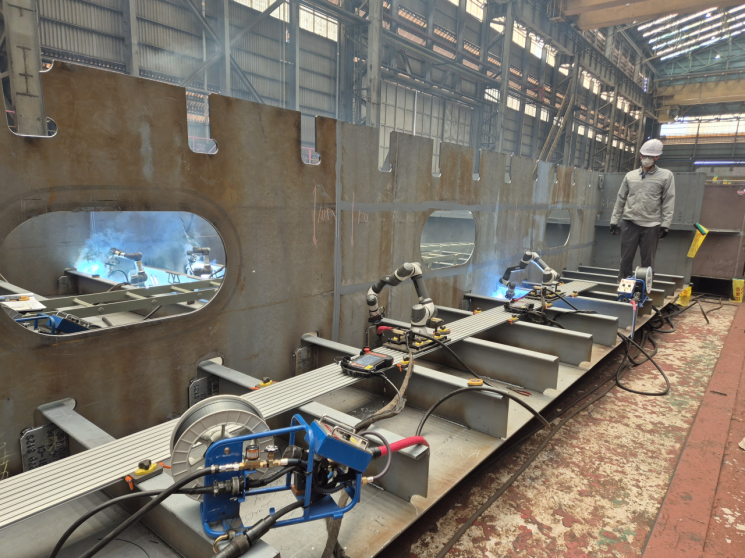
On the 12th, we visited the Medium Ship Division at HD Hyundai Heavy Industries in Ulsan. Inside the shipyard, a collaborative robot was moving along a rail, performing welding work. There was no need for a worker to manually move the robot or input the welding positions. Once the system read the design drawing information and calculated the work positions, the robot autonomously moved and continued welding. Artificial intelligence (AI) and robots are now entering shipyard worksites, which have traditionally been considered difficult to automate.
The shipbuilding industry is a representative example of a high-mix, made-to-order manufacturing sector. Unlike automobiles, the same product is not manufactured repeatedly. Each ship has a different design, and each block varies in shape. Even for ships of the same class, numerous variables arise during the manufacturing process. For this reason, the industry has long been regarded as difficult to automate.
However, HD Hyundai Heavy Industries has recently accelerated the establishment of AI-based autonomous manufacturing systems to boost productivity and address labor shortages.

On the 12th, a collaborative robot is performing ship block welding work at HD Hyundai Heavy Industries’ shipbuilding yard in Ulsan. Photo by Nahum Kang
The welding collaborative robot presented on this day is a prime example. In the past, collaborative robots had to be moved manually by workers. After each task, the position had to be changed and conditions re-entered. However, the currently developing autonomous electric rail system allows the robot to calculate its movement path based on design drawing information. The robot recognizes the welding location, performs the task, and then moves to the next process.
Dae-kyu Yoon, Executive Director of the Medium Ship Automation Innovation Division at HD Hyundai Heavy Industries, explained, “Previously, one worker could manage about two robots,” adding, “There has been a strong demand on the worksite to utilize more robots, and at present, we are building a system where one person can operate up to six robots simultaneously.”
HD Hyundai Heavy Industries plans to further advance its technology so that one person will eventually be able to manage up to eight robots. The company expects that once this system is fully implemented, productivity will increase by 153.8% compared to the current level.
Executive Director Yoon stated, “In the past, skilled workers had to manually set welding conditions, but now we are moving toward a system where work is carried out automatically using design drawing information,” and added, “Our goal is to increase productivity while reducing dependence on skilled labor.”

On the 12th, an industrial robot is performing rug production work at the rug autonomous manufacturing plant of HD Hyundai Heavy Industries in Ulsan. Photo by Kang Nahum
The most impressive area at the site was the autonomous manufacturing plant for lugs. Lugs are connecting components used to lift ship blocks with cranes. Although unfamiliar to the general public, they are essential materials used in large quantities at shipyards.
Inside the plant, industrial robots and autonomous mobile robots (AMRs) operated without pause. Robots manufactured lugs along the welding lines, and finished products were transported to the next process by autonomous mobile robots. Used lugs underwent cutting and regeneration processes before being fed back into the production line. From manufacturing to regeneration and transport, most processes were automated.
Executive Director Yoon explained, “Most shipyard products vary in shape, making automation difficult, but lugs are among the few items that can be mass-produced,” and added, “We prioritized this process because it is where the effects of automation can be confirmed most quickly.”
The results are clear. Previously, a team of six workers produced about 100 lugs per day. Now, the plant can autonomously manufacture 43 types of lugs and can meet up to 95% of the total usage volume.
Above all, the work environment has changed significantly. With robots handling much of the repetitive welding and heavy material movement, workers can now focus on management and operations. HD Hyundai Heavy Industries plans to expand these autonomous manufacturing technologies throughout its shipyards going forward.
Hot Picks Today

Executive Director Yoon stated, “Ultimately, the shipbuilding industry must increase productivity to remain competitive,” and emphasized, “AI and robots are not an option but a necessity.”
This content was produced with the assistance of AI translation services.
© The Asia Business Daily(www.asiae.co.kr). All rights reserved.














Leave a comment