
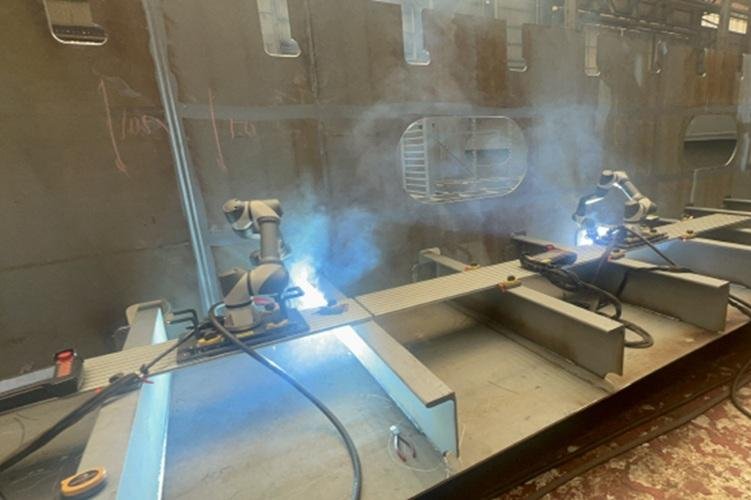
1 of 3 | A tracked autonomous collaborative robot welds steel plate cells for a ship hull at HD Hyundai Heavy Industries in Ulsan, South Korea. Photo by Asia Today
June 15 (Asia Today) — Sparks flew continuously inside HD Hyundai Heavy Industries’ Hull Assembly Plant 2 in Ulsan, where ship blocks stretching dozens of yards filled the production floor.
From a distance, the scene appeared to show welders at work. Up close, however, the welding torches were being operated not by people but by robots.
The collaborative robots moved steadily along welding seams without direct worker control. After completing one section, each robot moved to the next work area while nearby machines began other assignments.
Instead of carrying welding equipment from one ship block to another, workers monitored and controlled multiple robots through computer screens and tablets.
The production site visited Friday illustrated how South Korea’s shipbuilding industry is rapidly shifting toward autonomous manufacturing systems powered by artificial intelligence and robotics.
Shipbuilding is considered particularly difficult to automate because, unlike automobile manufacturing, it does not involve repeatedly producing identical products. Each vessel has a different design and structure.
Shipyards have therefore long depended on the experience and practical knowledge of highly skilled workers, making shipbuilding one of the most challenging manufacturing industries to automate.
The situation is changing, however, as South Korean shipbuilders face labor shortages and intensifying competition from China. Companies are accelerating the introduction of AI-based autonomous manufacturing technology to improve productivity while maintaining quality.
“Shipbuilding is one of the most difficult industries to automate because every vessel has a different structure and different working conditions,” said Yoon Dae-kyu, an executive at HD Hyundai Heavy Industries. “We determined that production innovation is essential to stay ahead in competition with China.”
The collaborative robots now operating at the shipyard were developed through a government-backed project to create an AI autonomous manufacturing system using collaborative robots for ship assembly.
HD Hyundai Heavy Industries participated in the project with the University of Ulsan, research institutions and technology companies. The project was supported by South Korea’s Ministry of Trade, Industry and Energy.
One representative system combines a collaborative robot with a self-driving, electrically powered tracked platform.
Earlier collaborative robots had to be moved manually and programmed with welding conditions by workers. The new system automatically identifies welding locations using ship design data.
After completing one assignment, the robot moves independently to the next section and continues working. In areas that previously required several experienced welders, one worker can now supervise multiple robots.
“A process that previously required seven experienced workers is now operated by one younger employee managing several robots,” said Hwang Sang-min, a senior official in the company’s midsize ship automation innovation department. “Welding quality has become more consistent and the amount of finishing work has been significantly reduced.”
The system has also improved production capacity.
According to HD Hyundai Heavy Industries, production that previously totaled about 500 tons a day under manual operations increased to about 750 tons during daytime operations after the AI welding system was introduced. Output could reach as much as 1,000 tons when the system operates during both day and night shifts.
Another automation project was operating elsewhere in the shipyard: an autonomous manufacturing system for shipbuilding lugs.
Lugs are heavy steel fixtures attached to large ship blocks so cranes can lift and move them during construction.
Six workers previously produced about 100 lugs a day. The new system automates much of the cutting, welding, transportation and inspection process.
Autonomous mobile robots transport components while an AI-powered vision system inspects welding quality.
Production data are connected through a digital twin platform, allowing managers to monitor output, equipment conditions and quality information from their offices in real time.
The company plans to use the accumulated data eventually to enable AI systems to predict potential quality defects before they occur.
HD Hyundai Heavy Industries is currently expanding automation primarily in standardized processes, including flat-block assembly. It plans to extend the technology to less predictable and more complex operations.
The company is considering the use of AI vision technology, humanoid robots and four-legged robots to expand autonomous manufacturing into docks and outdoor shipyard areas.
The Ministry of Trade, Industry and Energy also plans to spread the technology beyond individual large companies to smaller suppliers.
HD Hyundai Heavy Industries is standardizing the platform developed through the government-funded project so small and midsize partner companies can use the technology.
— Reported by Asia Today; translated by UPI
© Asia Today. Unauthorized reproduction or redistribution prohibited.
Original Korean report: https://www.asiatoday.co.kr/kn/view.php?key=20260614010004695















Leave a comment