
Also launches competition to make datacentres more appealing to communities

Image:
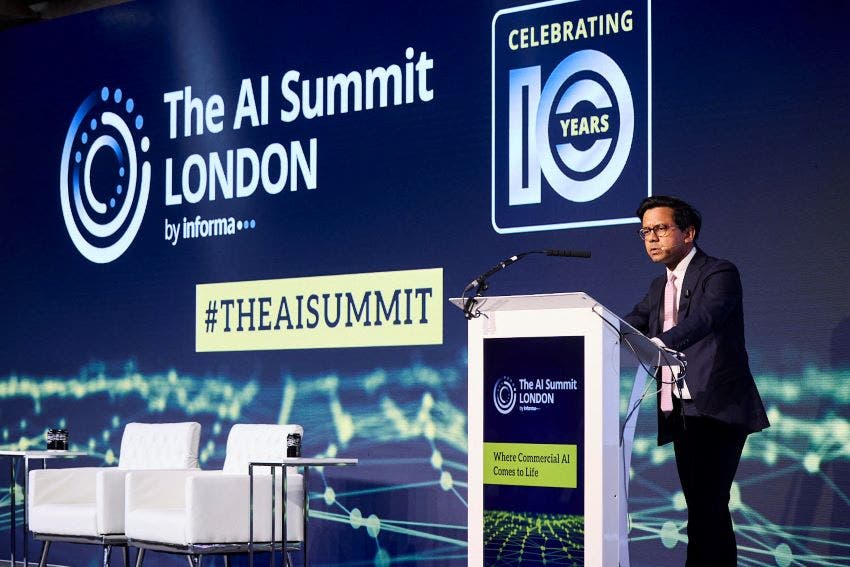
AI Minister Kanishka Narayan Credit:The AI Summit London
Speaking at London Tech Week, AI Minister Kanishka Narayan set out new government support for open-source AI developers and projects, alongside plans to rethink datacentre design and clarify rules for workplace robotics.
Speaking at The AI Summit, the headline AI event of London Tech Week, AI minister Kanishka Narayan said the UK must support the people who build AI tools, not just the technology itself. He said the key question for AI is not only what it can do, but who shapes it.
To this end the Department for Science, Innovation and Technology (DSIT) has announced several new measures. Narayan announced an extension to the Spark AI Scholars Programme which helps along with industry partners to fund exceptional AI students at various UK universities. Nayaran said:
“That funding will support scholars into roots in startups where they can build to the frontier of AI deployment, and it will create routes for others to become entrepreneurs and founders themselves.”
Open-source boost
The key plank of today’s announcement is the Open-Source AI Builder Fund – more than £500,000 in compute funding to help developers turn early-stage projects into working tools. The package also includes 160,000 GPU hours from the UK’s AI Research Resource.
The funding follows a recent “Hack for Impact” event run with Nvidia which brought together hundreds of developers from across the UK to build tools using tackling challenges across public services and city infrastructure, using open data from the City of London.
Projects included a tool which helps people find local services such as libraries and polling stations. Another tracks NHS waiting lists and drafts follow-up messages to patients. Other tools help firms find grants or prepare for disruption from roadworks and transport delays. One project uses satellite links to keep emergency services online if mobile networks fail.
The government will also launch an Open-Source AI Builder Mentoring Scheme. This will pair selected teams from the hackathon described above with experts from the governments in-house AI unit, the Incubator for Artificial Intelligence (i.AI). The aim is to help teams move from prototype to deployment of public AI assets.
Thirdly, a new Open-Source AI Dev Board will give ten UK-based developers under the age of 30 direct access to policymakers. The board, chaired by Nayaran, will meet through 2026 and feed directly into policy.
Selling datacentres to communities
Today’s announcements also shows that the publics message on datacentres – which can be summarised as ‘we hate them and don’t them in our communities’ – has been heard. Somebody has decided that datacentres might be more popular if they look a bit, well, less like a datacentres. Nayaran said:
“If we want people to support the infrastructure that Britain needs, we cannot build things that feel imposed – anonymous, grey buildings that our communities are asked to simply tolerate. Infrastructure should say something different, it should say your community matters, that you are part of the national story that you are helping to power into the future.”
To try to reduce public hostility to datacentres, DSIT has launched a data centre design challenge with the Royal Institute of British Architects. The competition is designed to address concerns about the environmental impact of datacentres in addition to the aesthetics. The competition will:
“Ask architects, designers and engineers to raise the bar for datacentres as they are designed in this country with meaningful public engagement, strong environmental outcomes, and genuine civic values.”
New clarity on robotics safety
DSIT has also set out plans to improve safety guidance for robotics. The Regulatory Innovation Office and the Health and Safety Executive will work with industry to deliver regulatory clarity for advanced robotics in Britain.
“This new guidance will give industry confidence in how they can make sure that robotics works safely alongside humans, so the future of robots in the workplace is about empowering rather than replacing human workers,” Nayaran said.
“It will also provide assurance, giving investors confidence and robotics companies the ability to deploy safely at scale.”
Professor Amanda Brock, CEO of OpenUK was less than impressed by the initiative. She commented:
“The open-source announcement is welcome but in no way goes to the heart of what is needed should the UK want to lead in open-source and AI. We need the actual infrastructure that sits behind the open-source ecosystem in place and proper funding of open-source. The words “open-source” are not magic words. We need to follow the tried and tested recipe for open-source success if the goal is to lead.
“The EU Commission committed 2bn euros last week. The UK’s established open-source community is bigger and contributes more than any in Europe. Whilst the compute credit might help some new users and meet the ministerial objective of building skills and some open-source talent, it is not going to enable the UK to lead.
“We have the people, we have the skills, and we know how to build our open-source future. What we don’t have is political engagement at a serious level.”















Leave a comment