
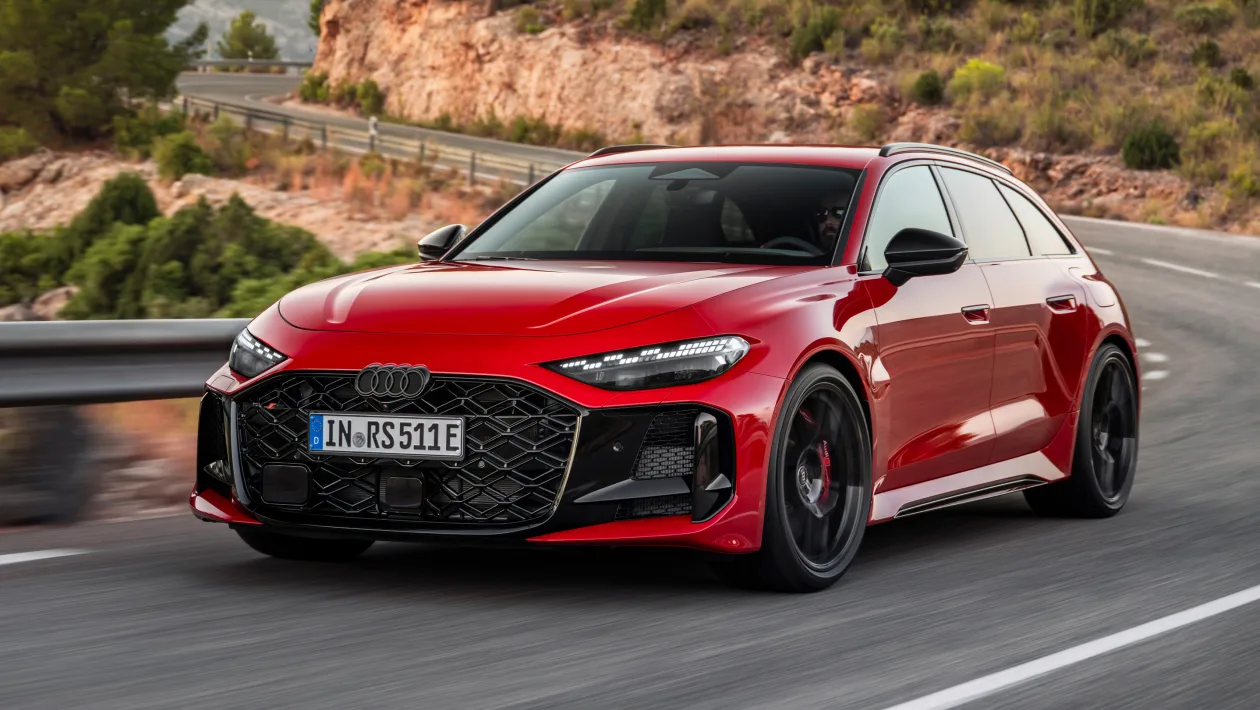
The engine has gone through some substantial changes in order to produce more power than its 444bhp predecessor, and still remain compliant with tough Euro 7 emissions regulations. The turbochargers are twin-scroll, plus there’s a new fuel injection system and water-to-air intercoolers.
Power is sent through an eight-speed Tiptronic automatic transmission – this is a standard torque-converter style, rather than dual-clutch – to a brand-new centre differential that’s able to split torque front-to-rear between 70:30, right out to 15:85.
There is a fresh differential set-up on the rear axle, which integrates another small electric motor that finely controls drive to the rear wheels. This system is capable of torque-vectoring – the ability to send power to each rear wheel individually – and fully locking the rear differential.
How fast is the new Audi RS 5?
Audi quotes a 0-62mph time of 3.6 seconds, which is 0.5 seconds faster than the previous-generation RS 4 Avant, and a top speed of up to 176mph with the Audi Sport Package fitted. However, as with all plug-in hybrid powertrains, this isn’t the only interesting figure. Audi quotes a 52-mile all-electric range, and under latest MPG testing regulations, the RS 5 is capable of between 62-74mpg, and a CO2 emissions rating of between 102-86g/km.
What changes has Audi made to the chassis and suspension?
Audi’s efforts to separate the RS 5 from its base A5 donor car is considerable. The body is considerably stiffer, and has 90mm added to the overall width. Almost every exterior body panel is new – only the bonnet, front door skins, roof panel and tailgate are shared.















Leave a comment