


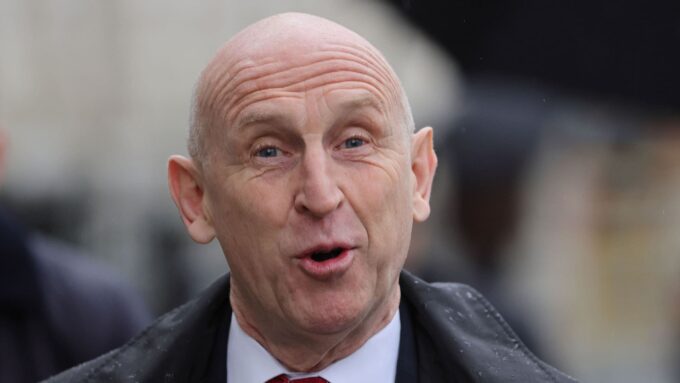
Defence Secretary John Healey has argued that 84% contracts have gone to British-based firms. (Image: Getty)
UK defence spending is being ‘Britwashed’, industry chiefs have warned, amid claims ministers are overstating how much of the military budget truly supports British industry. Defence sector leaders have hit out at claims by the Defence Secretary that 84% of contracts signed under Labour have gone to British firms. John Healey has on numerous occasions argued that 84% contracts signed since July 2024 have gone to “British-based firms.”
The wording of the term “British based” has been criticised by figures in UK small and medium defence enterprises as masking the difficulties currently being faced by UK headquartered and UK founded companies.
Rob Taylor, 38, a former Royal Marine and Founder of military tech firm 4GD, believes that genuine UK defence businesses are being impacted negatively by the ease with which foreign companies can claim to be British and reap the benefits that come with it. He told the Daily Express: “Foreign-owned defence companies turn up with a Union Flag on the brochure and a registered office in London, but the decisions are made in Washington or Paris.
READ MORE: I was in the room as a Royal Navy deployment to face Putin’s thugs was announced
READ MORE: Russian threat to UK airports not being taken seriously, experts warn

Rob Taylor, a former Royal Marine, has questioned the government’s definition of ‘British based’ (Image: -)
“We’re told it’s ‘British industry’, but we know it isn’t, and so does the MOD. We’re competing against companies backed by foreign governments, foreign banks and foreign balance sheets. We are then being told it’s a level playing field because they’ve got a UK postcode.
“They talk about sovereignty and resilience, but the reality is we’re losing core capability while pretending it’s safe because the logo looks British. You can’t outsource control and call it security.”
Analysis by the Daily Express found that the Defence Secretary’s claims were true if a presence in the country, however small, was enough to allow a company to claim they are “British based”. In an interpretation that requires a company to be headquartered in the UK and pay the majority or all of their taxes in Britain, that figure falls to 36%.
Large defence companies headquartered around the globe play a significant role in equipping the Armed Forces and bring with them thousands of jobs to the UK.
Speaking last month, Defence Secretary John Healey said: “I was in Edinburgh just the week before last to award a £450 million contract to Leonardo for a really important part of upgrading our Typhoon jets for the future.
“The supply chain to smaller and medium-sized firms is often mediated by primes such as Leonardo, which is why it is important that, since the election, we have let over 1,100 major contracts in defence, 84% of which have gone to British-based firms.”
Leonardo is an Italian based firm whose UK subsidiary provides more than 8,500 jobs in the UK over nine sites. Globally it employs more than 60,000 staff, with a presence in over 150 countries. Last month awarded a £1bn contract to provide the MOD with 23 new medium-lift helicopters.
Defence firms including the French Thales Group, which employs around 7,000 staff in the UK out of approximately 85,000 globally, and Dutch Airbus, which has about 12,000 UK-based employees within a worldwide workforce of roughly 165,000
A reliance on large conglomerates with multiple markets across the globe raises fear that in times of crisis, when demand outstrips supply, the UK government will be unable to rely on their needs being met.
Mr Taylor continued: “Having US or European companies with subsidiaries here is a good thing but there has to be an element of what are your domestic core capabilities?
“I really hope the UK government is being a little bit more strategic on it. Let’s say for instance, war did erupt and an order went in from country X to a firm headquartered within at the same point as a British Ministry of Defence order went in.
“Who would have priority? Would priority be given? And is that something that’s being considered?”
A senior defence source with experience of procurement at the heart of the MOD stressed the importance of large firms to the UK job market and capability of the Armed Forces.
They said on condition of anonymity: “These are still delivering sovereign capability in terms of jobs and output, but we don’t have the same level of ownership or control as we would with purely British firms like BAE Systems. There’s no truly “pure” British supply chain anymore.
“Companies like Thales, Leonardo, and Airbus do a lot of work in the UK. If Thales announced a big investment in Belfast tomorrow, we’d all welcome it. The point isn’t that foreign ownership is bad—it’s that the Government is presenting this as a boom in British enterprise, which isn’t accurate.”

Drone CEO Tom Redman says more needs to be done to make defence a sovereign asset (Image: Jordan Pettitt/PA Wire)
The government has repeatedly stressed the importance of developing the British industrial base to support plans to rearm the UK military over the next decade.
However, their attempts so far to do so have been criticised, with officials still said to be prioritising cost over sovereignty. Tom Redman, CEO of Evolve Dynamics says that some change has been seen to boost sovereignty in recent years but more needs to be done.
He told the Daily Express: “There’s progress, but not enough. We’re seeing faster procurement in some areas, but not a clear enough framework to prioritise sovereignty. Right now, most tenders are still heavily weighted towards price—often 50–60% of the scoring. Sovereignty might account for as little as 5%, which isn’t material.
“That means a highly British-built system can still lose to a cheaper, largely foreign-made one. If you want to prioritise domestic capability, that weighting needs to be significantly higher—30% or more—and clearly defined.”
Shadow Defence Secretary James Cartlidge has called on the government to do more to help SMEs grow and aid the UK’s rearmament. He said: “We would develop a Sovereign Defence Fund which would take up to £50 billion and galvanise private finance into Defence at an unprecedented scale; and transform the resilience of our Defence industrial base – removing Chinese dependencies and protecting critical supply chains.”
Several founders of UK defence companies vying for contracts with the MOD, bemoaned ongoing delays to the Defence Investment Plan (DIP), which they say is stifling action that would allow British firms to begin scaling production at pace.
Speaking on Friday, Mr Healey once more refused to commit to releasing the plan before the summer, despite originally being due for release last autumn.
An MOD spokesperson defended the government’s record in defence and use of the term “British based” without specifically defining what it meant.
They said: “We are getting on with the job of ensuring defence is an engine for growth by backing British jobs, British industry and British innovation. We welcome businesses who want to trade on our shores, boosting the economy, encouraging foreign investment. Our billion-pound helicopter deal secures 3,300 British jobs, boosts battlefield kit and unlocks up to £15 billion in UK exports.
“Earlier this year we established a dedicated Defence Office for Small Business Growth to boost opportunities and access, on top of our commitment to increase spending with SMEs by £2.5 billion by May 2028.”















Leave a comment