
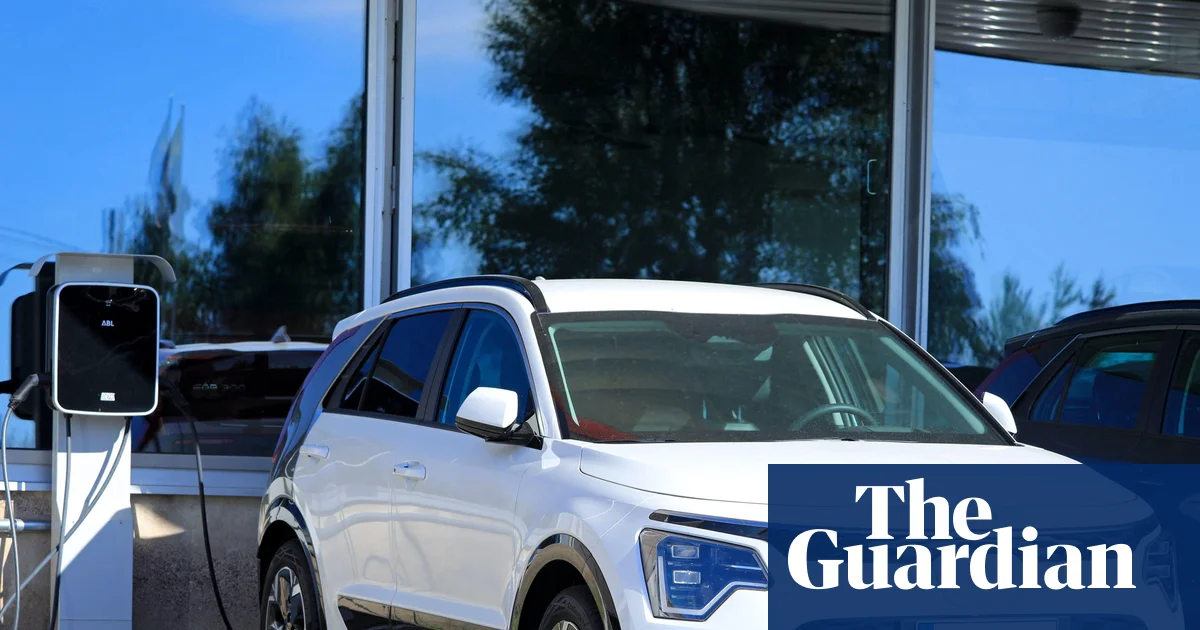
Campaigners have urged the government to resist calls to further water down electric car sale rules, as an analysis reveals that vehicles on UK roads will emit an extra 17m tonnes of carbon dioxide by 2030 mostly because of changes last year.
Parts of the car industry have urged ministers to review for a second time the rules that force manufacturers to sell increasing numbers of electric cars each year.
However, environmental groups and the charging industry said that further weakening would undermine the transition away from combustion engines.
The zero-emission vehicle (ZEV) mandate was introduced under the Conservatives in 2023 to force carmakers to increase sales of electric cars up to 80% by 2030. However, Labour last year weakened the rules, adding loopholes called “flexibilities” that mean carmakers can sell more cars with petrol engines.
Carmakers have responded this year with a 48% rise in sales of plug-in hybrid electric vehicles (PHEVs), which combine a small battery and a petrol engine.
There will be an extra 59bn miles driven using petrol and diesel engines in cars and vans compared with forecasts before the ZEV mandate changes, according to an industry analysis seen by the Guardian of updated forecasts by the Department for Transport (DfT).
Based on UK government average emission figures, those extra miles would add an extra 17m tonnes of direct carbon dioxide to the atmosphere – about equivalent to every Ryanair flight departing from Europe for a year, or the annual output of a small country such as Croatia. Battery electric cars produce zero direct carbon emissions.
The DfT has attributed the increase in driving using petrol and diesel primarily to the ZEV mandate changes that allow carmakers to sell more PHEVs, although it is understood the increase also reflects other changes in the government’s models. The DfT also said fewer PHEV drivers use the battery mode than previously thought.
The government has committed to reviewing the ZEV mandate again by early 2027.
Colin Walker, the head of transport at the Energy and Climate Intelligence Unit thinktank, said: “Were the government to weaken the mandate still further, it could lead to even more drivers being sold PHEVs that, far from saving them money, cost significantly more to run than their manufacturers claim, and which cost hundreds, even thousands, of pounds a year more to own and run than an electric car.”
For the charging industry, fewer electric cars on the roads will mean lower earnings, even as they are burning through cash to build more charge points.
Vicky Read, the chief executive of ChargeUK, a lobby group for charging companies, said: “The charging industry is channelling billions of pounds into building infrastructure on the promise of future customers based on the forecasts set by the ZEV mandate.
“Last year’s revisions to the quotas were not tweaks but a significant shift that has already undercut the industry’s investment case. Another rollback before the dust has even settled would pull the rug from beneath the charging sector and threaten a downward spiral for the entire transition.”
Carmakers have continued to lobby hard for further weakening of the rules, arguing they are too strenuous. Mike Hawes, the chief executive of the car industry lobby group the Society of Motor Manufacturers and Traders, said that a “review of the transition is now urgent to ensure ambition matches market realities”.
Manufacturers face the prospect of fines if they fail to hit the mandate targets, but the new PHEV flexibilities give them a lower bar to clear. Analysis by New AutoMotive, another thinktank, suggests that the headline rate of 33% electric sales this year could theoretically be as low as 7% if a manufacturer uses the flexibilities fully, including PHEV sales.
Ben Nelmes, the chief executive of New AutoMotive, said: “Carmakers are rewarded under government schemes if they sell more of these cars.
“The evidence is clear that plug-in hybrids fail to deliver the promised fuel savings and do not offer the country a way to improve its energy security.”
Undercounting emissions from PHEVs is also a big factor in carmakers under-reporting the carbon pollution from their products, according to research by Carbon Tracker, a research group. It found that the largest carmakers were underestimating carbon dioxide produced by their vehicles by a third on average.
A government spokesperson said: “We remain committed to phasing out all new non-zero-emission car and van sales by 2035. We’re investing more than £7.5bn to grow the market and deliver infrastructure, with May another record-breaking month for EV registrations.
“It has never been easier or cheaper to own an EV, especially against the backdrop of high and fluctuating prices at the pumps.”














Leave a comment