
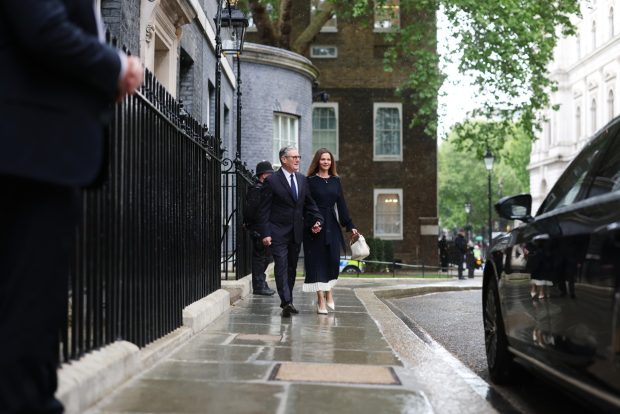
Sir Keir Starmer: the PM and wife Victoria depart 10 Downing Street for today’s King’s Speech I Credit: Lauren Hurley / No 10 Downing Street
Parliamentary bills to introduce a voluntary digital ID for public services and boost cybersecurity are among the UK government’s latest legislative priorities.
Thirty-seven bills in total were presented on 13 May in the King’s Speech – the set-piece occasion that marks the start of a new parliamentary year – which has been overshadowed by speculation about a potential leadership challenge to prime minister Sir Keir Starmer.
King Charles was speaking in the House of Lords as a growing number of media reports suggest that Starmer is likely to face a challenge in the coming days. At time of writing, four members of his government have so far resigned this week, while a growing number of Labour MPs have called on him to resign. The moves follow disappointing results for Labour candidates in local elections last week.
“The British people expect the government to get on with the job of changing our country for the better,” Starmer said in a Number 10 announcement on the King’s Speech.
The Labour government’s legislative programme would, Downing Street said, “strengthen public services, reform the state and reverse decline”; constituted an “ambitious programme to break with the status quo”; and contained new laws that “reflect big challenges the country faces” and “bolsters the UK’s economic, energy and national security”.
Digital ID legislation
The Digital Access to Services Bill brings forward powers to deliver a new voluntary digital ID scheme to access public services.
It comes just eight days after the end of a consultation in which the government invited the public to have their say on plans for the introduction of a government digital ID; and as the government progresses the development of its GOV.UK smart-phone app – which will eventually have payments functionality – to provide citizens with digital access to government services and benefits.
In its announcement of the launch of the eight-week consultation, the government said that a digital identity system would end citizens’ “reliance on multiple logins and paper documents to access the support they need” and save them “time and effort”.
“The government is renewing Britain with accessible public services that work for citizens, and come together on the GOV.UK app. The app will become the front door to accessing public services – as with online banking or shopping apps – with the digital ID system at its foundation,” a 129-page Number 10 briefing note on the King’s Speech explains.
“Digital ID will be free to access for anyone who wishes to use it, providing people with a trusted, useful, and secure proof of identity for use across public services and the wider economy, without needing to carry around physical documents that can be lost, forged or stolen,” the note continues. “Whether picking up a parcel or accessing public services like free childcare, or proving your right to work, it will give people greater control over their data, with a safe and simple way to decide who gets to see their details when using their digital ID.”
The bill will: establish the legal framework for the government to create, issue and use digital ID; set out the information the digital ID credential will contain, and “provide for how it can be issued, maintained, stored, and verified, as well as eligibility requirements”; and “include provisions to create and maintain the digital ID credential, enable its use, and aid public sector join-up, alongside appropriate safeguards”.
Read more: How to build digital credentials that work in government
Proposals for civil service reform forthcoming
Overall, the bills are grouped into five themes: strengthening economic security, ending the opportunity crisis, strengthening public services and reforming the state, strengthening energy security, and strengthening national security.
Among the legislation aimed at reforming the state are bills on reforming key public services. One bill will modernise the National Health Service by providing a legislative basis for building the Single Patient Record in the NHS, which will bring together patients’ health and social care records into one place to improve patient safety and experience.
Legislation will also be proposed to create Great British Railways, the planned state-owned operator of the UK’s railways, and a court modernisation bill, which will introduce new rules expanding the number cases that can be tried by a judge alone and without a jury.
Elsewhere in the King’s Speech, the monarch set out that the government would “bring forward proposals that strengthen the delivery, accountability, innovation and productivity of the civil service”.
In the speech, the King said these proposals will also seek to safeguard its impartiality and core values and to enhance trust and confidence in the institutions of government, but there was no additional information in the government briefing note on what this would include. The government will also introduce a so-called ‘Hillsborough Law’, officially the Public Office (Accountability) Bill, which will create a duty of candour for public servants to improve individual accountability, honesty and frankness when things go wrong.
Read more: UK government creates new ‘future civil service’ role to lead on transformation
Cybersecurity ‘fundamental step change’
The Cyber Security and Resilience Bill – already introduced to Parliament for its first reading in November 2025 – was also highlighted in the King’s Speech.
The bill will “deliver a fundamental step change in the UK’s national security – making essential digital services more secure in the face of cyber criminals and state actors who want to disrupt our way of life – ensuring the economy is better protected,” the briefing note states.
“Many managed IT companies will be regulated under the Bill,” it explains. “These organisations deliver key services such as IT helpdesks and cyber security to private and public sector organisations like the NHS. They will need to meet new security duties as they hold trusted access across government, critical national infrastructure and business networks.”
Data centres will be “brought into scope as they are critical to keeping the UK running, underpinning essential and digital services from patient records and online payments to email services and artificial intelligence development,” it continues.
The government will be “more agile and responsive to evolving cyber threats with powers to make changes to the regime in secondary legislation, such as bringing more services into scope, or updating security requirements,” it adds.
Read more: UK government launches cyber profession to bolster public sector IT resilience
Financial services ‘enhancement’
The Enhancing Financial Services Bill will deliver key parts of the reforms set out by Chancellor of the Exchequer Rachel Reeves in July 2025.
It includes reforms to the Financial Ombudsman Service to increase “consistency and clarity” of decision-making, Number 10’s King’s Speech briefing note explains.
The bill also includes “reducing the overall burden of the Senior Managers & Certification Regime (SM&CR) – the framework that holds senior leaders in financial firms personally accountable – by 50% “with a focus on accountability of the most senior figures in financial services”.
It will also enable credit unions to expand by “improving the rules on who can become a member”. This will allow “credit unions to serve more people and communities, widening access to affordable finance and supporting the government’s aim to double the size of the mutual and co-operative sector”, it says.
The bill will also consolidate the Payment Systems Regulator (PSR) into the Financial Conduct Authority (FCA) – a plan announced by Number 10 just under 14 months ago. The decision, it said at the time, “follows complaints from businesses that the regulatory environment was too complex – with payment system firms having to engage with three different regulators, costing them time, money and resource”.















Leave a comment